
The pass price is one charge; the evidence is scattered
A pass is usually bought months before the first chairlift, as a single charge on a single date. Everything that tells you whether it was worth it happens later and in pieces: the days you rode, the tickets you bought on the days the pass did not cover, the tank of gas, the motel split three ways, the rental, the lesson, the cocoa. None of it lands anywhere you would think to look, which is why the question usually gets a shrug.
What counts as a pass day, and what it is worth
A pass day is a day a rider spent at a resort their own pass covers. Its value is the walk-up window rate for that rider's type (adult or youth) at that resort, plus the peak surcharge on days you mark as peak. Add those values up as the season goes. The moment the running total first reaches the price that rider paid for the pass is the break-even day. Until then the useful number is how many more pass days it takes, at that rider's own average walk-up value per pass day so far.
Coverage is judged per rider. Two people at the same mountain on the same day can be one pass day and one ticket day, and the count treats them that way.
To find your own date, use the free ski pass break-even checker for one rider, or the Ski & Snowboard Season-Pass Value & Days Log for every rider in the household.
Why the window rate is the yardstick
The window rate is what you would have paid with no pass at all: show up, stand in line, buy a ticket. That makes it the fair measure of what a pass day replaced. It also means the rate is a choice you control. If you always buy tickets ahead online, set that price instead and the date moves with it. The break-even date is only as honest as the rate you hold the pass against, so use what you would genuinely have paid.
Using each resort's own rate matters too. A day at a big, expensive mountain is worth far more toward break-even than a day at a small local hill, even though the pass cost the same. A single average ticket price would hide whether the pass is being used where it earns the most.
Pass-only cost per day versus all-in cost per day
Pass-only cost per day is the pass price divided by the pass days ridden. It falls every time you ride, which is the whole point of a pass. All-in cost per day goes further and adds the lift tickets you bought, the drive (priced from round-trip miles and split across the riders in the car), lodging and parking (split the same way), rentals, lessons, food and gear upkeep.
The first answers "was the pass a good buy?" The second answers "what did a winter of skiing actually cost us?" On a season with long trips, the pass can turn out to be one of the smaller lines, and that is usually where the surprise is.
What moves the date
- Peak days. A holiday or peak weekend carries the resort's surcharge, so each one adds more value than an ordinary day.
- Youth rates. A youth rider is valued at the youth window rate. A youth pass can land late, or never, while an adult pass on the same trips pays off early. That is information, not failure.
- Ticket days at a resort the pass does not cover. They are real days and they count in what a day costs, but they add nothing to the pass's value, because the pass did not make them cheaper.
Two caveats worth knowing
- Blackout days. If coverage is a plain yes or no per resort, the log does not know your pass's blackout dates. A covered-resort day you paid a ticket for during a blackout still counts as a pass day. Record the ticket so its cost reaches the all-in total, and read that rider's break-even date as slightly early.
- Partner discounts. A discount at a partner resort is not counted toward the pass's value. The method credits only what the pass itself replaced.
An illustrative household
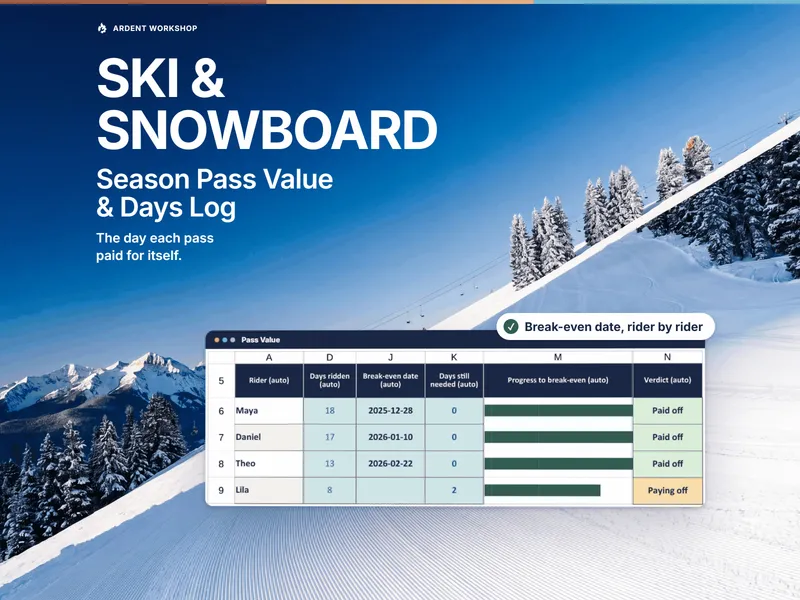
The workbook ships with a fictional example: four riders, 56 rider-days, and made-up resorts and passes. In it, Maya's pass breaks even on December 28, 2025, Daniel's on January 10, 2026 and Theo's on February 22, 2026, while Lila is still paying off at 70% with 2 more pass days needed. Different riders, different prices, different dates. (Illustrative figures, not published rates, and not typical of any real household.)
From this season's date to next season's pass
Break-even looks backward. The decision you face every spring looks forward: which pass to buy. The honest way to price it is each option, rider by rider, at the days and resorts you actually rode this season, with any resort a pass does not cover priced at its window rate. Compare that with plain day tickets and with keeping this season's setup. In the example household the cheapest plan, all four riders on one multi-resort pass, comes to $3,538 against $4,486 for keeping this season's setup, a difference of $948. Family and bundle discounts are not modeled, so check those with the seller. To weigh the three ways of buying skiing on, see multi-resort pass vs local pass vs day tickets.
Find each rider's break-even date with the Days Log
The Ski & Snowboard Season-Pass Value & Days Log finds each rider's break-even date, the all-in cost per day and next season's cheapest plan from one day log. A ski tracking app logs runs and vertical, and some now show ticket savings, but tracking apps generally do not add up what the day cost or price next season's pass at the days you actually rode. A spreadsheet you own does. To try the break-even part first, the free ski pass break-even checker is a one-rider season day log that marks the date the pass paid for itself, or how many more pass days it needs, with no signup. More trackers for people who spend their time outside are collected on the outdoor enthusiasts page.
Templates that implement this
A log that finds the date for you
1 template
Log each rider's day once and the break-even date appears on the row where the pass crosses its price.
Frequently asked questions
- What is season pass break-even?
- Season pass break-even is the day your pass days, each valued at what the ticket window would have charged for that rider at that resort on that day, first add up to the price you paid for the pass. Before that day the pass is still paying off. After it, every pass day is ahead of buying tickets.
- Why use the window rate instead of the online advance price?
- The walk-up window rate is the price you would have paid if you had no pass and simply showed up, so it is the fairest yardstick for what a pass day replaced. If you always buy tickets ahead online, type that price into the resort's rate instead and the break-even date follows it. The date is only as honest as the rate you set the pass against.
- What is the difference between pass-only and all-in cost per day?
- Pass-only cost per day is the pass price divided by the days you rode on it. All-in cost per day adds everything else the days cost: lift tickets you bought, the drive, lodging and parking, rentals, lessons, food and gear upkeep. Pass-only tells you whether the pass was a good buy; all-in tells you what a day of skiing actually cost your household.
- What moves the break-even date?
- Three things move it most. A day marked as a peak day carries the resort's peak surcharge, so it adds more value. A youth rider is valued at the youth window rate, not the adult one, so riders on the same trips can break even on very different dates: a youth pass can land late, or never, while an adult pass pays off early. And a day at a resort your pass does not cover adds nothing, because the pass did not make that day cheaper.
- Do blackout days and partner discounts count?
- Not automatically. A workbook that marks coverage as a simple yes or no per resort does not know your pass's blackout dates, so a covered-resort day you rode during a blackout, on a ticket you bought, is still credited as a pass day. Log that ticket so its cost still lands in the all-in total, and read that rider's break-even date as slightly early. Partner-resort discounts are not counted toward the pass either.
- Can one household have different break-even dates?
- Yes, and it is normal. Break-even is per rider because each rider paid a different price, rides different resorts and logs different days. In the illustrative household in the Ski & Snowboard Season-Pass Value & Days Log, three riders reach break-even on three different dates and a fourth is still paying off, two pass days short.