What does deadstock mean?
Deadstock (DS) is the top of the ladder: a pair that has never been worn, ideally still laced and packed the way it left the factory, box included. It is not a grade so much as a reference point — every grade below it is described in terms of how much of a deadstock pair's value it still holds, so "deadstock" is the number the rest of the scale is measured against rather than one condition among several.
Sitting just under it is Very Near Deadstock (VNDS), sometimes written 9.5/10 — tried on, maybe worn for minutes, with no visible crease, scuff, or sole wear under ordinary light. It is the most argued-over grade on the ladder, because "very near" is a judgment call, and two careful sellers can land on either side of it for the same pair.
What are the seven sneaker condition grades?
The scale collectors and resellers actually use runs seven rungs deep, from unworn to worn out:
- Deadstock (DS). Never worn, box and original laces typically present. The reference point — 100% of what a clean example of the model is worth.
- Very Near Deadstock (VNDS), or 9.5/10. Tried on or worn briefly, no visible flaw under normal light. Around 90% of deadstock.
- Excellent, or 9/10. Worn a handful of times. Light, even creasing at the toe box, a clean outsole, no discoloration. Around 70%.
- Good, or 7/10. Regular-rotation wear — visible creasing, a scuffed outsole, maybe faint yellowing on a light midsole. Still presentable, clearly not new. Around 55%.
- Fair, or 5/10. Wear that shows in photographs without being pointed out — worn tread, real creasing through the midsole, an insole that has taken the shape of a foot. Around 40%.
- Heavy wear, or 3/10. Well past its best days — flattened tread, deep creasing, heel drag, a midsole that has visibly yellowed. Often called a beater by anyone who isn't the one selling it. Around 25%.
- Beater, or 1–2/10. Worn through — a daily driver near the end of its life, with damage that goes past cosmetic. Around 15%.
You will also see pairs listed as NIB (new in box) or NWT (new with tags) alongside deadstock — descriptions of how a pair arrived rather than separate grades of their own, and usually treated as synonyms for DS.
How can you tell the grades apart?
The same handful of features carry almost every judgment call on the ladder, roughly in the order a careful buyer checks them:
- Outsole tread. Flattened lugs and worn traction patterns are the hardest thing to fake and the first thing an experienced buyer looks at — they are the difference between a pair that was tried on and a pair that was actually worn.
- Toe-box and midsole creasing. Every worn shoe creases eventually; the question is how much, and how deep. Light, even creasing reads as gentle wear. Deep, cracked creasing reads as heavy rotation regardless of how clean the rest of the shoe looks.
- Heel drag. Scuffing at the back of the outsole from how a pair is put on and taken off — a small tell that adds up over hundreds of wears and is hard to hide in photos.
- Yellowing. Light-colored midsoles oxidize with age and exposure, independent of how many times a pair was actually worn. A shelf-stored pair can yellow while barely being touched, which is why yellowing alone doesn't settle a grade.
- Insole wear. The insole takes the shape of a foot before almost anything else on the shoe does, so a flattened or grimy insole under an otherwise clean upper is usually the giveaway that a "9/10" has been worn more than the outside suggests.
- Box and laces. Weighed alongside the grade rather than folded into it — a crushed, taped, or missing box, or replacement laces, will knock value off a listing even when the shoe itself grades well.
This is exactly where buyers and sellers argue: a seller who owns the pair tends to grade generously, and a buyer looking at four photos tends to grade cautiously. Neither is dishonest — they're applying the same words to a judgment call that has no fixed answer.
How much does condition affect what a pair is worth?
Steeply, and in a way that isn't obvious from looking at two photographed pairs side by side. As a starting point, a VNDS pair runs around 90% of a deadstock price, Excellent around 70%, Good around 55%, Fair around 40%, Heavy wear around 25%, and a Beater around 15%. Two grades down from deadstock is not a small discount — on those figures it's close to a third of the value, gone.
Treat every one of those percentages as an illustrative starting point, not a price guide. They describe roughly how the used market behaves in general; they say nothing about your pair, your size, or this week's demand for a specific colorway. A grail in Fair condition can still outsell a common release in Excellent condition, because rarity and condition are two different variables and only one of them is on this ladder.
Is there a standard sneaker grading scale?
No — and this is the part worth taking seriously before you use the scale at all. Nobody issues these terms. There is no body that certifies a "9/10," no licensing authority, and no rule that binds one marketplace to grade the way another one does. The seven grades above are the convention in common use, but a platform's own condition dropdown, a reseller's private notes, and a casual seller's post in a group chat routinely disagree about where a given pair lands.
That's exactly why grading arguments in this hobby are so often, at bottom, arguments about what a word means rather than arguments about the shoe. The useful move isn't to find the "correct" scale — there isn't one — it's to pick one ladder and apply it the same way every time. A pair you graded Good two years ago should mean the same thing as a pair you grade Good today, and that consistency is something only you can guarantee, because no external standard is going to guarantee it for you.
How do you grade a pair yourself?
- Check the outsole first. Tread wear is the hardest feature to overstate or fake, and it usually sets the honest ceiling for the rest of the grade.
- Grade from the worst feature, not the best. A deeply creased toe box sets the grade even if the outsole and upper still look sharp. One bad feature is what a buyer notices first.
- Inspect in bright, even light. Yellowing, scuffing, and hairline creasing are easy to miss in a dim closet and obvious the moment they're photographed under a window.
- Note the box and laces separately. Record their condition alongside the grade rather than letting them quietly pull the number up or down.
- When in doubt, grade down. A buyer who receives a pair in better shape than described comes back for the next one. A buyer who receives it worse does not.
Why track condition, not just which pairs you own?
A list of what you own tells you whether you need another pair of the same silhouette. A list of what you own and the condition it's in tells you what the collection is actually worth, which pairs are worth resting, and whether the grail in front of you at a swap meet is priced fairly for its wear. The fields that make that possible are few:
- A condition grade — recorded per pair, and reassessed as wear accumulates rather than set once and forgotten.
- A deadstock reference value — what a clean example of the model is worth, which is the number every grade steps down from.
- What you paid and when — so a gain or loss against that reference is a fact, not a feeling.
- Wear count — because condition and cost per wear are two sides of the same pair, and a beater that's been worn five hundred times has already done its job.
The free sneaker rotation starter is one tab that gets the habit going — a row per pair with a have or want flag, so your collection and your grail list sit in the same place. It records a condition; it doesn't value anything. The full Sneaker Collection Tracker adds the part this page is about: the seven grades as an editable ladder on its Setup tab, each carrying the share of a deadstock value a pair in that condition is worth. Enter a deadstock market value for a pair and its condition grade, and the workbook multiplies the two to get what your pair is worth right now, then measures that against what you paid.
Neither file is an appraisal, an authentication, or investment advice. Grading describes condition; it doesn't establish that a pair is genuine or predict what it will be worth next year. And because condition grading is a market convention rather than a standard, every grade and every value factor in the workbook is an ordinary cell you can edit to match how you actually grade.
Own it, don't rent it
A collection app can cap how many pairs you log, put your own export behind a subscription, or shut down entirely and take your grading history with it. A blank spreadsheet asks you to build the grading ladder and the arithmetic yourself. The workbook sits between the two: the ladder, the valuation math, and the wear tracking are already built, and the file is yours — it opens in Excel, Google Sheets, and LibreOffice with no account, no subscription, and nothing to renew.
Related templates and concepts
Grading isn't unique to sneakers — collectors of records apply the same idea with a different ladder; see what record grading is for the disc-and-sleeve version of this same argument. Collecting more than sneakers? The free collection trackers index has a no-signup starter for most of the hobbies Ardent Workshop covers, and the templates for collectors hub gathers the paid collection trackers and the grading guides in one place.
Templates that implement this
Grade your rotation, and see what it's worth
4 templates
Log the condition each pair is actually in, and see what that condition does to the collection's value on your own numbers.
- $6.95 Spreadsheet
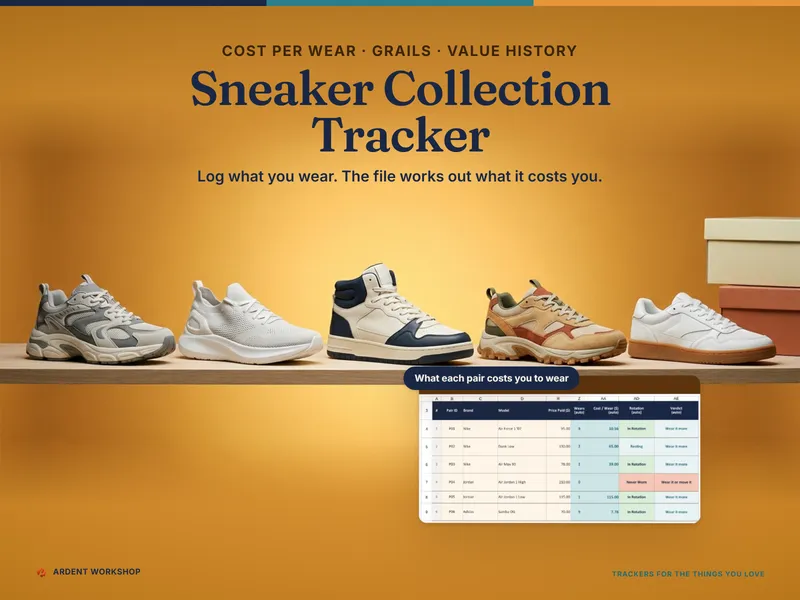
Sneaker Collection Tracker - Cost Per Wear, Grails & Value History (Excel + Sheets)
A sneaker collection tracker for Excel and Google Sheets. Get a real cost per wear on every pair, and a valuation history that records where each figure came from.
TrackersView details - $6.95 Spreadsheet
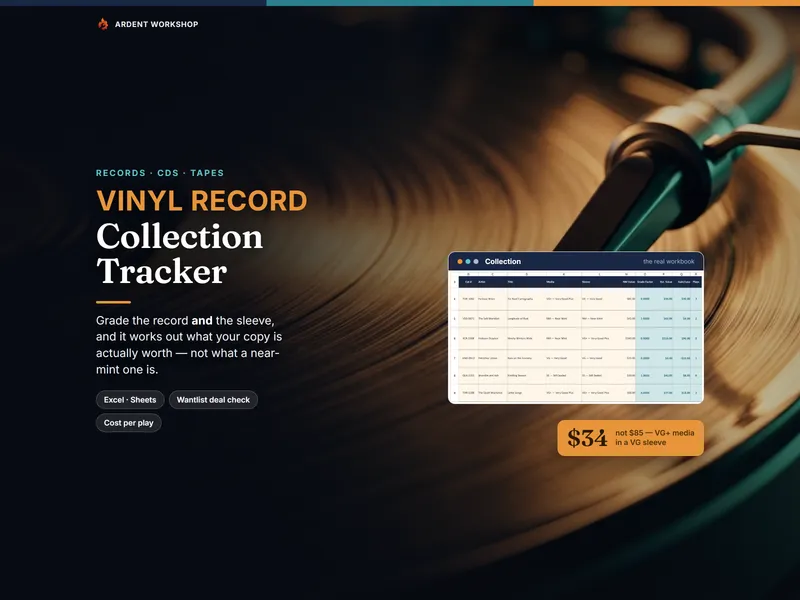
Vinyl & Music Collection Tracker - Condition Grading, Wantlist Deal Check (Excel + Sheets)
A vinyl record collection tracker for Excel and Google Sheets. Grade media and sleeve separately for a real value, and price any copy against your ceiling.
TrackersView details - $6.95 Spreadsheet

Board Game & TTRPG Collection Tracker — Excel & Google Sheets
A board game & TTRPG collection tracker for Excel & Google Sheets — catalog your shelf, log plays, and track cost-per-play, win rate, and campaigns.
TrackersView details - $6.95 Spreadsheet

Whiskey, Wine & Spirits Tasting Journal — Excel and Google Sheets
A whiskey, wine and spirits tasting journal for Excel and Google Sheets: cost per pour, a palate derived from your own scores, and a scored wishlist.
TrackersView details
Frequently asked questions
- What does deadstock (DS) mean for a sneaker?
- Deadstock means a pair that has never been worn — still new, typically still laced the way it shipped, with its original box. It is the reference point the rest of the ladder is measured against: every other grade is described as a share of what a deadstock pair of the same model is worth, not as a fixed price of its own.
- What is VNDS?
- VNDS stands for Very Near Deadstock — a pair that has been tried on or worn very briefly, with no visible creasing, scuffing, or sole wear under normal light. It is the grade directly under deadstock, and the one most argued over, because "very near" is doing a lot of work and different sellers draw the line in different places.
- Is sneaker condition grading the same everywhere?
- No. It is a market convention that collectors and resellers converged on informally, not a standard issued by any organization. The seven grade names are widely recognized, but no two marketplaces apply the cutoffs between them identically, so the same pair can get graded differently depending on who is looking at it.
- Does condition grading tell you if a pair is authentic?
- No. Grading describes wear, not authenticity. A grade is a judgment about how used a pair looks; it says nothing about whether the pair is genuine, and it is not a substitute for authentication.
- Does the box count toward a sneaker's grade?
- It affects it, but it is usually weighed separately from the shoe itself. A pair in excellent condition with a crushed, taped, or missing box is not the same listing as the same pair with a clean box and original laces — most sellers note box condition alongside the grade rather than folding it invisibly into one number.