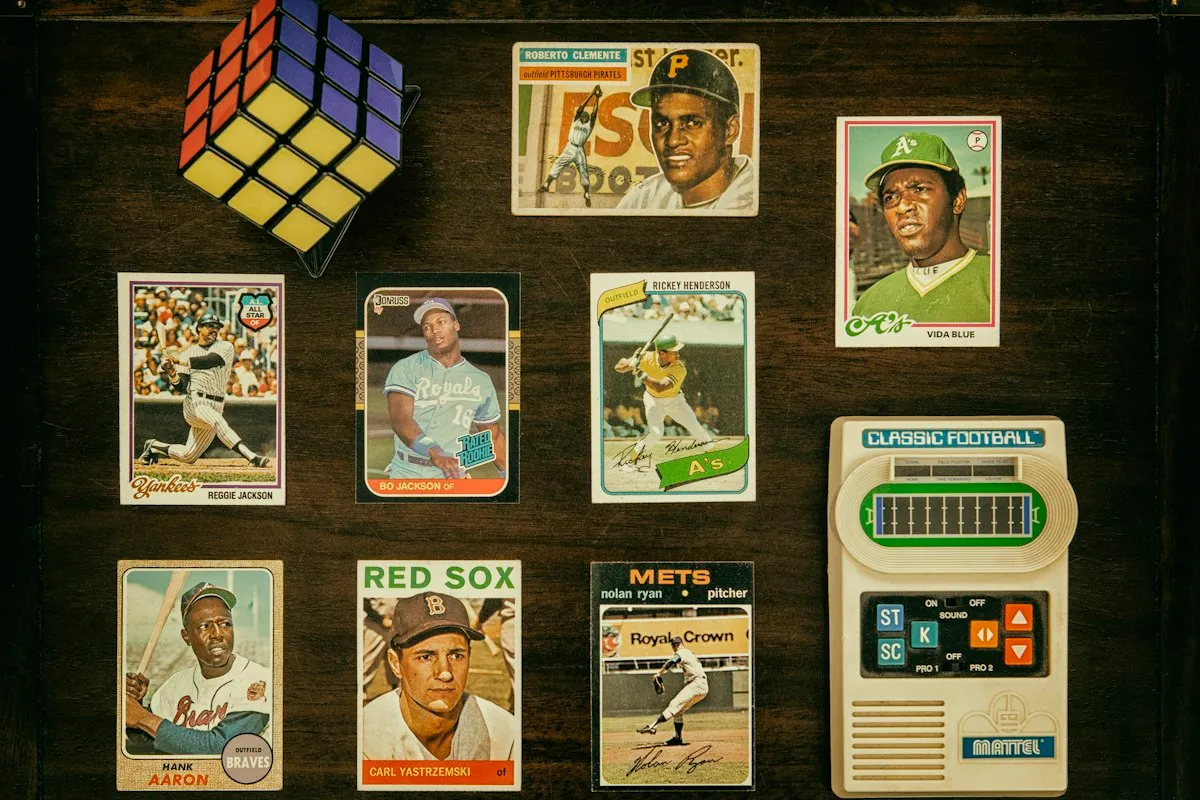
What happens when a card gets graded
Grading is a service, not a machine reading: a collector packages a raw card and mails it to a third-party company, which opens it under strong light and magnification, checks it against counterfeits and alterations, and scores it on a numeric scale for centering, corners, edges, and surface. The card then goes into a hard plastic holder — a slab — with a label carrying the grade, a certification number, and, on services that offer it, a barcode that looks the card up in the company's records. Once sealed, the card cannot be handled directly again without breaking the slab, which is most of the point: a slabbed grade travels with the card from sale to sale without anyone having to re-examine it in person.
The company doing the grading is not neutral in the sense of having no reputation to protect, but it is not your buyer and it is not your seller. What you are actually buying is a second, standardized opinion, sealed where it can't be argued with later the way a raw card's condition constantly is.
The numeric grading scale, top to bottom
Every major grader expresses a card's condition on essentially the same ladder — a scale from 1 to 10, run through nine rungs once you count the steps in between and the label reserved for cards it won't assign a number to at all:
- 10 — Gem Mint. The top of the scale: centering, corners, edges and surface all read as issue-free at the level that grader inspects to. It is generally the hardest grade to earn, and the one two companies are most likely to disagree about on the same card.
- 9.5. Essentially flawless with one very small allowance — a hair of centering drift, or a corner not quite razor-sharp. Not every grader issues this half-step (see PSA, below).
- 9 — Mint. Genuinely clean, with one clearly identifiable flaw rather than several small ones stacking up. Still reads as a premium card at a glance.
- 8.5. More than one small flaw, or one flaw that runs a little past what a 9 allows — centering, a corner, and surface usually working together rather than a single clean issue.
- 8 — Near Mint-Mint. Solidly attractive but with combined, visible softness across more than one category. Still displays well in a binder or a case.
- 7 — Near Mint. Wear that's visible without hunting for it — a rounded corner, real edge wear, a surface mark that catches the light. Still commands a real premium over a raw, ungraded copy on many cards.
- 6 — Excellent-Mint. Clear, cumulative wear: rounded corners, visible edge chipping or scuffing. A collectible copy at this point, not a display piece.
- 5 and below — Excellent, Very Good, Good, Fair, Poor. Below 6, the grades stop distinguishing fine detail and start describing how much of the card survives intact — creasing, soiling, and worn edges become the story. Precision matters far less down here than it does above 6. Watch these particular words, though: they are also raw condition terms, and a raw seller means something much higher by them than a grading label does. See what "raw" means, below.
- Authentic (no number). Issued when the card has been altered in a way the grader won't put a number on — most often trimming, recoloring, or a repaired tear — even after the card itself is confirmed genuine. It is a label about trust, not appearance, and the market generally prices it well below any numeric grade for the same card.
That ladder is a convention the industry converged on, not a law any of the graders are bound to word identically — which is exactly why the next section matters before you pick one.
The major grading companies, side by side
Four companies are the ones this page covers, and there is a long tail of smaller and regional graders besides. None of the four is presented here as "the best" — each has a different way of reporting the same scale, and which one fits your card depends on the card, the grader's own current published standards, and what a buyer for that specific card expects to see on the label:
- PSA (Professional Sports Authenticator). Numeric 1 to 10 in whole-grade steps, plus half grades from 1.5 up to 8.5 — there is no PSA 9.5, so a card that misses a 10 is graded a 9. It issues no subgrades and publishes a population report a card can be looked up in. Check PSA's own site for its current published grading standards, turnaround times and population figures before submitting; all of them change.
- BGS (Beckett Grading Services). Numeric 1 to 10 in half-point steps across the whole scale, reported alongside four individual subgrades — centering, corners, edges, and surface — that combine into the overall number. A high overall grade can still hide one weak subgrade, so read the four numbers, not just the headline one, before valuing a BGS-graded card.
- CGC (Certified Guaranty Company). Numeric 1 to 10 in half-point steps, with an optional subgrade tier on some submission levels. It came to trading cards later than PSA did, so population data on older sets can be thinner — check the population count yourself rather than assuming it is comprehensive.
- SGC (Sportscard Guaranty Corporation). Numeric 1 to 10 in half-point steps, historically without a subgrade breakdown, in a holder that looks visually distinct from the others. It has a vintage-leaning reputation, and collectors often describe its grading as conservative on older cardboard — a reputation, not a published rule, so verify it against recent sold comps for your own card rather than assuming it holds for every era.
Smaller and regional graders exist too, and their scales vary by company — some mirror the 1-to-10 numeric scale above, others use their own bands or wording entirely. The real risk with an unfamiliar grader isn't the number on the label so much as resale liquidity: a card slabbed by a company few buyers recognize can be hard to sell at any grade until you find someone who trusts that label.
What "raw" means
A raw card is simply one that has never been submitted for grading — no slab, no numeric grade, no certification number. Because there's no third-party number to point to, collectors and marketplaces describe a raw card's condition in words instead, and two overlapping vocabularies are both in common use:
- Near Mint, Lightly Played, Moderately Played, Heavily Played, Damaged. The shorthand most trading-card marketplaces use — often abbreviated NM, LP, MP, HP, and DMG — running from a card that looks unplayed down to one with a tear, crease, or stain that goes past ordinary wear.
- Excellent, Very Good, Good, Fair, Poor. The same words, used as raw condition terms — and this is the trap. Sellers using this wording generally treat Excellent as roughly Lightly Played and Very Good as roughly Moderately Played — the upper and middle rungs of the raw ladder. On a grading label those same two words sit at 5 and below. One word, two heights: check which ladder a listing means before you read a condition term as a grade.
A card can also be raw and still unopened — sealed product (a pack, box, or case still in factory wrap) has no individual card condition to assess at all until it's opened — and a card that has already been slabbed is, by definition, no longer raw; its condition is expressed by the grader's number instead. As with the numeric scale, none of this raw vocabulary is issued or enforced by any single authority. It is a market convention, and two sellers can and do draw the line between adjacent grades in different places for the same card.
Is grading worth it? The break-even question
This is the part that actually decides whether to submit a card, and it's simple arithmetic that is easy to skip: grading costs a fee, plus shipping to the grader and shipping back. That cost has to be cleared before grading breaks even, let alone profits — and it's cleared by the difference between what the raw card is worth today and what the same card is worth carrying a specific grade from a specific grader, not by the grade alone.
Put in words, it is three steps:
- Take what the card is likely to sell for at the grade you expect, from the grader you're using. The expected grade matters as much as the card does — a 9 and a 10 of the same card can sell for very different amounts.
- Subtract what the raw card is worth right now.
- Whatever is left has to cover the grading fee and both legs of shipping. Until it does, grading has moved money from your pocket to the grader's and nothing else.
Some cards never get past step three. If the expected graded value can't clear the raw price plus that cost at any grade a grader would plausibly assign, the card has no break-even at all — grading it isn't a bad bet, it's a bet with no way to win. That is a real answer the arithmetic is meant to produce, not a sign you worked it out wrong.
Two things make this harder than it looks. First, the expected grade is a guess, not a certainty — the same card sent to two graders, or graded twice by the same grader on different days, does not always come back with the same number. Second, the fee and shipping costs change and vary by grader and by the declared-value tier you choose, so there's no fixed number to check your comp against; look up the grader's current published fee schedule for the tier your card needs before you do the math, not a number you remember from a past submission.
How to submit a card, start to finish
- Decide it's worth grading. Weigh the card's raw value, its condition, and the fee-plus-shipping cost together before committing — see the break-even question above.
- Check the declared-value tier. Pick the tier that matches what the card is actually worth: underdeclaring can cap what you're reimbursed for if something goes wrong, and overdeclaring just costs you more than the card needs. The tier also affects turnaround time, so weigh both together.
- Photograph and record the card before it ships. Clear photos of front and back, with a note of its condition at submission, are your reference if anything is ever disputed later.
- Sleeve and semi-rigid. A penny sleeve and a semi-rigid holder, minimum, before the card goes anywhere near a shipping box.
- Fill out the submission form carefully. Match the declared value, service tier, and card details exactly to what's in the package — a mismatch is one of the more common causes of processing delays.
- Package, insure, and log the shipment. Pack it so nothing shifts, insure it for the declared value, and record the tracking number, ship date, and every cost involved against the card in your own records.
- Wait, then check the return against your record. When the slab comes back, verify the certification number, grade, and card details all match what was submitted before doing anything else with it.
- Record the grade and re-comp. Update your records with the final grade and look up a current comp for that specific card at that specific grade from that specific grader — that number replaces your raw estimate going forward.
Why track raw and graded cards together
A list of cards you own tells you what you have. A list that also records each card's condition or grade, and what it actually cost you to get it there, tells you whether grading a given card would have paid, and whether it's worth grading the next one. The fields that make that possible are few:
- Product type — raw, slab, sealed, or lot — so a graded card and a raw card in the same collection are never compared as if they were the same thing.
- Condition, or grade and grader — recorded separately for a raw card versus a slabbed one, because they are answering different questions.
- A true cost basis — the purchase price plus shipping and, for a graded card, the grading fee and both legs of shipping to and from the grader. Without it, "what you paid" quietly understates what a graded card actually cost you.
- Current value, dated — a value that's stamped with when you checked it, not one overwritten cell that slowly drifts out of date without anyone noticing.
The free card collection starter is one card tab plus a short Read Me, and it gets the habit going — a row per card or lot with the game, the set, the product type, the condition or grade, what you paid and what it's worth now, and four boxes along the top — rows logged, total paid, current value, and the difference between them — that keep themselves current. It doesn't do the grading math; it's a starting habit, not the engine. The full Trading Card Game & Sports Card Collection Tracker adds the part this page is about: a Grade or Sell Raw tab that runs the break-even math above for you — raw comp, the premium for the grade you expect and the grader you pick, less the fee for that grader's service tier and both legs of shipping — and a true net cost basis on every card that accounts for shipping, lot splits, grading, and platform fees, so the gain or loss on your dashboard is money you actually made, not price minus price. Its Grading Guide tab lays out the full numeric scale, the major and regional graders, and the raw condition terms above in one reference you can keep next to your collection.
Own it, don't rent it
A collection app can average your cards' values from data you can't audit, cap what you can export, or shut down and take your grading history with it. A blank spreadsheet asks you to build the break-even math and the cost-basis arithmetic yourself, from scratch, before you can trust a single number it shows you. The workbook sits between the two: the math is already built, and the file is yours — it opens in Excel, Google Sheets, and LibreOffice, with no account, no subscription, and nothing to renew.
Related templates and concepts
Grading isn't unique to cards — sneaker collectors and record collectors apply the same idea with their own ladders; see what sneaker condition grading is or what record grading is for the disc-and-sleeve version of the same argument. Collecting more than cards? The free collection trackers index has a no-signup starter for most of the hobbies Ardent Workshop covers, and the templates for collectors hub gathers the paid collection trackers and the grading guides in one place.
Templates that implement this
Track your cards, raw and graded, in one file
4 templates
Log every card's condition or grade, its cost, and what it's worth — and let the sheet tell you when grading actually pays.
- $6.95 Spreadsheet
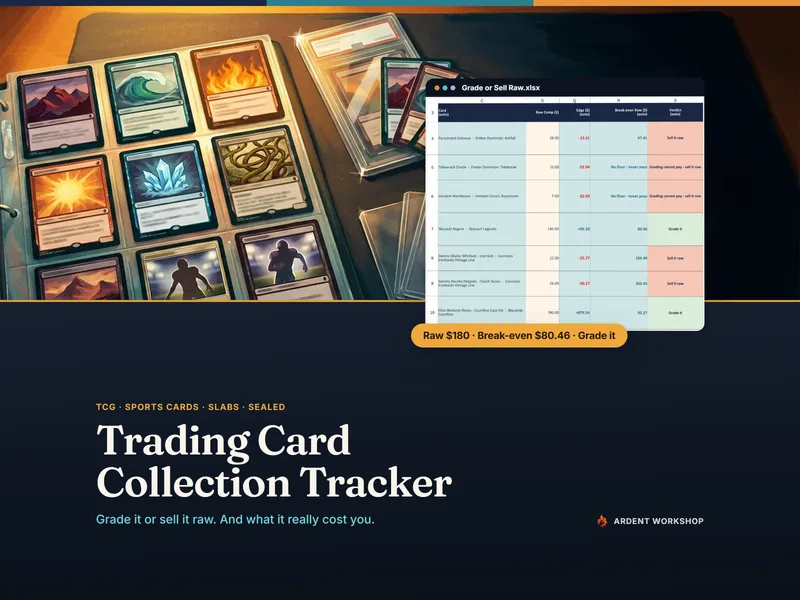
Trading Card Game & Sports Card Collection Tracker — Excel & Google Sheets
A trading card and sports card collection tracker for Excel & Google Sheets — grading break-even, true net cost basis, set completion, computed dashboard.
TrackersView details - $6.95 Spreadsheet

K-Pop Photocard Collection & Trading Tracker — Excel & Google Sheets
A K-pop photocard collection and trading tracker for Excel & Google Sheets — catalog every card, hunt grails, run trades, and see it on a live dashboard.
TrackersView details - $6.95 Spreadsheet
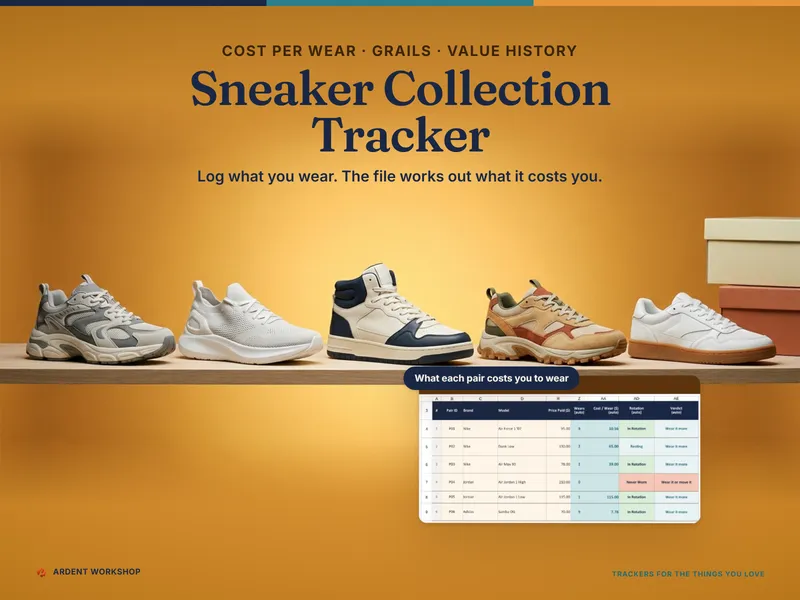
Sneaker Collection Tracker - Cost Per Wear, Grails & Value History (Excel + Sheets)
A sneaker collection tracker for Excel and Google Sheets. Get a real cost per wear on every pair, and a valuation history that records where each figure came from.
TrackersView details - $6.95 Spreadsheet
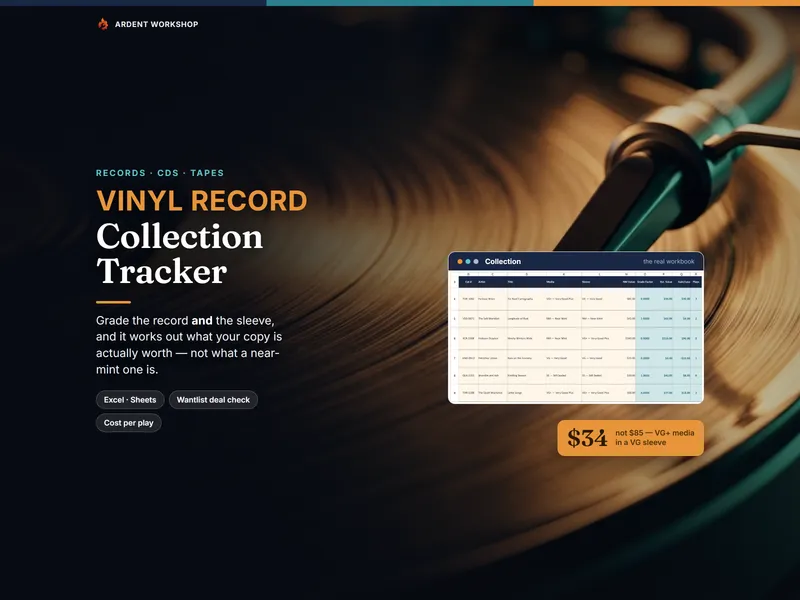
Vinyl & Music Collection Tracker - Condition Grading, Wantlist Deal Check (Excel + Sheets)
A vinyl record collection tracker for Excel and Google Sheets. Grade media and sleeve separately for a real value, and price any copy against your ceiling.
TrackersView details
Frequently asked questions
- Is it worth grading a card?
- Only if the raw card's comp, multiplied by the premium the grade you expect carries with the grader you're using, clears the raw comp by more than the fee and both legs of shipping — a break-even you have to work out per card, per expected grade, per grader. A card sitting near a condition threshold, or one with real scarcity behind it, is a far better candidate than an already-common card in average shape. Some cards have no break-even at any grade a grader would realistically assign; for those, "don't submit it" is the arithmetic working correctly rather than failing.
- What does PSA 10 mean?
- On PSA's scale a 10 — labeled Gem Mint — is the top numeric grade: centering, corners, edges and surface all read as issue-free at the level PSA inspects to. PSA's scale runs whole grades 1 through 10 plus half grades from 1.5 up to 8.5; there is no PSA 9.5, so a card that just misses a 10 is graded a 9, not a 9.5.
- What is a raw card?
- A raw card is one that has never been submitted to a grading company — it has no numeric grade and no slab. Collectors instead describe a raw card's condition in words, most often along a scale like Near Mint, Lightly Played, Moderately Played, Heavily Played, and Damaged, borrowed from marketplace convention rather than any single graded standard.
- What is the difference between PSA and BGS?
- Both run a numeric 1-to-10 scale, but they report it differently. PSA issues one number — whole grades 1 to 10, half grades 1.5 to 8.5, no 9.5 — with no subgrade breakdown. BGS reports four individual subgrades (centering, corners, edges, and surface) alongside the overall number, so a buyer can see exactly which feature held a card back. Neither company is ranked above the other here; which one fits a given submission depends on the card, the grader's own published standards, and what a buyer for that card expects to see.
- How much does it cost to grade a card?
- It depends on the grader, the declared-value tier you choose, and the turnaround speed you pay for — figures that change often enough that quoting one here would be wrong by the time you read it. Look up the grader's current published fee schedule for the tier you need, and budget for shipping both ways on top of it before you decide whether a card is worth submitting.
- Does a grade mean a card is authentic?
- Yes, in the sense that a graded card has been inspected by the company and confirmed as a genuine print of that card — that is part of what the fee pays for. But a numeric grade is a condition judgment, not a guarantee of future value, and a card that has been altered in a way the grader will not put a number on is labeled Authentic (or a similar wording) rather than given a numeric grade at all.