Picture a gardener (call them Sam; they’re a composite, not a real person) standing in their kitchen in late July with four grocery bags of green beans and nowhere to put them. Every bean in the garden came ready in the same ten days. By the third week of August there won’t be a single one left.
That glut-then-nothing pattern is what a succession planting schedule prevents. Sowing the same crop in rounds a fixed number of days apart spreads one big harvest into a steady supply. The concept itself is covered in what succession planting is. This post is about the part that goes wrong in practice: the schedule, and the late round that never makes it before frost.
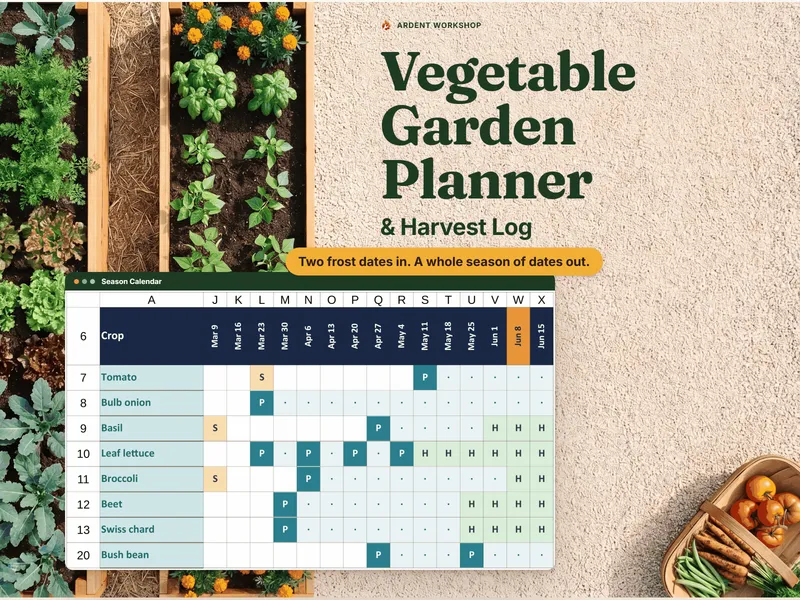
A succession planting schedule is a dated list of every sowing of a crop across the season, with the date each round will be ready and a check that it beats your first fall frost. You can build one on paper in an evening. The Vegetable Garden Planner & Harvest Log builds it for you from your two frost dates and checks every round against frost. The arithmetic below is the same either way, so here it is in full.
What goes into a succession planting schedule
A succession planting schedule runs on five numbers. Two describe your garden, and three describe the crop.
| Input | Where it comes from | What it controls |
|---|---|---|
| Last spring frost | Your local frost date | When round one can go in |
| First fall frost | Your local frost date | The deadline every round is checked against |
| Interval | The crop (e.g., every 14 days) | The gap between rounds |
| Days to harvest | The seed packet or variety | When each round is ready |
| Frost tolerance | The crop: tender, half-hardy or hardy | How far past the first fall frost a round can still finish |
How to build a succession planting schedule
Building a succession planting schedule takes five steps, and each one is simple addition:
- Write down your two frost dates. Find your average last spring frost and average first fall frost. Every other date in the schedule is counted from these two.
- Date the first round. Count from the last spring frost by the crop’s usual sowing offset. Bush beans go in about a week after it; hardy greens can go in weeks before it.
- Add one interval per round. Round two is the first round plus one interval, round three is plus two, and so on until the season runs out.
- Date when each round is ready. Add the crop’s days to harvest to each sowing date. For rounds sown after midsummer, add a fall slowdown allowance as well, because growth slows as the days shorten.
- Check each round against the first fall frost. A round passes if its ready date falls on or before the first fall frost plus the crop’s grace period. Any round that fails is a round you do not sow.
Step 5 is the one a hand-drawn schedule often leaves out, and it’s the most useful. Without it, the schedule just keeps adding rounds until you lose interest.
A worked succession planting schedule for bush beans
Here is Sam’s schedule for this season.
- Last spring frost: May 10
- First fall frost: October 5
- Midsummer (halfway between the two frost dates): July 23
- Bush beans: sown 1 week after last frost, every 14 days, 55 days to harvest, tender (0 days of grace past frost)
- Fall slowdown allowance: 14 extra days for any round sown after midsummer
| Round | Sow | Days added | Ready | Frost check |
|---|---|---|---|---|
| 1 | May 17 | 55 | July 11 | OK |
| 2 | May 31 | 55 | July 25 | OK |
| 3 | June 14 | 55 | August 8 | OK |
| 4 | June 28 | 55 | August 22 | OK |
| 5 | July 12 | 55 | September 5 | OK |
| 6 | July 26 | 55 + 14 | October 3 | OK, with two days to spare |
| 7 | August 9 | 55 + 14 | October 17 | Too late |
Six rounds make it. The seventh would be ready twelve days after the first frost, and beans are a tender crop, so frost would kill the plants first. The schedule’s answer is to skip round seven, and that saves the seed, the bed space and an evening of planting.
Why round six passes and round seven doesn’t
Round six passes and round seven fails because of two rules that only kick in late in the season: the fall slowdown and the frost grace period.
The fall slowdown. Round six goes in on July 26, three days after midsummer. Growth slows as the days shorten, so the planner adds a cautious 14-day allowance to any round sown after the midpoint between the two frost dates. Without that allowance, round seven would look ready on October 3 and pass. With it, round seven is ready on October 17 and fails. The allowance is a planning default, not a measurement, but leaving it out is how a schedule ends up promising a harvest that never comes.
The grace period. Different crops tolerate frost differently. The planner’s defaults are 0 days of grace for tender crops, 7 for half-hardy and 21 for hardy. Beans get none. Run the same arithmetic for leaf lettuce, a half-hardy crop sown every 14 days from April 12, and its last passing round in Sam’s garden is August 2. A hardy crop like spinach runs later still.
“OK” doesn’t always mean “worth it.” Round six is ready on October 3, and frost arrives on October 5. It passes the check with two days of picking before frost. Whether that’s worth a packet of seed is your call, and the schedule is what lets you make it in June instead of finding out in October.
The frost check only tests frost. Summer heat is a separate question, especially for cool-season crops like lettuce, and you may want to pause those sowings during the hottest weeks. A schedule tells you what can finish before frost, and you still decide what you actually want to grow in August.
How often to succession plant common crops
There’s no single right interval for succession planting, and published guidance varies. The University of Kentucky Franklin County Extension guide to succession planting (opens in new tab) suggests 7 days between plantings for leaf lettuce, radish, spinach and cilantro, 10 days for sweet corn, bush beans and head lettuce, and 14 days for beets, turnips, basil and dill. The planner’s defaults space most crops a little further apart, which uses less bed space at once.
| Crop | Extension interval (days) | Planner default (days) | Days to harvest (planner default) | Frost tolerance |
|---|---|---|---|---|
| Radish | 7 | 10 | 28 | Hardy |
| Leaf lettuce | 7 | 14 | 45 | Half-hardy |
| Spinach | 7 | 14 | 40 | Hardy |
| Cilantro | 7 | 14 | 45 | Half-hardy |
| Bush beans | 10 | 14 | 55 | Tender |
| Sweet corn | 10 | 14 | 75 | Tender |
| Beets | 14 | 21 | 55 | Half-hardy |
| Dill | 14 | 21 | 45 | Half-hardy |
A shorter interval gives a smoother supply but more rounds in the ground at once. A longer one leaves gaps. Start with the default, then let last season’s harvest log tell you which way to adjust: if your harvests overlapped, lengthen the interval, and if you had gaps, shorten it.
Crops that come ready over a short window and then finish, like radishes, lettuce and bush beans, are the usual candidates for succession planting. Long-season crops such as tomatoes hold a bed most of the summer, so they need far fewer rounds than a quick crop.
The busiest week sets how much bed your succession plantings need
A succession planting schedule is also a space plan. Each round holds its patch of bed from sowing until its harvest ends, so rounds overlap.
Look at Sam’s bush bean schedule again. Each round is ready 55 days after sowing and then picked for about three weeks. That means round one is still in the ground on July 26, the day round six is sown. In the last week of July, all six bean rounds are in the ground at once. If each round gets a 4-square-foot patch, that week needs 24 square feet for beans alone, even though no single round ever uses more than 4.
This is the number a schedule surfaces and a seed packet never mentions. Find your busiest week before you sow round one. Then either make room for it, pull spent rounds promptly, or follow early rounds with a different crop in the same ground. For example, spring peas can be followed by fall radishes. The two never overlap, so they can share a bed.
Common questions about succession planting schedules
How many succession plantings can I fit in one season?
As many as clear the frost check. Count forward one interval at a time from your first sowing date, and stop at the last round whose ready date lands on or before your first fall frost plus the crop’s grace period.
Do I need a different schedule every year?
Only the dates change. The crop numbers (interval, days to harvest, frost tolerance) carry over, so a schedule built once is re-dated each spring from that year’s frost dates and adjusted from what your harvest log showed.
What if my last round fails the frost check?
Skip it, or change one input: start the first round earlier, shorten the interval, or choose a variety with fewer days to harvest. Row cover is the other lever, because late plantings may need cold protection to finish.
Build the schedule once, then re-date it every spring
A succession planting schedule is worth more than the effort it takes to make. In practice it’s a crop list kept with your frost dates, and the work is re-doing the date math for every crop, every spring. That re-dating is the part that’s easiest to drop after the first year.
The Vegetable Garden Planner & Harvest Log was built for exactly that part. You type your two frost dates and every round of every crop you plan dates itself, each one marked OK or Too late. It also tracks the space each bed needs in its busiest week and logs what each crop and bed actually produced, so next year’s intervals come from your own garden. It’s a workbook you keep, not an app you rent. If you’d rather start smaller, the free vegetable garden planting log records what went in where and dates each crop’s first harvest. It doesn’t build succession rounds, but it’s an honest place to start.
If you like having the year on one calendar, the same habit works indoors too. A seasonal home maintenance calendar is the house’s version of a planting schedule.