Every October, the same thing happens. Someone announces a Halloween movie marathon, everyone agrees it’s a great idea, and the schedule survives about a week. Night one is a crowd-pleaser. Night three is whatever was on the front page of a streaming app. By night eight somebody has picked a film that was too much for the youngest person in the room, and the marathon quietly becomes “we’ll just watch something.” The fix is a Halloween movie marathon schedule sorted by scare level rather than by quality — five levels, one per week, ending on the hardest night on Halloween itself.
Sorting by scare level means starting where everyone in your house is comfortable and escalating on purpose, so nobody gets ambushed and nobody spends the whole month bored.
Below is a 31-night slate organized on that five-level ladder, plus the swaps that make it work for a house full of eight-year-olds, a house full of adults, or the much more common house that contains both.
One piece of timing worth knowing before you plan: Halloween 2026 falls on a Saturday, which means the final night of the marathon is a genuine no-school, no-bedtime night. Build toward it.
Why Most Halloween Movie Lists Fall Apart by October 8
Seasonal watchlists are usually ranked by quality, and quality is the wrong axis for a group.
A “best horror movies” list is a fine reference for one person choosing one film. It’s close to useless for a household, because it sorts by how good a film is rather than by who can be in the room for it. The result is a slate that lurches: a cozy stop-motion night, then something genuinely upsetting, then back to a cartoon. That whiplash is what makes people opt out — and once two people opt out, a marathon is just a person watching TV.
The second failure is scope. Thirty-one nights is thirty-one commitments on top of school, work, and everything else October already contains. Any schedule that demands a two-hour film every single night will collapse, so it needs a stated escape hatch from the start.
The fix for both problems is the same: sort by scare level, not by quality, and make the escalation the point. When the ladder is public, everyone knows what tonight is and roughly what next Tuesday is. Nobody has to negotiate. If you’ve read our take on how to pick a family movie, this is the seasonal version of the same idea: decide the rule once, and stop re-litigating it every night.
The Scare Ladder: Five Levels, Actually Defined
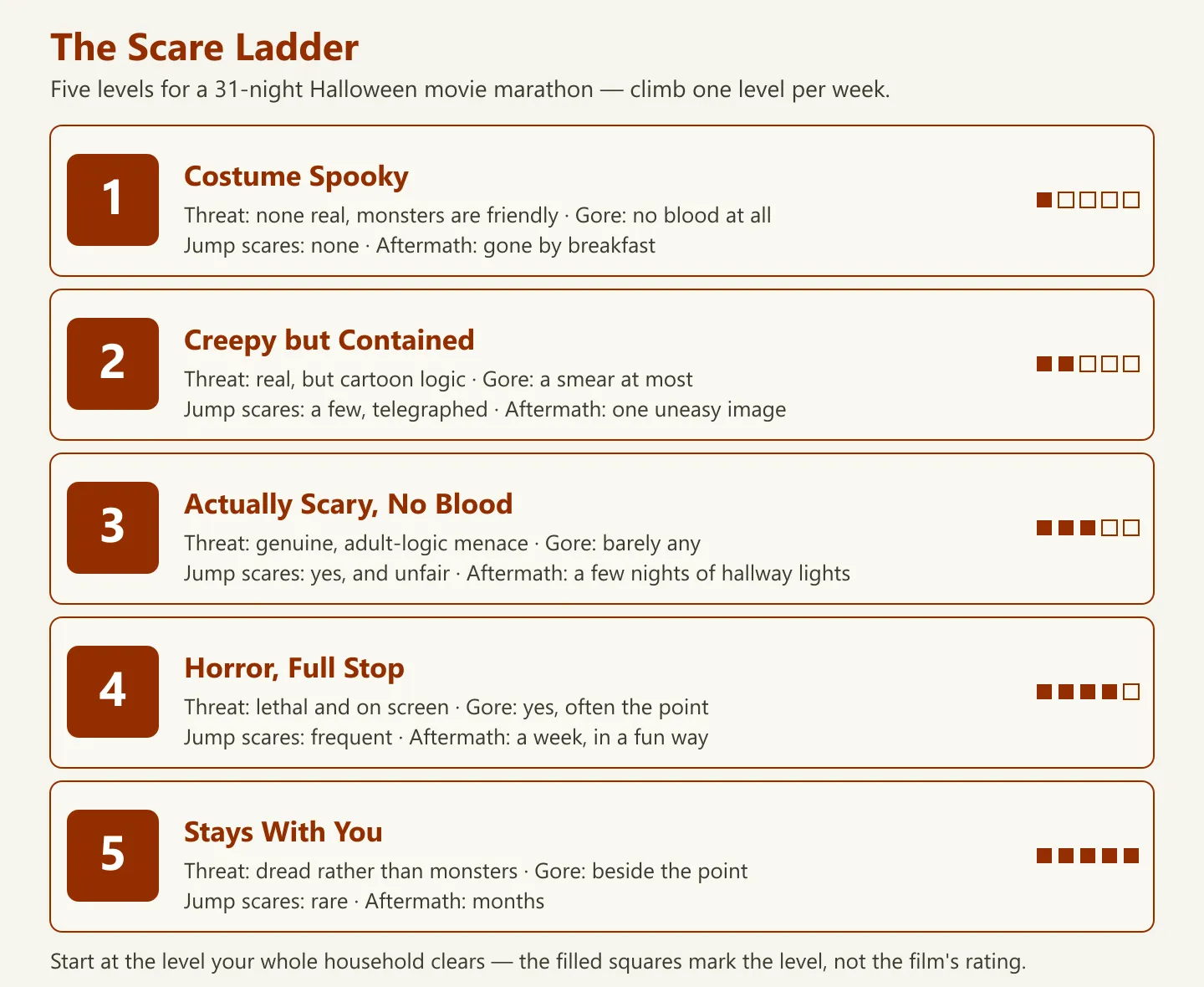
The ladder rates films on four things that decide whether someone can watch them: how real the threat is, how much blood is on screen, how hard the jump scares hit, and how long the film stays in your head afterward. That last column is the one most lists ignore, and it’s the one that determines whether a nine-year-old sleeps.
| Name | Level | Threat | Gore | Jump scares | Aftermath |
|---|---|---|---|---|---|
| Costume Spooky | 1 | None real — monsters are friendly | No blood at all | None | Gone by breakfast |
| Creepy but Contained | 2 | Real, but cartoon logic; always resolved warmly | A smear at most | A few, telegraphed | One uneasy image |
| Actually Scary, No Blood | 3 | Genuine, adult-logic menace | Barely any | Yes, and unfair | A few nights of hallway lights |
| Horror, Full Stop | 4 | Lethal and on screen | Yes, often the point | Frequent | A week, in a fun way |
| Stays With You | 5 | Dread rather than monsters | Beside the point | Rare — it doesn’t need them | Months |
Two things are worth noticing before you use it.
-
A rating letter is not a scare level. The Motion Picture Association’s film ratings guide (opens in new tab) does describe frightening content — its descriptors include “scary images,” “frightening images” and “scary moments,” and it ties the more intense end of those to PG-13. But those descriptors are weighed alongside language, violence, nudity and drug use in arriving at a single letter, and while the rating reason names them, the letter on the poster carries none of that detail. A PG film can be far more disturbing than a PG-13 one, and no letter tells you how a particular child will react, or how long a film will stay with them.
-
PG in 1984 is not PG today. The PG-13 rating debuted on July 1, 1984 (opens in new tab) to flag film content with a “higher level of intensity” than PG covered. As NPR recounted in its thirtieth-anniversary piece on the rating (opens in new tab), the pressure came from gory scenes in PG-rated movies — Indiana Jones and the Temple of Doom and Gremlins among them. Several films below carry a PG they would not be given now, and the verdict column says which.
The 31-Night Halloween Movie Marathon Schedule
The slate runs one level per week and lands on the hardest rung during Halloween weekend. Nights are numbered to the date — night 12 is October 12 — so you can drop in and out without recalculating anything.
Before you start: streaming rights move constantly, and a title that’s included with a service in September can be rental-only by October. Check availability for the week ahead rather than trusting any list, this one included. On the table below, the years are US release years and the ratings are the Motion Picture Association’s. You can check the ratings yourself in the MPA’s rating lookup (opens in new tab), with two caveats: it records the year a film was rated rather than the year it came out, and a few pre-1990 titles are missing or carry odd records — Poltergeist is listed as unrated because its PG came out of a successful appeal (opens in new tab), the ratings board having first given it an R. Titles marked “Not rated” are television specials or direct-to-video releases that never carried a theatrical rating.
Week 1 (Nights 1–7): Costume Spooky
The on-ramp, and every film here sits at Level 1. Nothing will frighten anyone; the job of week one is to establish that the marathon happens, at a predictable time, and that it’s fun.
| Night and film | Year | Rating | The one-line verdict |
|---|---|---|---|
| Night 1 · It’s the Great Pumpkin, Charlie Brown | 1966 | Not rated | Under half an hour, zero risk, and it makes night one impossible to skip. |
| Night 2 · Monsters, Inc. | 2001 | G | The best film ever made about being scared, which is a useful thing to open with. |
| Night 3 · Hotel Transylvania | 2012 | PG | Every monster archetype the rest of the month uses, introduced as a joke first. |
| Night 4 · Wallace & Gromit: The Curse of the Were-Rabbit | 2005 | G | A werewolf movie for people who do not want a werewolf movie. |
| Night 5 · Casper | 1995 | PG | Gentler than it looks, but it is quietly a film about a dead child — worth knowing in advance. |
| Night 6 · Scooby-Doo on Zombie Island | 1998 | Not rated | Underrated pick: the one where the monsters are real. Call it a Level 2 in a Level 1 week. |
| Night 7 · The Nightmare Before Christmas | 1993 | PG | Ends week one on the visual language the rest of October runs on. |
Week 2 (Nights 8–14): Creepy but Contained
Level 2: real tension and real scary images, but the threat runs on cartoon logic and always resolves warmly. This is the week where younger viewers find their ceiling — pay attention to who’s watching through their fingers, because that tells you how to run week three.
| Night and film | Year | Rating | The one-line verdict |
|---|---|---|---|
| Night 8 · Hocus Pocus | 1993 | PG | Broad, loud and safe — the correct palate-cleanser before the week gets going. |
| Night 9 · Ghostbusters | 1984 | PG | A comedy with two or three images that genuinely land. Peak “PG used to mean something else.” |
| Night 10 · Beetlejuice | 1988 | PG | Grotesque rather than frightening, and much more adult than its rating suggests. |
| Night 11 · The Witches | 1990 | PG | Practical-effects nightmare fuel wrapped in a children’s film. Skip this if week one already found your limit. |
| Night 12 · Monster House | 2006 | PG | Genuinely tense for its whole runtime, and the rare kids’ film built on real dread. |
| Night 13 · ParaNorman | 2012 | PG | Zombies, but the actual subject is how a town treats the people it decides to fear. |
| Night 14 · Coraline | 2009 | PG | The week’s high-water mark, and effectively a Level 3: a PG film that plays like a PG-13 one, and the buttons stay with people. |
Week 3 (Nights 15–21): Actually Scary, No Blood
Level 3: adult-logic menace, real jump scares, almost no gore. All seven are PG or PG-13, and several are more frightening than the R-rated week that follows — dread does more work than blood.
| Night and film | Year | Rating | The one-line verdict |
|---|---|---|---|
| Night 15 · Gremlins | 1984 | PG | One of the films that caused the PG-13 rating to exist. Watch it and you’ll see why. |
| Night 16 · Jaws | 1975 | PG | Barely shows the shark and is scarier for it — the whole week’s thesis in one film, and another PG that predates PG-13 entirely. |
| Night 17 · Poltergeist | 1982 | PG | A suburban haunting carrying a PG rating no ratings board would repeat today. |
| Night 18 · Tremors | 1990 | PG-13 | Underrated pick: a monster movie that’s genuinely funny, which resets the room mid-week. |
| Night 19 · Signs | 2002 | PG-13 | Two of the best-constructed scares of its decade, built almost entirely out of waiting. |
| Night 20 · A Quiet Place | 2018 | PG-13 | Best watched with the house silent, which is the only night of the month that rule is fun. |
| Night 21 · The Sixth Sense | 1999 | PG-13 | Ends the week on a ghost story rather than a monster, and sets up the tonal shift. |
Week 4 (Nights 22–28): Horror, Full Stop
Level 4: R-rated genre filmmaking. If your household is mixed-age, this is the week the ladders split (see the variants below). If it isn’t, this is the week the whole marathon has been building toward.
| Night and film | Year | Rating | The one-line verdict |
|---|---|---|---|
| Night 22 · Halloween | 1978 | R | The template. Less gore than its reputation, more patience than you remember. |
| Night 23 · An American Werewolf in London | 1981 | R | The transformation scene is the reason practical effects still have defenders. |
| Night 24 · The Thing | 1982 | R | Paranoia horror where the monster is mostly the other people in the room. |
| Night 25 · Scream | 1996 | R | A horror film about horror films — the correct midpoint of a slasher week. |
| Night 26 · Alien | 1979 | R | Structurally a haunted-house film in space, and still the best-paced one on this list. |
| Night 27 · 28 Days Later | 2002 | R | Bleak, fast, and widely credited with making modern zombies run. |
| Night 28 · Get Out | 2017 | R | The bridge into the final three nights, and the week’s one Level 5: it works on dread rather than danger. |
The Final Three (Nights 29–31): Stays With You
Level 5, escalating across three nights and ending on Halloween itself — a Saturday in 2026, so the last night carries no next-morning penalty.
| Night and film | Year | Rating | The one-line verdict |
|---|---|---|---|
| Night 29 · The Shining | 1980 | R | Slow, enormous, and best on the biggest screen you have access to. |
| Night 30 · Hereditary | 2018 | R | The most upsetting film on this list. Not a “fun scary” night — schedule it deliberately. |
| Night 31 · The Exorcist | 1973 | R | The Halloween-night finale if you want the hardest level. Swap in your household’s annual rewatch if you’d rather end warm. |
Where to start if you’re only doing one night: night 16, Jaws. It’s the clearest demonstration on the slate of why restraint beats gore, and it’s the rare Level 3 that a mixed room will actually sit through together — Common Sense Media puts it at 12+ (opens in new tab), so check that against your youngest viewer first.
How to Adapt the Schedule to Your Household
The 31-night version above assumes an audience that can reach Level 5. Plenty of households can’t, and there’s no prize for forcing it. Here are the four common shapes and what to change.
| Your household | What to change | Where the month lands |
|---|---|---|
| Young kids only (roughly 5–9) | Cap at Level 2. Repeat weeks one and two with the Level 1–2 films you skipped, and make night 31 the biggest Level 1 favorite. | A month of costume-spooky nights with two or three genuinely tense ones. |
| Mixed ages under one roof | Run two ladders in parallel. Shared Level 1–2 nights in weeks one and two; older viewers continue to Levels 3–4 after bedtime. | Everyone gets a marathon; nobody gets ambushed. |
| Teens and adults | Start at night 15. Run weeks three and four across the whole month, one film every two or three nights. | Ten to twelve films, all Level 3+, no filler. |
| One person genuinely hates horror | Cap the shared nights at Level 2 and let the horror fan run Levels 3–5 solo or with friends. Do not renegotiate this nightly. | Two traditions instead of one resentful one. |
The mixed-age version is the one worth planning properly, because it’s the one that fails silently. The little kids don’t complain that week four excluded them — they just stop asking about movie night. Giving them their own ladder, on the same nights, keeps the tradition intact for everyone.
Five Rules That Keep a Marathon Alive
The schedule is the easy part. These are the rules that decide whether you’re still doing this on October 24.
-
The 20-minute rule. Anyone can call it, once per night, in the first 20 minutes. You stop the film and put on something from Level 1 — no argument, no explanation required. The existence of the escape hatch is what lets people say yes to a harder night.
-
Nothing long on a school night. Weeknights get the shorter films and a start time you actually keep. The longest nights on this slate — 16, 29, 30 and 31 — belong on a Friday or a Saturday, and a Tuesday that ends at 11:40pm costs you the rest of the week.
-
Pick tomorrow’s film tonight. The reliable killer of a marathon is 25 minutes of scrolling at 8pm. Deciding the next night’s film while everyone is still in the room takes 30 seconds and removes the whole failure mode. Our post on watch party etiquette covers the rest of the group-viewing ground rules.
-
Miss nights on purpose. Skipping night 19 costs nothing. Sliding night 19 to night 20 and pushing everything back is what turns a tradition into a backlog. Stay on the calendar date and let the misses go.
-
Log it. One line per night — what you watched, who was there, whether it landed. It takes fifteen seconds in a movie tracker or a notes app, and it’s the entire reason next October takes ten minutes to plan instead of an evening.
How to Track a 31-Night Marathon Without a Group Chat
By about night nine, nobody remembers what’s been watched, who was there, or which film got vetoed. This is a small tracking problem that a screenshot in a group chat solves badly and a single file solves permanently.
What’s worth recording isn’t complicated: date, title, scare level, who watched, and a one-to-five rating from each person. That’s it. Do that for one October and you own something you can’t buy — an evidence-based map of what your household can actually watch, which makes every subsequent year’s schedule mostly a copy-paste job.
The Movie Tracker is built for exactly this shape of record: a Movies tab holding up to 500 films, five separate rating lanes per title rather than one blunt score, a Journal tab for the running commentary, and status flags like Completed and Currently Watching that keep the in-progress pile visible. If your marathon is a series rather than a film slate — a night per episode of an anthology show — the TV Show Tracker does the same job by episode.
And if the reason a title above isn’t available is that you’re paying for four services and watching one, the Streaming Service Value & Watchlist Workbook joins what you pay against what you actually watch and gives you a cost per hour for each subscription — a much better basis for an October cancellation than a vibe. If you’re weighing a spreadsheet against a dedicated app for this, we’ve compared them in spreadsheet vs. streaming tracker app.
For the decorations themselves — placement, a budget, and a permanent inventory so you don’t buy a second skeleton — the Halloween Decoration Planner covers the part of October that isn’t sitting on a couch.
Common Questions About Halloween Movie Marathons
How do I run a Halloween movie marathon with kids of different ages?
Run two ladders in parallel rather than one compromise ladder. The younger viewers get Levels 1 and 2 for the whole month, the older ones get the Level 3 and 4 nights after the little ones are in bed, and everyone shares the Level 1 and 2 nights in weeks one and two. A single compromise slate produces a month that’s too scary for one group and too tame for the other.
What if we miss a night?
Skip it and stay on the calendar date rather than sliding the whole schedule. A marathon that owes you four movies stops feeling like a tradition and starts feeling like homework, and the backlog is what kills it.
How do I know if a movie is too scary for my kid?
The rating tells you what is in the film, not how your specific kid will handle it, so pair it with a per-film breakdown from a source like Common Sense Media and with what you already know about your child. Their movie reviews (opens in new tab) flag the specific frightening content and give a suggested age for each title — the Jaws entry (opens in new tab) shows the shape of it — which is a level of detail a rating letter can’t carry.
Do we really have to watch 31 movies?
No. The ladder is the useful part and the count is not, so eight to fifteen nights across October works just as well — you climb the same five rungs more slowly. Eight nights that escalate beat thirty-one that don’t.
The Takeaway
A Halloween movie marathon fails for a structural reason, not a taste reason: the films arrive in a random order, so somebody is always either bored or ambushed. Sorting the month by scare level instead of by quality fixes it, because the ladder tells everyone what tonight is and what’s coming.
Start at the level your whole household clears, climb one level a week, keep the 20-minute escape hatch open, and log what you watch. Do that once and next October plans itself.