This page is about the gardening technique. Not to be confused with the workforce concept of succession planning.
The four parts of succession planting
Every succession plan, on paper or in a notebook, is made of the same four decisions:
- The interval — the gap between rounds, "every N days." It is set per crop: fast salad crops are typically sown every couple of weeks, slower ones less often.
- The number of rounds — how many times you sow the crop across the season.
- The frost cutoff — a round is only worth sowing if it can be ready by the first fall frost, plus a grace period for crops that tolerate cold.
- Space over time — each round takes its space while it is in the ground. Overlapping rounds need that space at the same time; plantings that don't overlap can share the same ground.
The interval and the number of rounds
The first round goes in on your planting date, and each later round goes in one more interval after it: round two after one interval, round three after two, and so on. The interval is a trade-off. A short gap gives a steady trickle but uses more space at once; a long gap leaves holes in the harvest. The number of rounds is capped by the season, which is where the frost cutoff comes in.
The frost cutoff
A late round that can't mature before frost is wasted seed and wasted space. Count from the sowing date by the crop's days to maturity and ask whether it is ready by your first fall frost. Hardy crops can keep going a little past it, so they get a grace period. The Vegetable Garden Planner & Harvest Log uses deliberately cautious planning defaults, not measurements: tender crops get 0 days of grace, half-hardy 7 days and hardy 21 days, and plantings that go in after the midpoint between your two frost dates get a 14-day fall slowdown allowance, because growth slows as days shorten. Crops set to Yes in the Over-winters column of the Crop Guide tab skip both the frost check and the slowdown.
Space over time
Succession planting is a calendar problem as much as a seed problem. Rounds that overlap in the ground each need their own square footage in the same weeks, so the busiest week sets how much bed you need. Rounds that don't overlap, like spring peas followed by fall radishes, can use the same ground because the space is occupied at different times.
Which crops suit it
The technique suits fast crops that come ready over a short window and then finish: lettuce, radish, bush beans and cilantro are typical examples. Long-season crops that occupy a bed for most of the year gain little from it.
When the last rounds won't make it
If a late round can't be ready by frost, you have four options: sow fewer rounds, start earlier, shorten the gap between rounds, or pick a variety with fewer days to harvest. Dropping the round is a legitimate answer. The mistake is sowing it anyway and finding out at first frost.
How a planner handles it
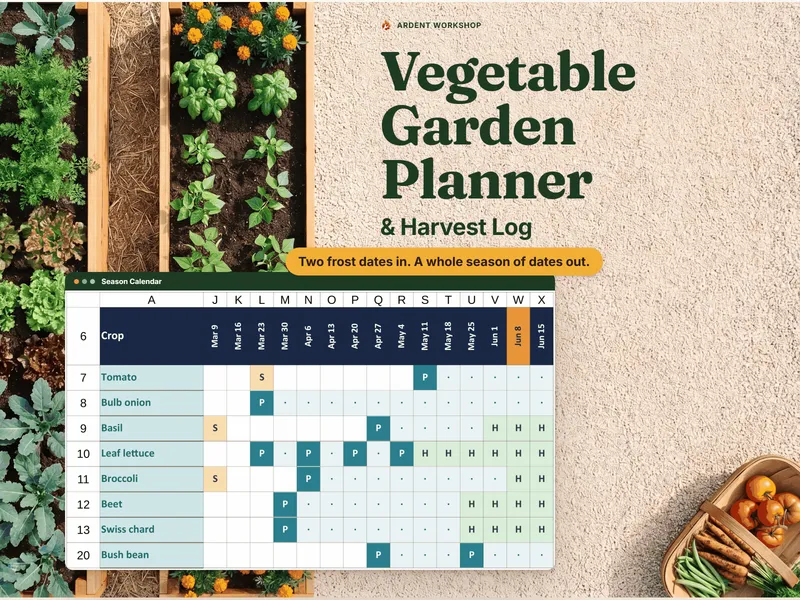
The Vegetable Garden Planner & Harvest Log turns the four parts into a schedule you own, in a workbook rather than a subscription app:
- On the Plan tab you set Rounds and Every (days). The Crop Guide tab supplies a typical interval for each crop.
- Every round is checked on the Succession Schedule tab: it passes if it will be ready by your first fall frost plus the crop's grace days, otherwise it reads "Too late." The Plan tab reads OK, "n of N rounds mature", "Won't mature before frost," or "Overwinters" for a crop set to Yes in the Crop Guide tab's Over-winters column. In the sample, bush bean with 6 rounds reads "4 of 6 rounds mature."
- A too-late round drops out downstream: its seed is left off the Seed Order tab, it takes no space on the Beds tab, and the This Week tab says "Skip: too late to mature" on its sowing date.
- Sq ft on the Plan tab is per round. The Beds tab counts space week by week and reports each bed's busiest week.
- All dates come from two frost dates on the Setup tab, last spring and first fall. Change one and the whole season re-dates. The frost dates aren't supplied because they depend on where you garden.
The crop figures are typical starting points, consistent with US cooperative extension planting calendars and the days to maturity printed on seed packets.
Where to start
Begin with the free vegetable garden planting log: a one-tab sheet with crop, bed, planting date and an expected first harvest from days to maturity. It doesn't build a succession schedule, which is the step up when you want rounds checked against frost.
Templates that implement this
Plan your succession rounds in a workbook you own
1 template
A garden planner and harvest log that takes your two frost dates, checks every round against them, and carries the result into a seed order, bed space and a weekly to-do list.
Frequently asked questions
- What is succession planting?
- Succession planting means sowing the same crop in several rounds at a fixed interval, or following one crop with another in the same space, so the harvest is spread across the season instead of arriving all at once. It has four parts: the interval between rounds, the number of rounds, the frost cutoff that decides whether a late round can still mature, and the space each round takes while it is in the ground.
- How often should I succession plant lettuce?
- Every couple of weeks is a common interval for fast salad crops like lettuce, but the right gap depends on the variety, your weather and how much you can eat or share at once. Check the seed packet and your local cooperative extension service, then adjust after you see how a round actually does.
- When is it too late to sow another round?
- A round is too late when it can't be ready by your first fall frost, plus a grace period if the crop tolerates cold. Count forward from the sowing date using the days to maturity on the packet, and allow extra time because growth slows as days shorten in fall. If a round won't make it, skip it, or sow fewer rounds, start earlier, shorten the gap, or choose a variety with fewer days to harvest.
- How much space does succession planting need?
- It depends on whether the rounds overlap. Rounds that are in the ground at the same time each need their own space at the same time, so the busiest week is what sets the bed size. Plantings that don't overlap, such as spring peas followed by fall radishes, can share the same ground because the space is used at different times.
- Is succession planting the same as succession planning?
- No. Succession planting is a gardening technique for staggering sowings. Succession planning is a workforce concept about preparing people to step into key roles, and it has its own glossary entry, titled "What is succession planning?" The two share a word and nothing else.