The number of days that makes a ski pass worth it is the pass price divided by the price of the day ticket you would really have bought, rounded up. A $1,000 pass held against a $200 ticket breaks even on day five. Every day after that is cheaper than buying tickets would have been.
That one line is the whole formula. What makes the question hard is that both of its inputs are easy to fudge. It is easy to divide by the window price, the most expensive ticket on the mountain, when you would really have bought online at a discount. And it is easy to plan for the winter you hope to get rather than the one you usually get. Both mistakes push the answer the same way: toward buying the pass.
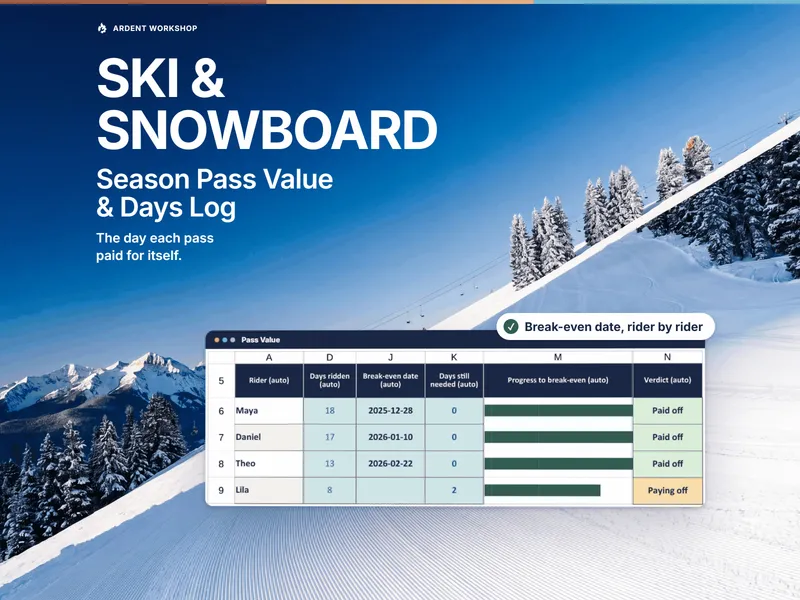
So this post makes the case on both sides honestly. If you have already logged a season, the Ski & Snowboard Season-Pass Value & Days Log finds each rider’s break-even date from the days you actually rode and prices next season’s pass at those days. For a quick single-rider version, the free ski pass break-even checker does the same count with no signup. The math below works either way.
The Ski Pass Day-Count Formula
Break-even days = pass price ÷ the price of one day you would otherwise have bought. Round up, because nobody rides 0.6 of a day.
Three numbers go into it, and each has an honest version and a flattering one:
- The pass price, all in. Include sales and lift taxes and any processing fee. If you are on a payment plan, use the total you will have paid.
- The day you would otherwise have bought. This is the input that moves the answer most, and it gets its own section below.
- The days you will really ride. The formula tells you the target. Whether you will reach it is a separate question, and it is the one people get wrong.
The formula looks forward: it answers “should I buy?” Its backward-looking twin answers “has it paid off yet?” That is season pass break-even: the date the days you have ridden first add up to what you paid. Same arithmetic, different moment.
Which Ticket Price Should You Divide By?
Divide by the price you would actually have paid, not the highest price posted at the window. The window rate tells you what a pass day is worth in the best case. It is the right yardstick only for someone who really would walk up and pay it. Ardent Workshop’s season pass break-even guide, linked above, uses the window rate as its default for days already ridden, and says to swap in the online price if that is what you always pay. Before you buy, start from that second case: the price you would really pay.
If you are organized enough to price a pass in October, you may well not walk up. You might buy ahead, buy a multi-day pack, or ride mid-week. Each choice lowers the comparison price, and every drop in the comparison price raises the number of days the pass needs.
Here is the same illustrative $1,000 pass against three ways of buying the day instead:
| What you would have bought instead | Price per day (illustrative) | Days to break even |
|---|---|---|
| A walk-up window ticket on the day | $250 | 4 |
| A ticket bought ahead online | $180 | 6 |
| A per-day share of a multi-day pack | $130 | 8 |
Same pass, same skier, and the answer doubles from four days to eight depending on an honest answer to one question. That spread is why “a pass pays for itself in four days” and “a pass is never worth it” can both be said with a straight face. They are dividing by different numbers.
The takeaway: pick the row you would really have been in, and be strict about it. If you are not sure, use the cheaper price. A pass that only wins against the window rate only wins for someone who pays the window rate.
How Many Days Will You Actually Ride?
Count the days you rode last season, not the days you plan to ride this one. Plans are made in October on a calendar with no bad weather, no sick kids and no work trips on it. Last season’s count already had all of those taken out.
Weather alone can wipe out a plan. Preliminary figures from the National Ski Areas Association put the 2025-26 U.S. season at an estimated 52.6 million visits (opens in new tab), and the association said challenging weather in the West drove the decline. That was a 14.5 percent drop from 2024-25 (opens in new tab), as Storm Skiing reported. As an illustration, a pass bought for a ten-day winter in a season like that can land at seven or eight days without anyone doing anything wrong.
If you have no history to go on:
- Start from your planned days.
- Remove any day that depends on something you do not control: a trip that needs fresh snow to be worth the drive, a weekend that needs a friend’s car, a holiday that needs the whole family healthy.
- What is left is your realistic count. If it clears the break-even number with a day or two to spare, the pass has room to absorb a bad winter. If it only just clears it, a single canceled trip flips the answer.
This is the same trap that can make prepaid vacation products disappointing. The value depends on usage, and usage is easy to overestimate when you are paying in advance. We walked through that pattern in whether a timeshare is worth it, and a season pass is a smaller, one-year version of the same bet.
Blackout Dates and Day Caps Change the Count
A day the pass does not cover is a ticket day, whatever you planned. Two kinds of restriction quietly take days out of the formula.
Blackout dates. Cheaper pass tiers often exclude the busiest days. For example, the Ikon Base Pass lists blackout dates (opens in new tab) of December 26–30, 2026, January 16–17, 2027 and February 13–14, 2027. If your family’s skiing happens over the holidays and long weekends, those are exactly the days a blackout pass will not cover. Each one has to come out of the pass’s count and go back in as a full-price ticket.
Day caps at partner resorts. Multi-resort passes often limit days at some mountains. The full Ikon Pass (opens in new tab) lists unlimited access at some destinations but “up to 7 days each at select destinations”, and the Base Pass lists up to 5. An eighth day at a capped resort is a ticket day.
So the honest count is not “days I will ski”. It is days I will ski at a resort this pass covers, on a date it covers, within its cap. For a skier whose winter is one home mountain on Saturdays, the two numbers are the same. For a family that travels at the holidays, they can be far apart.
The Case for Buying the Pass
Buy the pass when your realistic day count clears the break-even number with room to spare. The arguments for it are real:
- Every day past break-even is free on the lift. The tenth day of a pass that broke even on day six costs nothing extra, so you ride more, take the short afternoon, and stop when you are tired.
- The pass price is known today. As of October 6, 2026, the full Ikon Pass is listed from $1,449 (opens in new tab) for adults and the Ikon Base Pass from $1,019 (opens in new tab). Pass prices can change during the sales season, so check the current price and any deadline before you divide.
- Age-based prices can cut the break-even sharply. Vail Resorts launched the 2026/27 Epic Pass at $869 for ages 13 to 30 (opens in new tab), and said eligible skiers who bought a lift ticket at one of its North American resorts in 2025/26 could take up to $175 off select passes. A lower pass price against the same ticket price means fewer days to break even. Check your own age band before you assume the adult number applies.
The Case for Day Tickets
Buy tickets when your realistic day count sits below the break-even number, or only just above it. The arguments on this side are just as strong:
- Tickets cost nothing to be wrong about. You pay for the days you ride. A bad snow year, an injury or a new job costs you nothing that you already spent.
- Tickets go anywhere. A pass is only worth the mountains it covers. If you want to try somewhere new each trip, a pass can leave you buying tickets anyway.
- A pass only just over break-even leaves no margin. If the formula says seven days and you expect seven, a single lost weekend makes the pass the more expensive option. Being one day over is not a win. It is a coin flip that you paid for up front.
Which Side Wins at Your Day Count?
Compare your realistic covered days with the break-even number, and decide by the gap between them.
| Your realistic covered days | What the math says |
|---|---|
| Fewer than the break-even number | Day tickets. The pass needs days you are not going to ride. |
| Equal to it, or one or two over | Close call. Lean toward tickets unless you are sure of the days, or the pass’s flexibility is worth something to you. |
| Comfortably over it | The pass. Every day past break-even is one the tickets would have charged for. |
Do this for each rider separately. An adult who rides every weekend, a teenager on an age-discounted pass and a beginner who comes twice a season are three different answers, and one family decision can hide a cheaper mix. For pricing a whole household across pass types, see multi-resort pass vs local pass vs day tickets.
Keep the Count This Season So Next Year Is Easy
The most useful thing you can do with this year’s pass is log every day you ride it. One line per rider per day, with the resort and whether the pass covered it, gives you next October’s realistic day count instead of a guess.
The Ski & Snowboard Season-Pass Value & Days Log is built around exactly that day log. From it, the workbook marks the date each rider’s pass broke even and shows what a day really cost once tickets, gas, lodging and rentals are added. It also prices next season’s options rider by rider at the days and resorts you actually rode. It is one file you own, in Excel or Google Sheets, with no app and no subscription. If you only need one rider’s break-even, start with the free ski pass break-even checker.
Common Questions About Ski Pass Days
Is a ski pass worth it for 5 days?
It is if five days at the ticket you would really buy cost more than the pass. Divide the pass price by that ticket price; if the answer is five or fewer, the pass wins at five days. If it is six or more, five days of tickets is cheaper, unless the days fall somewhere a ticket costs more than you assumed.
Which ticket price should I divide a pass price by?
Use the price you would actually pay. If you always buy ahead online, the online price is your yardstick. The window price only belongs in the formula if you really would walk up and pay it.
Do blackout dates change the break-even?
Yes, a blackout day is a ticket day. Any day you plan to ride during a blackout has to come out of the pass’s day count and go back in as a full-price ticket.