Somebody at dinner says they’ve been to 34 countries. Somebody else says 51. What almost nobody says out loud is that those two numbers were produced by completely different methods — different master lists, different rules about what a visit even is, and wildly different amounts of forgetting. If you want to track the countries you’ve visited, the tracking is the easy half. Deciding what you’re counting is the part that actually determines your number.
The short answer: pick your master list (the 195-country UN-based list is the sane default), write down one rule for what counts as a visit, then backfill in three passes — mark what you’re sure of, sweep photos, passports, email, and statements for what you forgot, and apply your rule to the edge cases in one sitting. Jump to the three-pass backfill.
Here’s what’s underneath a country count, layer by layer — and how to build one you can defend.
Nobody’s country count means the same thing
Three hidden variables sit behind every number a traveler quotes. Change any one and the number moves by ten or more.
How many countries are there to visit?
There is no single answer, which is exactly why two travelers with the same passport stamps report different numbers. The UN has 193 member states (opens in new tab) plus two non-member observer states (opens in new tab) — the Holy See and the State of Palestine — which is where the familiar figure of 195 comes from.
But there are other lists, and serious travelers use them. The Travelers’ Century Club (opens in new tab) — a club you can only join after visiting 100 of its destinations — counts 330 countries and territories as of January 2022, because it treats places like Alaska, Hawaii, Sicily, Easter Island, and Greenland as distinct destinations rather than folding them into the sovereign state that administers them.
| The list | What it counts | What it does to your count |
|---|---|---|
| UN-based (195) | 193 member states + Holy See + Palestine | Your lowest defensible number |
| Territory-based (330) | Sovereign states plus islands, dependencies, and geographically separated regions | Higher — the same trips can split into several entries |
| Your own | Whatever you decide, applied consistently | Whatever your rule produces — only comparable to itself |
None of these is wrong. But a number is only interesting if you know which list produced it, so pick a list once and stay on it. For most people the 195-country list is the right default: it’s the one other people assume you mean.
Does a layover count as visiting a country?
By the strictest common rule, no — if you never cleared immigration, you were in an airport, not a country. But it isn’t the only defensible rule: the Travelers’ Century Club counts even a port of call or a fuel stop, provided you disembarked and set foot in the place. The rule you pick matters far less than writing it down and applying it to every country the same way.
The club’s own criterion (opens in new tab) puts it plainly — the shortest visit suffices, while noting that it “prefers and encourages longer and more meaningful visits.” So choose your own line and then be ruthlessly consistent about it. Three lines are worth choosing between:
- Feet on the ground — you left the airport or the ship. Generous, and easy to verify.
- Cleared immigration — a stamp, an e-gate, a border officer. Stricter, and easy to evidence.
- Slept there — you spent a night. The strictest of the three, and it quietly deletes a lot of day trips.
Whichever you pick, record it in the file itself. A count with a stated rule is a fact. A count without one is a vibe.
The layer nobody accounts for: what you’ve already forgotten
Here’s what most people don’t realize about their own travel history: the record is worse than they think, and it degrades on a schedule. Passports expire and get replaced, and the old one usually ends up in a drawer, a box, or the trash. Crossing between countries inside a travel zone often produces no stamp at all — in the Schengen area, checks at internal borders have been abolished (opens in new tab) — and automated e-gates can skip the ink entirely. And the trips you took as a kid — the ones a parent booked and you barely remember — are almost never in anyone’s count.

Your passport is evidence. It is not the record. Which is why the fix isn’t a better memory — it’s a backfill.
How to track every country you’ve visited: the three-pass backfill
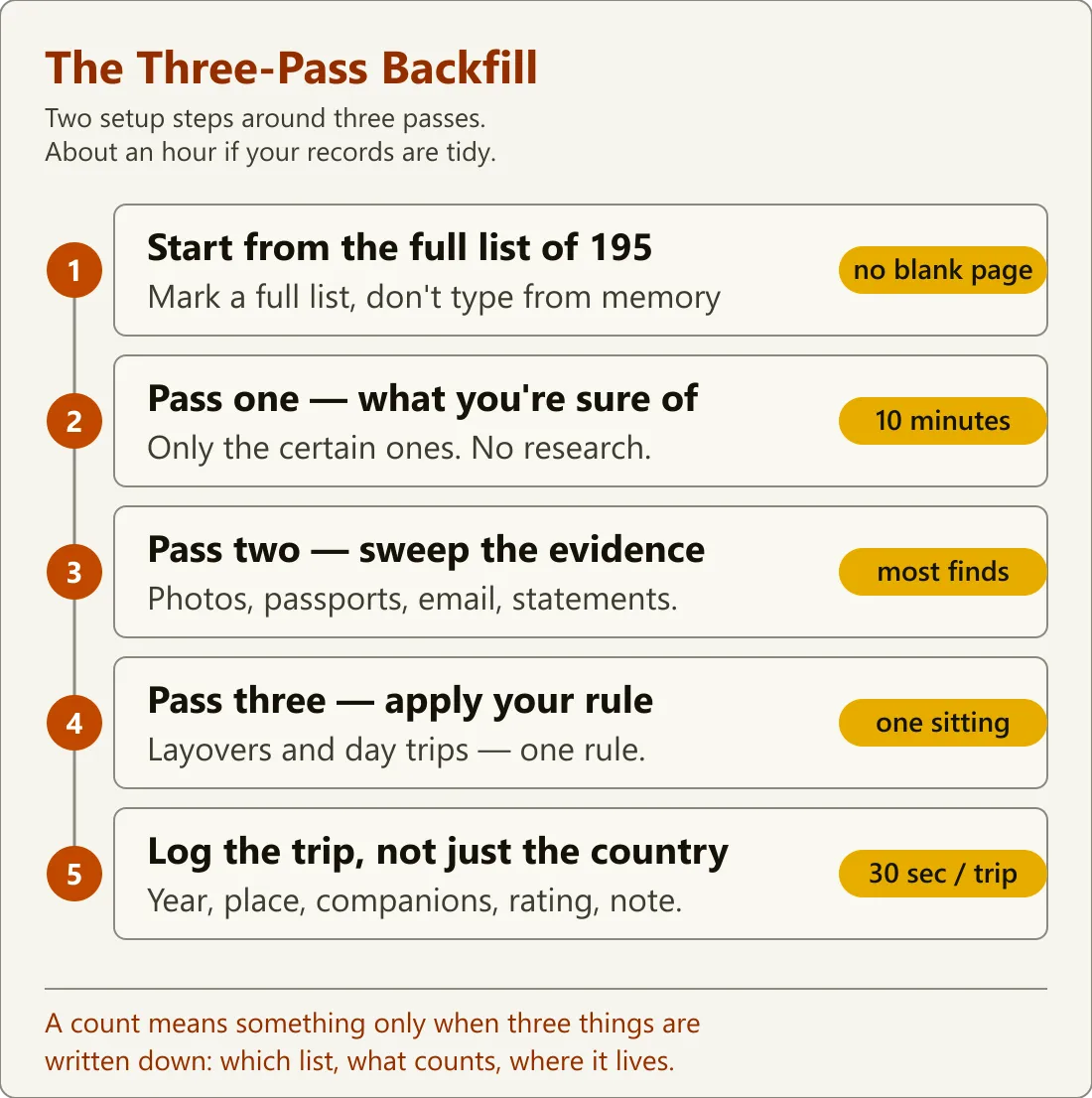
This is the whole method: two setup steps bracket the three passes — where you start, and what you record. Budget about an hour if your records are tidy; pass two is as deep as you want to go. After that it’s maintenance forever.
1. Start from a full list, not a blank page
This is the single biggest mistake. Don’t open an empty spreadsheet and start typing country names from memory — you will only ever write down the countries you already remember, which is precisely the number you were trying to improve on. Start from a complete list of all 195 and mark the ones you’ve been to. Recognition beats recall, every time.
Where do you get the list? The free route is to copy the names off the UN’s alphabetical list of member states (opens in new tab) and add the two observer states — that works, it’s just tedious: 195 names, correctly spelled, then sorted into continents and regions yourself, with the disputed ones resolved. The shortcut is a file that already has it: the Travel Bucket-List & Countries-Visited Tracker ships with all 195 pre-sorted by continent and region, so the work you do is marking statuses, not typing geography.
2. Pass one — mark the obvious ones
Go down the list and mark everything you’re certain of without thinking hard. Ten minutes, no research, no phone. This is the count you’d have given at dinner anyway — you’re just making it visible so the gaps have somewhere to show up.
3. Pass two — sweep the evidence
Now go find the trips you forgot. Four sources, in order of how much they turn up:
- Your photo library, searched by year. Most phones let you scroll a timeline or filter by place. Ten years of photos will usually surface at least one trip you’d stopped counting.
- Old passports. Dig out the expired ones. Stamps are dated, which also fixes the “was that 2014 or 2015?” problem.
- Your email, searched for
booking,itinerary, andconfirmation. Airline and hotel confirmations sit in your inbox essentially forever. - Old card statements and points activity. Foreign transactions and award redemptions are a travel diary nobody thinks to read. If your trips run on miles, your loyalty accounts are the cleanest date-stamped record you own.
Every trip you took left a paper trail somewhere. This is usually the pass that turns up trips you’d forgotten. And once you’ve mined your loyalty accounts for past trips, a Travel Points & Miles Rewards Tracker keeps the balances, expiration dates, and award goals those redemptions draw on in one file.
4. Pass three — apply your rule to the edge cases
Now the arguments. Work through the layovers, the cruise ports, the border towns, the ninety-minute walk across a bridge into a neighboring country, and mark them all with the rule you chose above. Do them in one sitting so you apply the same standard to all of them — deciding case by case, months apart, is how counts get soft. Then leave a note in the file saying what your rule is, because in three years you will not remember.
5. Log the trip, not just the country
A checkmark tells you whether. It doesn’t tell you when, with whom, or whether it was any good — and that’s the part memory actually loses first. For each trip, capture:
- Year (and month, if you know it)
- Destination and country
- Who you went with
- A rating out of 5
- One line on the highlight — the meal, the hike, the wrong turn
Five fields, thirty seconds per trip. In a decade it’s the most valuable file you own, and it’s the same discipline behind how to catalog a collection you’ve been building for years: capture the small structured facts while you still have them, because reconstructing them later is the expensive part.
What a count gives you that a list doesn’t
Once the data is structured rather than remembered, it starts answering questions a list never could:
- Percentage of the world. 34 of 195 is 17%. That reframes “I travel a lot” into something specific.
- Continent coverage. Six of seven continents reached, but only 4 of 54 African countries — that’s not a trivia stat, that’s a decision. Coverage gaps are the most honest source of “where next” you’ll ever get, and they beat scrolling a destination list. If the choice is a family negotiation rather than a solo one, that’s a separate problem with a separate method — see how to choose a vacation destination everyone agrees on, or run the shortlist through the Vacation Decision Helper.
- A year in review. “What did 2025 actually look like?” is a question you can only answer if trips are dated.
- A bucket list with a status, not just a wish. Dreaming → Booked → Done is a ladder. A list of dream destinations with no status is a daydream that never converts.
Own it, don’t rent it
There’s a real temptation to hand this to an app: install something, tap the countries, get a colored map. It works — until an app changes its pricing, drops the feature, or shuts down. Your travel history was never really yours; it was hosted.
A travel record is a decades-long document. It should outlive any particular app, phone, or subscription. A single file you own — one that opens in Excel, Google Sheets, or LibreOffice — will still open in ten years, with no account and no monthly fee. That’s the whole argument for a workbook over a rented app: same structure, and nobody can turn it off.
It’s also private by default. A file you keep is never published anywhere — and wherever you store it, whether that’s a synced folder or Google Sheets, leave sharing off, because it holds other people’s names and dates as well as your own.
If you’d rather not build the 195-country list yourself, the Travel Bucket-List & Countries-Visited Tracker ships pre-loaded with all of them, plus a trips log and a bucket list. Want to try the idea first? The free places-I’ve-been starter is a one-tab version where you log places yourself instead of marking a pre-built list. And if travel isn’t the only thing you keep track of, the rest of the Trackers line catalogs the other things you love the same way.
The takeaway: your country count is only meaningful when three things are written down — which list you’re counting against, what you call a visit, and where the record lives. Fix those once, backfill in a single sitting, and from then on you’re adding a row after each trip instead of re-deriving your entire travel history from memory every time somebody asks.