The three margins, in plain English
Most "what's your margin?" conversations conflate three different numbers. They live on different lines of a P&L and answer different questions.
- Gross margin = (Revenue − COGS) ÷ Revenue. What's left after the direct cost of making the thing you sold. The number that tells you the underlying product is viable.
- Operating margin = (Revenue − COGS − Operating expenses) ÷ Revenue. What's left after running the business — rent, software, marketing, platform fees, the accountant. The number that tells you the business itself is viable.
- Net margin = (Revenue − all expenses including taxes and interest) ÷ Revenue. What you actually keep. The number on your tax return.
A boutique can have a 70% gross margin and a -5% net margin. The product is profitable; the rent isn't. Without all three numbers, you can't say where the leak is.
Worked example: a $40 candle
Same candle, same price, three margins:
- Revenue: $40
- Wax, fragrance, wick, jar, label: $8
- Packaging (box, tissue, shipping label): $3
- Direct labor (20 minutes at $25/hour): $8.33
- COGS total: $19.33
- Gross profit: $40 − $19.33 = $20.67
- Gross margin: 51.7%
Then operating expenses come out:
- Etsy listing + transaction + processing fees (~10%): $4
- Marketing allocation (Etsy Ads + Instagram boosts): $3
- Software / studio rent / utilities (allocated): $2
- Operating profit: $20.67 − $9 = $11.67
- Operating margin: 29.2%
And finally taxes (say 25% self-employment + income):
- Tax: $11.67 × 25% = $2.92
- Net profit: $11.67 − $2.92 = $8.75
- Net margin: 21.9%
The same candle has a 52% margin, a 29% margin, and a 22% margin — all three are true, depending on which question you're answering.
Margin vs. markup — they are not the same number
The single most common confusion in small-business pricing:
- Markup = Profit ÷ Cost. A $4 cost sold for $10 has a 150% markup.
- Margin = Profit ÷ Price. Same product has a 60% margin.
Big enough difference that pricing rules built on one and reported as the other consistently leave money on the table — or charge customers in ways that produce less profit than the seller thinks.
Healthy margin ranges (rough)
Targets vary wildly by category, but as starting points for small-product businesses:
- Gross margin. 50–70% is a working target for handmade. Below 40% is hard to operate; below 30% is usually unsustainable.
- Operating margin. 15–25% is reasonable once the shop is established. Below 10% and there's no buffer for a slow month.
- Net margin. 10–20% in the long run, often less during growth. Lower than that and the business is fragile.
These aren't industry averages — they're rules of thumb. Compare against your own history first; a shop with a 35% gross margin that used to be 25% is in better shape than a shop with 50% that used to be 60%.
How to actually improve margin
- Raise prices on the products with the highest demand and thinnest margin. A 10% price increase on items that sell regardless is pure margin.
- Lower COGS without lowering quality. Bulk buying, packaging consolidation, recipe efficiency.
- Drop the worst items. Two or three products in most shops account for a disproportionate share of revenue. The tail is taking your time without paying for it.
- Renegotiate or replace the most expensive operating lines. Software, ad spend, shipping providers. Annual review.
- Reduce labor per unit. Batch production, template decoration, jigs. Same finished product, less labor cost in COGS.
Common mistakes
- Confusing markup with margin. Covered above. Costs people serious money.
- Leaving labor out of COGS. Gross margin looks great until you remember your time isn't free.
- Reporting gross margin as "our margin." Gross is the easy number. Operating and net are the honest ones.
- Pricing on cost alone. A 2× markup on a $4 cost gives an $8 price — even if the market will happily pay $20. Cost-plus is a floor, not a ceiling.
- Not segmenting by product. Average margin across a catalog hides the unprofitable items. Calculate per-SKU.
- Forgetting taxes. Self-employment tax alone is ~15%. Your "profit" before tax overstates take-home by a meaningful amount.
Related templates and concepts
Profit margin depends on COGS (the denominator's other input), and for food sellers specifically the starting point is recipe costing. See the templates for Etsy sellers and templates for home bakers hubs for the full pricing toolset.
Templates that implement this
Templates that calculate profit margin
6 templates
Pricing tools, P&L spreadsheets, recipe calculators — all linked so margin updates the moment a cost does.
- $5.95 Spreadsheet

Etsy Pricing Tool - Excel & Google Sheets
The price to charge worked back from what a product costs you to make, Etsy's real fees applied to every listing, and a target blended from what your competitors actually charge.
Operator OSView details - $10.95 Spreadsheet

Etsy Financial Tool - Excel & Google Sheets
Paste your Etsy monthly statement and read the year: revenue, fees, expenses, and what the month actually left you, totaled month by month.
Operator OSView details - $7.95 Excel
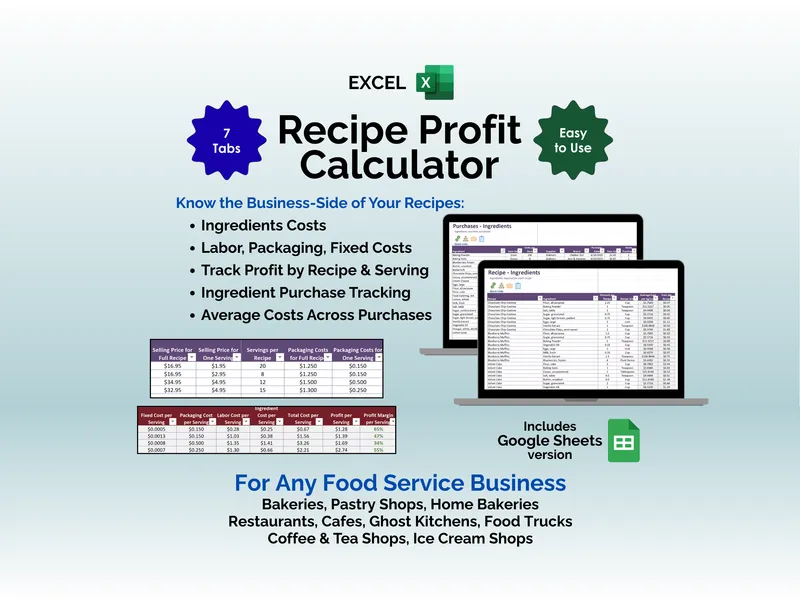
Recipe Profit Calculator - Excel
Pricing cakes by gut feel and hoping it covers cost? This excel recipe profit calculator turns ingredients, yield, and labor into a real margin per recipe and per serving.
Operator OSView details - $7.95 Sheets
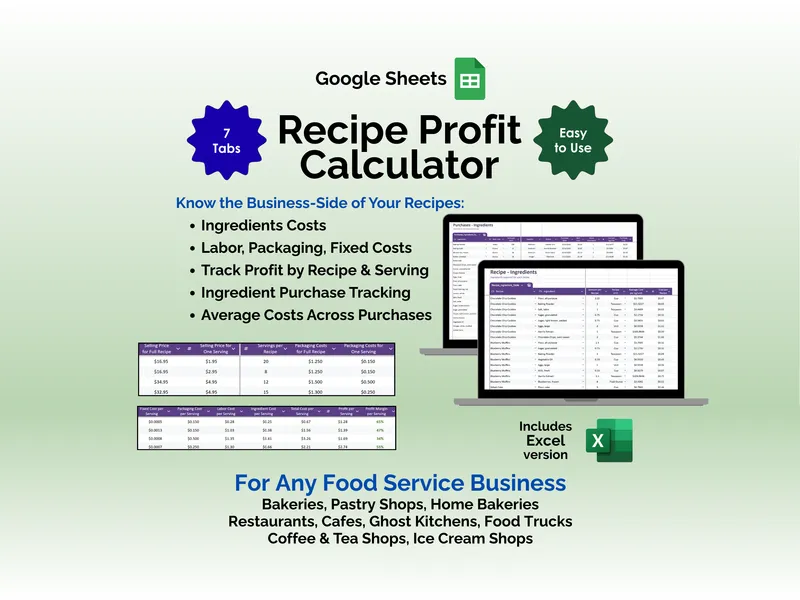
Recipe Profit Calculator - Google Sheets
Food businesses guess at pricing because the costing math is annoying. This google sheets recipe profit calculator returns per-recipe and per-serving margins automatically, with unit conversions and purchase averaging.
Operator OSView details - $29.95 Excel
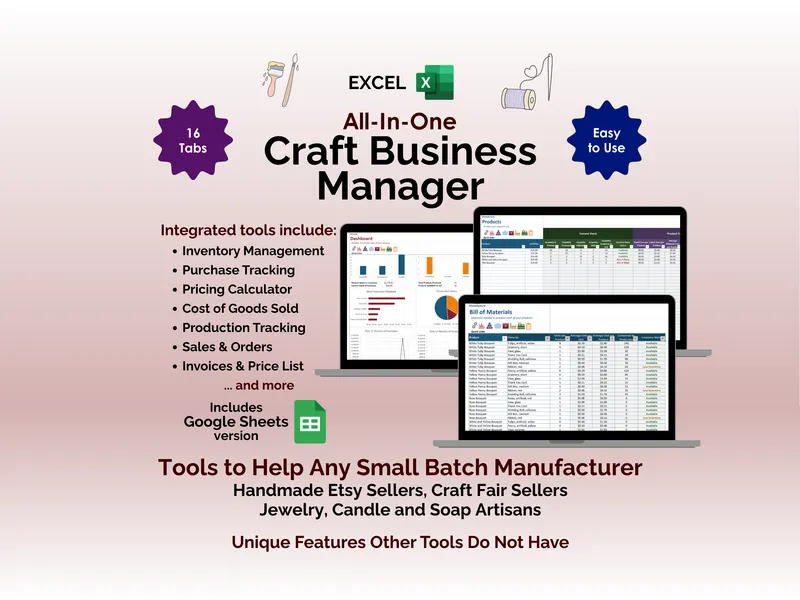
Craft Business Manager - Excel
Craft Business Manager is a 16-tab workbook for handmade sellers, connecting materials, product costs, production batches, sales, and invoices. Excel and Google Sheets versions are included.
Operator OSView details - $29.95 Excel
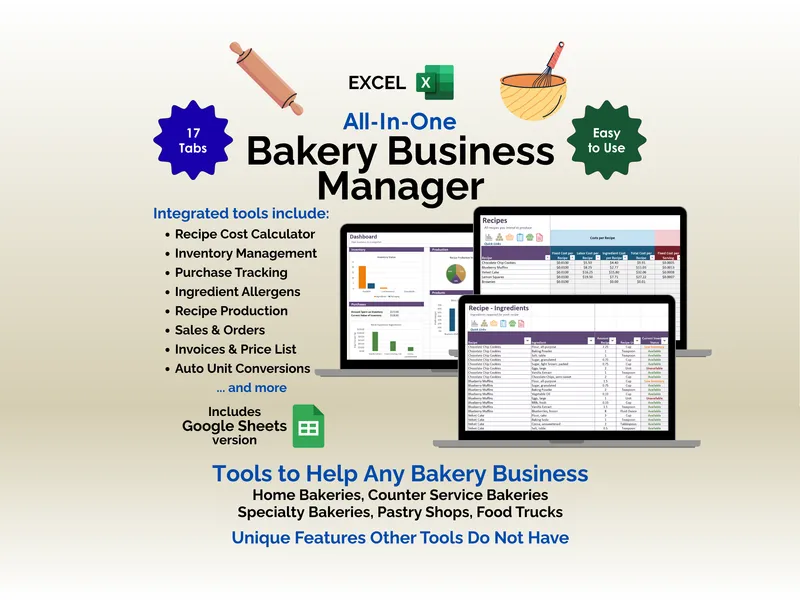
Bakery Business Manager - Excel
Bakery Business Manager is a 17-sheet workbook for home bakers and small bakeries, connecting ingredient inventory, recipe costing, sales, invoices, and profit. Excel and Google Sheets versions are included.
Operator OSView details