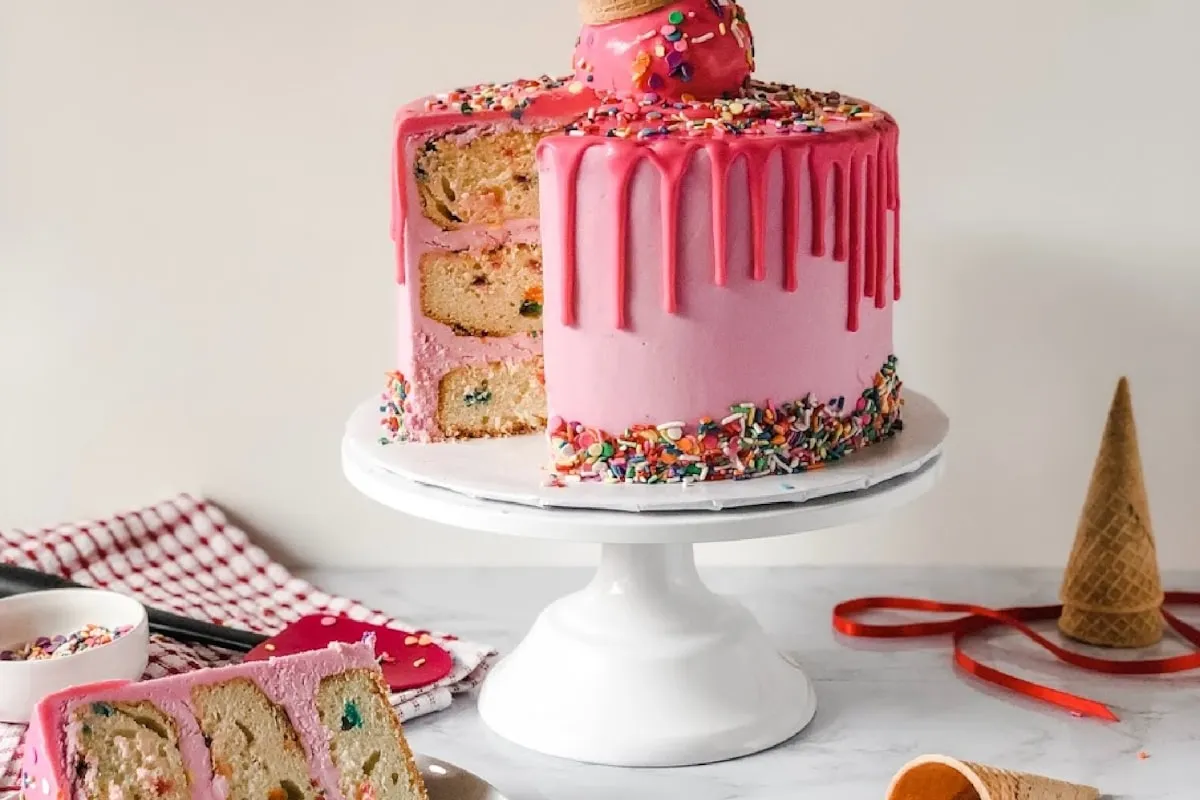
You spent an hour decorating. The photo was perfect, the order came in from three states away, and you shipped it Monday feeling good about your little operation. Then, a week later: a one-star review with a photo of a brown box, a smear of melted chocolate, and the words “arrived as a puddle.”
Here’s the hard truth about shipping baked goods in summer heat: the truck always wins. A delivery trailer, a metal mailbox baking on a porch, a sorting facility with no air conditioning — none of it is climate controlled, and all of it runs hotter than the air temperature outside. You can’t out-decorate physics. What you can do is decide, on purpose, what you ship in July and what you don’t.
The short version: in summer, dry and shelf-stable bakes — most drop cookies, biscotti, shortbread, unfrosted brownies — survive non-refrigerated shipping with good packing. Chocolate-coated, frosted, cream-filled, and anything that needs refrigeration does not reliably survive, and trying to ship it anyway is what generates the refunds and bad reviews.
This isn’t a “give up on shipping” post. Plenty of baked goods travel beautifully in summer. But the sellers who get through the hot months without a wall of melted-box reviews all do the same thing: they match the product to the season, pack for the worst-case truck, and stop shipping the handful of items that were never going to make it. Let’s get specific.
Why Summer Heat Breaks Baked Goods in Transit
Two different problems are happening inside that box, and they have different stakes.
Problem one: things melt. Cocoa butter — the fat that gives chocolate its snap — melts at roughly 93°F (opens in new tab), and a solid bar of dark chocolate softens into a mess by 113–120°F. Butter starts to soften well before 90°F. Those numbers matter because a closed mailbox or the back of a delivery truck can run far hotter than the air outside — easily past the point where chocolate liquefies, buttercream slumps, and royal icing goes tacky and bleeds color. Your package doesn’t experience “the high was 88° today.” It experiences the inside of a hot metal box.
Problem two: things spoil. This one is more serious than a cosmetic melt. The USDA calls 40°F to 140°F the “Danger Zone” (opens in new tab) — the range where bacteria multiply fastest, doubling in number in as little as 20 minutes. Perishable food shouldn’t sit in that zone for more than two hours, and the FDA notes that once it’s above 90°F, that window shrinks to one hour (opens in new tab). Standard ground shipping takes days. So anything that genuinely needs refrigeration — cream cheese frosting, custard, fresh dairy, cheesecake — is in the danger zone the entire trip. That’s not a quality issue; it’s a food-safety issue.
A quick vocabulary check, because it determines everything below:
- Shelf-stable means the item is safe at room temperature — low moisture, no perishable fillings. These are your summer shipping workhorses.
- Perishable (or “TCS” — time/temperature control for safety) means it needs refrigeration to stay safe. These should not go in a non-refrigerated box, full stop.
The melt problem is about your brand. The spoilage problem is about someone’s health. Treat them differently.
What Survives the Truck and What Melts
Here’s the honest breakdown. “Risky” means it can be done with serious packing and cool-weather luck, but you’re gambling — and in a heat wave, you’ll lose.
| Baked good | Ship in summer heat? | Why | If you must |
|---|---|---|---|
| Drop cookies, snickerdoodles, oatmeal | Yes | Low moisture, sturdy, no melt-prone coating | Standard packing |
| Biscotti, shortbread, gingersnaps | Yes | Dry and durable — the best summer shippers | Standard packing |
| Unfrosted brownies, blondies, bar cookies | Yes, with care | Stable, but can soften and stick | Wrap individually, cushion well |
| Quick breads, banana bread, pound cake | Yes, with care | Shelf-stable; can get crumbly | Wrap tightly, ship fast |
| Chocolate-chip / chocolate-dipped cookies | Risky | Chips and coatings melt and bloom | Insulated liner + ice pack, expedited |
| Royal-icing decorated cookies | Risky | Icing softens, colors bleed, details smear | Cool weather only, rigid box |
| Macarons | Risky | Shells soften; fillings can be perishable | Insulated, expedited, non-dairy filling |
| Caramels, fudge, candy | Risky | Melt and “sweat” in humidity | Insulated + ice pack |
| Buttercream-frosted anything | No | Frosting slumps and melts | Don’t ship — local only |
| Cream- or custard-filled, cheesecake | No | Perishable — sits in the danger zone | Don’t ship — local only |
| Cream-cheese-frosted cakes/cookies | No | Perishable and melts | Don’t ship — local only |
| Anything with fresh fruit filling | No | Spoils; promotes mold | Don’t ship — local only |
If you sell a lot from the “No” rows, that doesn’t mean your business is broken. It means those items want a different fulfillment method in summer — which we’ll get to.
The Hidden Cost of Shipping Something That Melts
It’s tempting to ship the risky item anyway. The customer wants it, you don’t want to say no, and maybe it’ll be fine. Here’s why “maybe” is a bad bet — because a melt doesn’t cost you one sale, it costs you several.
Let’s work through an illustrative example. Say you ship a $35 order of chocolate-dipped cookies, with $12 in shipping you absorbed to stay competitive. It melts in transit. Now look at what that one box actually costs you:
- The refund or remake. You eat the $35 — either as a cash refund or as a second batch of ingredients and labor you give away free.
- Shipping, twice. The original $12 is gone, and a replacement is another $12 (which had better travel in an insulated box this time).
- The review. This is the expensive one. A single photo of a melted box on your shop page quietly lowers the conversion rate on every visitor who sees it for months. You can’t put a clean number on it, but it’s the biggest cost on this list.
- The time. The apology message, the troubleshooting, the “let me make this right” — that’s unpaid customer-service labor pulled away from baking.
A $35 sale that melts can easily turn into a $60-plus loss once you count the remake, double shipping, and your time — and that’s before the review does its slow damage. Shipping the wrong thing in July isn’t a small gamble with a small downside. It’s a small upside against a large, lingering cost.
This is also where summer quietly eats your margins even when nothing melts: insulated liners, gel packs, and faster service all cost money. If you’re not rebuilding those costs into your prices for the season, you’re absorbing them. A tool like the Recipe Profit Calculator makes it easy to add a “summer packaging” line to your cost-per-order so your prices reflect what it actually takes to ship safely — the same margin trap we dug into in why summer baking quietly kills your margins.
How to Pack Baked Goods to Survive Summer Heat
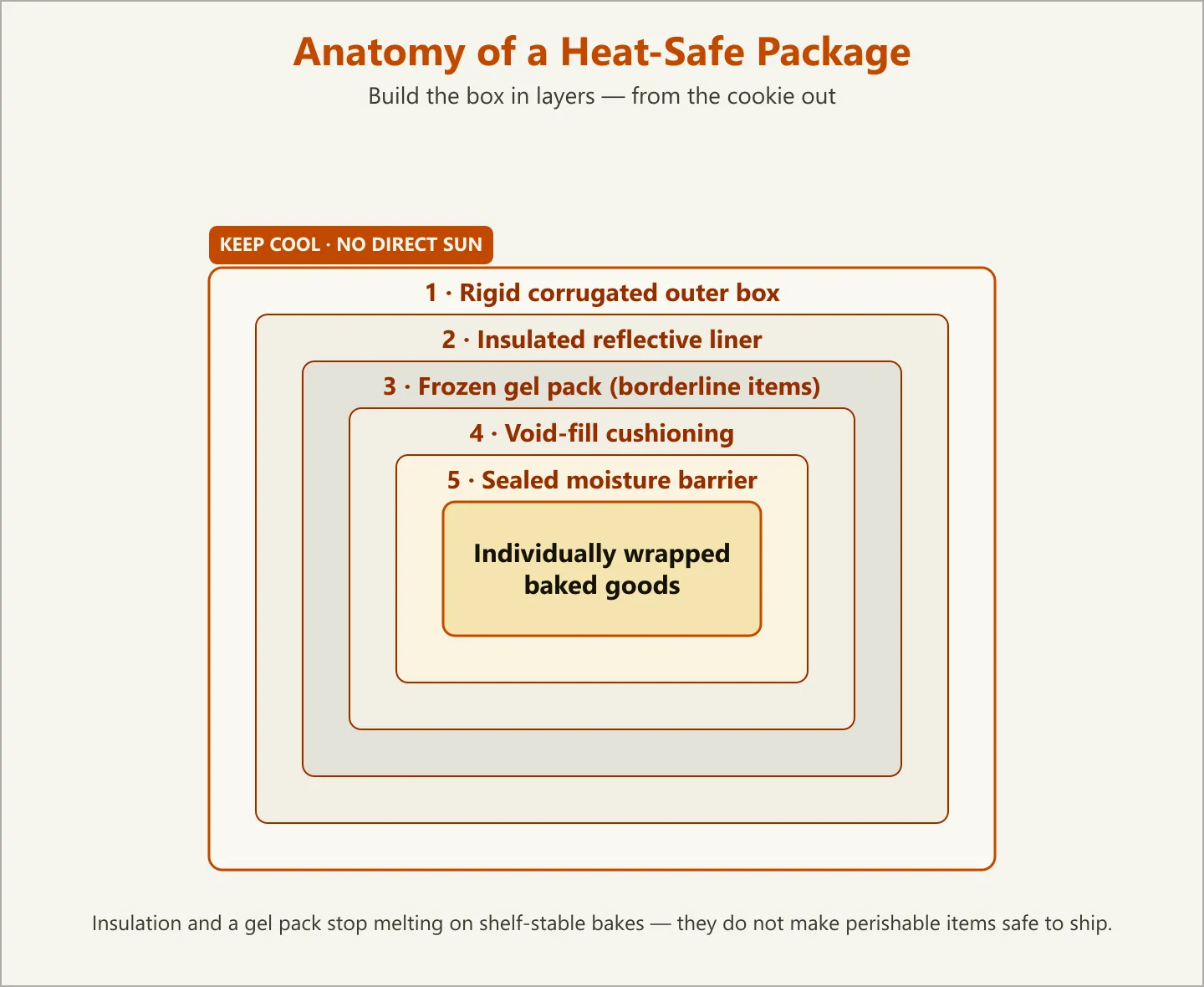
For everything in the “Yes” and “Risky” rows, packing is what separates an intact arrival from a refund. Build the box in layers, from the cookie out.
- Choose the right product first. The best packing in the world can’t save buttercream. Start by shipping only what’s on the green list — packing is the second line of defense, not the first.
- Cool completely, then wrap individually. Warm baked goods create condensation, and condensation makes everything soggy and moldy. Let items reach room temperature, then seal each one (or each pair) in its own bag. Individual wrapping also stops cookies from sanding each other to crumbs in transit.
- Add an insulated liner and a gel pack for borderline items. For anything in the “Risky” rows, line the box with a reflective insulated liner and add a frozen gel pack (not loose ice — it leaks). This buys hours, not days, so it only works paired with fast shipping. It does not make a perishable item safe to ship; it only protects a shelf-stable item from cosmetic melting.
- Use a rigid box and fill every gap. Baked goods break from movement, not just heat. Pack snugly in a sturdy corrugated box with cushioning (paper, not loose foam peanuts, which shift) so nothing rattles. A crushed-but-cool cookie is still a refund.
- Label the outside. Mark the box “Perishable — Keep Cool, Do Not Leave in Sun.” Carriers won’t guarantee it, but a label nudges the handler who can keep it off the hot dashboard.
- Include a storage card. A small insert telling the customer to refrigerate or freeze on arrival closes the last gap — the hot mailbox after delivery. Packaging inserts like the Care Cards & Packaging Inserts set turn that into a branded touch instead of a sticky note.
Here’s how those layers stack up inside the box:
Two more decisions sit outside the box itself:
- Ship early in the week, fast. Mail a perishable box on a Monday or Tuesday so it never sits in a weekend sorting limbo. Pay for the fastest service the order can bear — every extra day in transit is another day in the heat.
- Watch the destination forecast, not yours. It might be 72°F where you bake and 99°F where it’s landing. Check the arrival city’s forecast, and if it’s brutal, message the customer and offer to hold the order a few days.
When to Just Stop Shipping It
This is the part most sellers resist, so here it is plainly: the most profitable move in summer is often to stop shipping your most fragile items entirely, on purpose, for a defined season. Saying “we pause shipped buttercream cakes June through September” isn’t a failure. It’s a policy — and a policy you decide in advance always beats a melt you discover in a review.
The own-it move is to build a simple seasonal shipping plan you keep and reuse every year, instead of re-deciding under pressure with every order. A few ways to keep selling the “No” items without shipping them:
- Offer local pickup or delivery for perishable and frost-heavy items. Keep the shipping menu to the shelf-stable list.
- Set expectations on the listing. A one-line note — “Chocolate and frosted items ship October–May; available for local pickup year-round” — stops the problem order before it’s placed.
- Build a summer menu. Lean into what ships well. Biscotti, shortbread, and crunchy cookie boxes are practically built for July, and you can market them as a “heat-proof” collection.
- Have your responses ready. When something does go wrong, a fast, gracious reply limits the damage. A Customer Service Response Library gives you pre-written, on-brand replies for melted-arrival messages so you’re not writing apologies from scratch at 11 p.m.
One more thing worth knowing before you ship anything across state lines: if you operate under a cottage food law, you may not be allowed to. University of Nebraska Extension notes (opens in new tab) that “almost all states do not allow sales across state lines,” because each state’s cottage food law only covers homemade food sold to its own residents — and the only way to sell interstate, including online, is usually to go commercial. The heat question is moot if the shipment isn’t legal in the first place. Check your own state’s rules before you list a product for nationwide shipping.
Your Summer Shipping Policy, in One Checklist
Decide these six things once, write them down, and reuse them every summer:
- Summer menu — which products ship June–September, and which pause to local-only
- Packing standard — wrap, liner, gel pack, rigid box, fill, label (every order, no exceptions)
- Carrier and service — the fastest option you’ll commit to for perishable-adjacent boxes
- Cutoff days — ship early in the week; no Thursday/Friday perishable sends
- Listing disclaimer — the exact sentence on each at-risk product about seasonal shipping
- Refund and reship policy — what you’ll do when a box melts, decided before it happens
Keeping all of this — your menu, your packing costs, your seasonal rules — in one connected workbook instead of your head is exactly what a Bakery Business Manager is built for, and it’s the same discipline that separates bakers who actually price for profit from the ones who find out in September that summer cost them money.
And when your shipping, inventory, and orders outgrow a spreadsheet, Ardent Seller (opens in new tab) is the next step — the same system, built to scale.
Summer doesn’t have to be the season your reviews tank. It just has to be the season you ship on purpose: the right products, packed for the hottest truck on the route, with the fragile stuff kept close to home until the weather turns. Decide it once, and you’ll spend July baking instead of writing apologies.