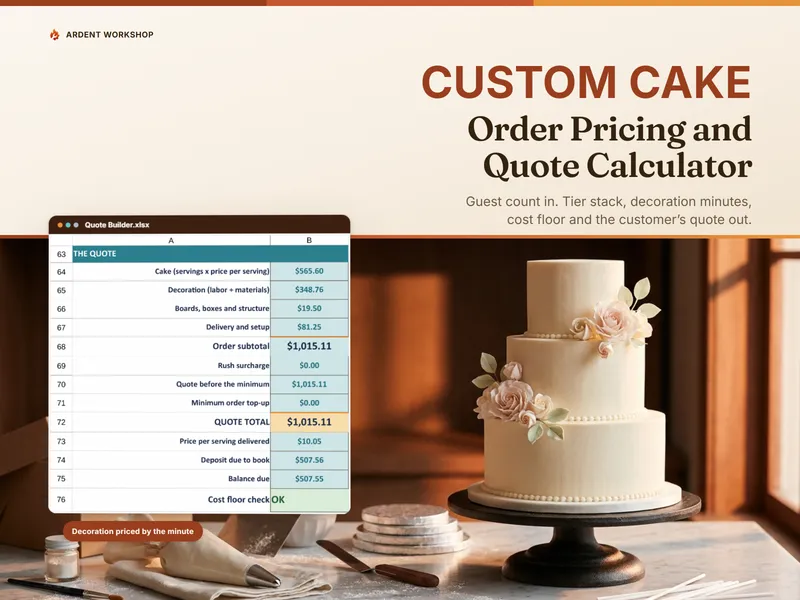
Pricing a custom cake order is a sequence, not a single formula: each step takes the number the step before it produced, and the quote is what falls out of the end. This tutorial walks that whole workflow — from the moment a message lands to the moment you mark the order won or lost — on a worked 100-guest order. It runs the same way for a wedding cake, a birthday order, or anything in between; the inquiry doesn’t know what kind of cake it’s about to become. (If what you want is the underlying pricing formula — a per-serving base, a complexity adjustment, add-ons, delivery, a consultation fee — that is Wedding Cake Pricing for Home Bakers, and this workflow is the other half of it.)
You can run every step below with nothing but a notebook. The free Cake Servings Chart does step 2 for you on its own — no email, no signup. The paid Custom Cake Order Pricing & Quote Calculator runs all nine steps in one connected file.
Step 1 — Log the inquiry
Before any pricing happens, write down what was actually asked for: the guest count, the portion style (a party slice and a wedding slice aren’t the same size, so this decision changes everything downstream), the flavor and filling, and whatever design details came up, in the customer’s own words rather than your summary of them. Nothing gets priced from memory a week later. This is the row that starts the inquiry’s life in your records, and it’s the row you’ll come back to whether the order books or not.
Step 2 — Turn the guest count into a tier stack
A guest count only becomes a cake once it’s resolved to a tier stack, and that resolution should come from real geometry, not a guess. Each tier size has a serving count computed from its top area divided by a slice size, round, square, and sheet alike — and a stack of tiers sums its own servings back out of that table.
Run 100 guests on wedding portions and the resolver returns a 6-inch + 9-inch + 12-inch three-tier stack — 101 servings delivered, one spare. Stacks are written smallest tier first, so read that top to bottom: a 6-inch tier on top, a 9-inch in the middle, a 12-inch on the bottom. That’s one recommendation out of a library of standard stacks sized from a full table of cake sizes, so an unusual guest count still resolves to a checkable answer instead of a shrug.
Step 3 — Price the per-serving base
The tier stack gives you the servings; the flavor gives you the price. Multiply the 101 servings the stack delivers by your price per serving for the flavor and filling the customer chose, and you have the price per serving base — the floor of the quote before a single decoration is added. This number alone is not the quote. It’s the cake with nothing on it yet.
If you don’t have a per-serving rate yet, don’t guess one: it comes out of what a plain, undecorated cake actually costs you to make and what margin you need on top — which is the same arithmetic step 7 runs in reverse. Wedding Cake Pricing for Home Bakers walks through setting that base rate.
Step 4 — Price the decoration by the minute
This is the step where a single “complexity multiplier” runs out of resolution: one number scaled off the base cake can’t separate a smooth buttercream finish from a tier covered in hand-piped lace and sugar flowers, and those two cakes take wildly different amounts of time. Pricing the decoration by the minute is the finer-grained version of the same idea. Each design choice becomes its own line, pulled from a library of design elements — fondant covers, buttercream finishes, piping styles, sugar and isomalt work, metallic accents, figures — each carrying its own preset labor minutes and its own material cost. Add the elements the design actually needs, up to ten lines on one quote, and each one shows its own labor, its own materials, and its own line total — so if a customer asks what the sugar flowers are adding to the price, you can point at the line instead of guessing.
Step 5 — Add the structure and the supplies
A stacked cake needs more than cake and icing to survive being a stacked cake: boards, internal dowels, boxes sized to the tiers, and whatever else the order calls for. These are real, itemizable costs pulled from a dedicated supplies list — worth their own lines rather than folding into a single “materials” figure, where they are easy to under-price. Add the lines the order needs and they carry their own cost into the total, the same way the decoration lines do.
Step 6 — Add delivery, setup, and rush
Delivery is a separate service with its own risk, not a courtesy folded into the cake price. Price the drive at your per-mile rate beyond the miles you absorb for free, add an on-site setup fee if you’re stacking or assembling at the venue, and add a rush surcharge if the turnaround is short — all at rates you set once, so a far venue or a next-week request doesn’t quietly cost you margin you never priced for.
Step 7 — Check it against your cost floor
A quote can look reasonable and still lose money, so before it goes anywhere, cost the same order from the other direction: ingredients and decoration materials, every production minute paid at your hourly rate, overhead charged on those hours, and the admin time the inquiry itself took whether or not it books.
On the 100-guest order, that comes to a cost floor of $744.55 against a quote of $1,015.11 — $10.05 per serving delivered — a 26.65% margin against a 25% target, so the verdict reads OK. Quote the same order too low and the same check would read BELOW FLOOR, or THIN if it clears the floor but misses your target margin — with the price that would hit that target shown right alongside it, so you’re never guessing how much to raise it.
| Quote at a glance | Value |
|---|---|
| Guest count (wedding portions) | 100 |
| Tier stack (top to bottom) | 6-inch + 9-inch + 12-inch (3 tiers) |
| Servings delivered | 101 (1 spare) |
| Quote total | $1,015.11 |
| Price per serving delivered | $10.05 |
| Cost floor | $744.55 |
| Margin vs. 25% target | 26.65% — OK |
Step 8 — Set the deposit and the balance
A quote isn’t booked until a deposit is paid, and every customer should be quoted the same terms — the same percentage, the same lead time on the balance. On the $1,015.11 order, that split comes to a $507.56 deposit due to book and a $507.55 balance due before delivery.
Step 9 — Send the quote, then log what happens
The customer-facing quote should read like a document, not a text message: the tier stack and what it serves, the flavor and finish, every design element listed by name so nothing is assumed, the total, the deposit due to book, and the balance and the date it falls due.
Then, whatever happens next, log it — won, lost, or still pending — against the cost floor and margin you already calculated for that inquiry. One quote tells you nothing about your prices. A season of logged quotes, tracked across the price bands your orders actually fall into, tells you where you’re booking and where you’re losing orders, and whether the ones you’re losing are walking away from a fair price or a genuinely underpriced one.
Try it on your own order
Want to see this whole sequence run on a guest count of your own? The free Cake Servings Chart gives you the tier-stack half — party and wedding servings for every standard size — no signup. The paid Custom Cake Order Pricing & Quote Calculator runs the whole sequence above in one connected file: the servings resolver, the decoration library priced by the minute, the cost floor check, a printable customer quote, and a log across every inquiry you record.
For the underlying pricing formula — including the complexity multiplier that step 4 above refines into per-minute decoration pricing — see Wedding Cake Pricing for Home Bakers. For the same “true cost, priced honestly” method applied to a different kind of handmade product, see how to price handmade products. And once an inquiry turns into a booked order, the free Home Baker’s Order & Delivery Tracker (opens in new tab) on Ardent Seller picks up from there — one row per order, working backwards from the delivery date.