Somewhere today a customer is looking at an invoice that reads Service call — $129.00, doing some quick arithmetic, and deciding they went into the wrong line of work.
An hour. One hundred and twenty-nine dollars. That’s north of a quarter of a million a year, they’re thinking, if you just worked a normal week.
Here’s what most people never see. Run the numbers on an illustrative one-truck shop — one tech, one van — and that $129 leaves about nineteen dollars of actual profit. Not nineteen dollars for every hour of the working day, either: nineteen dollars for each hour that actually gets billed, and only five of every eight paid hours do.
To price a service call, you divide everything the business has to pay for in a year by the hours you can actually sell, then divide that by one minus the margin you want. On the illustrative numbers below, that turns a $32.00-an-hour technician into a $129.21 billable hour — and it is the same arithmetic whether you end up quoting hourly or flat-rate.
That gap between what the customer sees and what the shop keeps is where service businesses quietly die. So let’s pull the invoice apart layer by layer, and then rebuild it into a number you can defend on the doorstep.
The number the customer sees is not the number you keep
The price on a service call is not payment for the hour a technician spent under a sink. It is payment for every hour it took to get that hour to happen — the drive, the stocking, the phone call, the dead time when a customer wasn’t home — plus a share of everything that had to exist before the truck could roll at all.
Plenty of shops price as if none of that is real. They ask what the company down the road charges, shave ten percent off it because they’re newer, and then spend three years wondering why a full schedule doesn’t turn into a bank balance.
The way out is not confidence. It’s arithmetic. Every number below is illustrative — one tech, one truck, a small shop — but the structure is the same whether you’re a solo electrician or running four vans.
A billable hour is not a paid hour
A billable hour is an hour a customer is charged for. A paid hour is any hour you write a check for. The whole pricing problem lives in the distance between those two, and underpriced shops usually got there by confusing them.
Take one ordinary week and split the paid hours into billable and not:
| Where the 40 paid hours go | Hours |
|---|---|
| On site, hands on the work — billable | 25 |
| Driving between calls | 8 |
| Parts runs, stocking the truck, the supply house | 3 |
| Invoicing, quoting, callbacks, scheduling | 2 |
| No-shows, dead time, waiting on a customer | 2 |
| Total paid hours | 40 |
Twenty-five billable hours out of forty paid. That ratio has a name — your utilization rate — and 62.5% is the number every per-hour figure below is built on. If your own split lands lower, every one of those per-hour figures gets bigger, not smaller — the annual costs don’t move, but there are fewer hours to spread them over.
Now annualize it. The technician is paid for 2,080 hours a year. Four of those weeks are holidays and sick days, so they actually work about 1,920 hours. And of those, only 1,200 hours get billed.
That is the denominator. Every cost below gets divided by 1,200 — not by 2,080, and not by 1,920. Dividing by the wrong number is the easiest way to end up badly under-priced: in this example, dividing by the 1,920 hours worked puts the rate about 38% too low, and dividing by all 2,080 paid hours puts it about 42% too low.
Layer 1: What an hour of labor actually costs you
You pay a technician $32.00 an hour. That is not what an hour of that technician costs you.
On top of the wage sits the payroll burden: the employer’s half of Social Security and Medicare, which the IRS puts at 6.2% and 1.45% respectively for the employer (opens in new tab) — 7.65% before anything else — plus unemployment insurance, workers’ compensation (brutal in the trades), any health or retirement contribution, and the paid time off you’re funding.
How big is that in total? The Bureau of Labor Statistics measures it directly. In the March 2026 Employer Costs for Employee Compensation release (opens in new tab) (USDL-26-0827, published 12 June 2026 — that link serves whichever edition is current), employers in the construction industry paid an average of $51.23 per hour worked, of which $35.54 was wages and $15.69 was benefits. That’s roughly 44 cents of benefits on top of every wage dollar.
Apply it:
- Wage: $32.00/hour
- Plus ~44% burden: $46.08/hour
- Hours actually worked: 1,920
- Annual cost of that technician: $88,474
Divide by 1,200 billable hours and a $32.00 technician costs you $73.73 per billable hour — before the truck has burned a drop of fuel.
This is also why the employee-or-contractor decision for a small shop changes your pricing model and not just your paperwork: a subcontractor’s day rate carries no burden, but it carries no idle time you control either.
Layer 2: The truck bills you whether or not you bill it
The van is not a fixed asset that sits quietly on a balance sheet. It is a consumable that runs down every mile, and its cost belongs in the hourly rate.
You can build this up from payments, insurance, tires, brakes, fuel and depreciation, and eventually you should. But there’s a faster method that is defensible on day one: multiply your business miles by the IRS standard mileage rate, which the IRS sets from an annual study of the fixed and variable costs of operating an automobile (IRS Notice 2026-10, PDF (opens in new tab)). For 2026 that rate is $0.76 per mile from July 1 onward (opens in new tab), raised mid-year from $0.725. We are borrowing it here as a costing shortcut, not making a deduction claim — what you can actually deduct is a separate question for your accountant. And treat it as a floor rather than a ceiling: the IRS sets a single rate for all business miles, whether you drive a sedan or a loaded van, so as soon as you can build the number up from your own payments, insurance, fuel and tires, do — a heavy, tool-loaded van may well come out above it.
- 22,000 business miles × $0.76, using the current rate rather than a blended 2026 average: $16,720/year
- Tools, blades, bits, sealant, fittings and truck stock you never itemize: $3,600/year
- Total: $20,320/year, or $16.93 per billable hour
Note what just happened. The eight hours a week your technician spends driving are non-billable and they generate most of this cost. Drive time bills you twice.
Layer 3: The shop runs on hours nobody pays for
Overhead is every cost that exists whether or not anyone books a job this week. It doesn’t stop when the phone stops.
| Overhead item | Per year |
|---|---|
| Phone, scheduling software, email, dispatch | $2,400 |
| General liability insurance | $1,800 |
| Licensing, bonding, continuing education | $1,200 |
| Bookkeeping and tax preparation | $2,400 |
| Marketing, website, listings, review management | $3,600 |
| Shop or yard rent, utilities, storage | $9,600 |
| Card processing and bank fees | $2,000 |
| Total | $23,000 |
Divided by 1,200 billable hours: $19.17 per hour.
Notice what is deliberately not on that list — your own time. If you’re answering the phone, writing quotes and chasing invoices in the evening, that labor is currently free, which means your rate is being propped up by unpaid work you can’t scale. The moment you hire someone to do it, this row grows and your rate has to grow with it. Better to know that now than to discover it at the point you can’t take another call.
Layer 4: Profit is a cost, not what’s left over
One of the most expensive beliefs in the trades is that profit is whatever survives the month.
Profit is the line item that pays for the next truck, absorbs the January when nobody’s boiler breaks, funds the warranty callback you eat without arguing, and eventually buys you a week off. Treat it as a leftover and it will behave like one.
So build it in, and build it in correctly — because this is an easy place to lose the thread. To end up with a 15% net margin you divide by 0.85; you do not add 15%.
- Break-even rate ÷ 0.85 → a genuine 15% margin
- Break-even rate × 1.15 → a 13.0% margin
On our numbers that mistake is $2.91 an hour, every hour, forever. It’s the same confusion that makes people mark parts up 30% and wonder why the margin came out at 23%. (Markup and margin are different animals; a 30% margin needs a 42.9% markup.)
What a $129 service call is actually made of
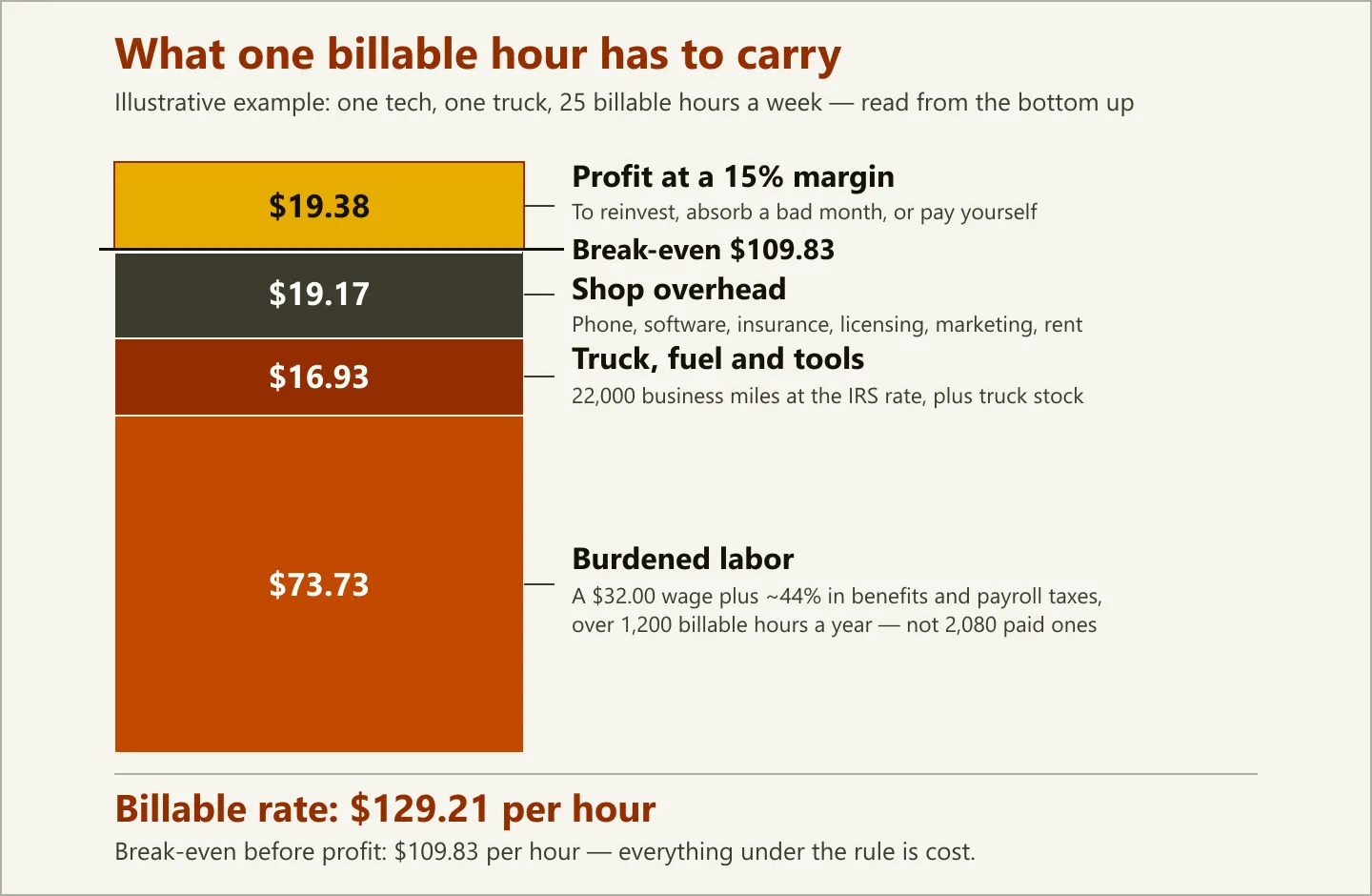
Here is the same build-up as a table, per year and per billable hour:
| Layer | Per year | Per billable hour |
|---|---|---|
| Burdened labor | $88,474 | $73.73 |
| Truck, fuel and tools | $20,320 | $16.93 |
| Shop overhead | $23,000 | $19.17 |
| Break-even | $131,794 | $109.83 |
| Profit at a 15% margin | $23,258 | $19.38 |
| Billable rate | $155,052 | $129.21 |
A $32.00-an-hour technician has to bill $129.21 an hour for the business to clear 15%. That is a 4× multiple on the wage, and it is not greed — it’s the arithmetic of paying someone for 2,080 hours and being able to sell 1,200 of them.
Round $129.21 down to a clean $129.00 and you have quietly handed back 21 cents an hour — about $250 a year — which is why a price book should round up to the clean number, never down. The $129 this post keeps quoting is the invoice we opened with; $130 is what your own price book should carry.
If the number feels high, run your own version before you argue with it. If your current rate came from what the shop down the road charges, expect it to land somewhere unrelated to your own break-even, in whichever direction their costs happen to differ from yours — which is the problem, rather than the direction.
How to build your own billable rate for a service call
Set aside about an hour with last year’s numbers in front of you — a payroll summary, a profit-and-loss, and your mileage. Five steps.
-
Count your real billable hours. Take one ordinary week and split the paid hours into billable and not. Drive time, parts runs, truck stocking, invoicing, callbacks, waiting on a customer who isn’t home — none of it is billable, and all of it is paid. Multiply the billable figure by your working weeks. This is your denominator for everything that follows.
-
Burden the wage. Take the hourly wage you actually pay and add the employer’s share of Social Security and Medicare, unemployment insurance, workers’ compensation, any health or retirement contribution, and paid time off. If you can’t itemize it yet, the construction-industry benchmark of roughly 44% is a defensible starting point until your accountant gives you the real figure.
-
Add the truck. The simplest defensible method is to multiply your business miles by the IRS standard mileage rate, then add the tools and truck stock you never bill separately. It is the same rate whatever you drive, from a sedan to a loaded van, so treat the result as a floor.
-
Add the shop. List every cost that exists whether or not anyone books a job this week, total it for the year, and divide by the same billable-hour count. Include the software you forgot you subscribe to.
-
Set the margin, then convert to a service-call price. Divide your break-even rate by one minus the margin you want. Adding a percentage on top is not the same thing and will quietly leave you short.
Every one of those steps is a small spreadsheet, and they all feed each other — change the billable-hours number in step one and all four layers move. That interlock is exactly what the Flat-Rate Pricing Book for Service Trades is built to hold: a Billable Rate tab that turns a wage into a defensible hourly figure, a Markup and Margin calculator that stops the 15%-versus-÷0.85 mistake, and a price book that pushes the result into every task at once rather than leaving you to re-derive it per quote.
Turning an hourly rate into a service-call price
An hourly rate is the engine. The price a customer actually sees is the bodywork, and you have three decisions to make.
Set a minimum charge. A 20-minute repair still consumed a drive, a diagnostic, and a slot in the day that nobody else could book. In this model, one billable hour is the floor: $129.21, or a clean $130 once you round up. Without a minimum charge, the jobs that feel easiest are the ones most likely to lose money.
Charge a diagnostic or trip fee, and credit it toward the work. This makes the drive visible instead of buried, and it filters the calls that were never going to convert.
Then decide hourly or flat-rate. Flat-rate pricing means you price the task, not the clock: a garbage disposal swap carries one price, whether it takes your best tech 40 minutes or your apprentice 80. Build each task from its book hours at your billable rate plus parts at your markup, and the customer approves a number before you start. It kills the invoice argument, it rewards you for getting faster, and it makes a newer technician’s slower pace your problem to solve rather than the customer’s to fund.
Whichever you pick, the rate underneath is the same $129.21. Flat-rate isn’t a different pricing philosophy — it’s a different presentation of the same hour.
Three ways this number gets destroyed after you set it
You can do all of the above and still end up back where you started. Watch for these.
-
The friendly discount. At a 15% margin, knocking 10% off the price does not cost you 10% of the profit — it costs you two thirds of it. $129.21 drops to $116.29 against a $109.83 cost, leaving $6.46 instead of $19.38. To make the same money you would need to sell three times the hours. Discounting is expensive marketing — and it is free to hand out, which is why it gets handed out.
-
“I was in the area anyway.” You weren’t. In the week we split up top, drive time is the biggest non-billable block — eight hours against three, two and two — and it is the main driver of vehicle cost. Route density is a real lever — clustering calls geographically genuinely raises your billable hours per paid hour — but it is a scheduling fix, not a reason to give the trip away.
-
The quick job you didn’t write up. A no-charge favor for a good customer is a legitimate business decision. A no-charge favor you never recorded is a hole in your data, and next year’s rate gets built on numbers that quietly understate how many hours the work really consumed.
Underpricing is rarely a single decision. It’s the compound effect of a hundred small ones, each individually defensible — which is exactly what goes wrong when people price handmade goods too, in a completely different trade with an identical mechanism.
Common questions about pricing a service call
What is a fair service call fee?
A fair service call fee is one that covers the drive, the diagnostic time, and a real share of your overhead before any repair is authorized. A technician who spends 30 minutes driving and 30 minutes diagnosing has already consumed a full paid hour before a single part is touched — which is why the worked example above sets its minimum charge at one full billable hour — $129.21, rounded up to $130 in the price book — rather than billing the half-hour that was technically on site. Local rates vary enormously, but “what the shop down the road charges” tells you about their cost structure, not yours.
Should I charge a diagnostic fee or fold it into the repair?
Charge it separately and credit it toward the repair if the customer proceeds. Folding it in means the jobs that don’t convert are free, and a shop that quotes free diagnostics is paying for every tire-kicker out of the margin on the customers who do say yes.
How do I raise my rate without losing customers?
Change the menu, not the number. A rate rise announced as a rate rise invites a negotiation; a rebuilt price book with a stated minimum charge, a diagnostic fee, and clean per-task prices is simply what your pricing is now. Roll it out to new customers first, hold your existing schedule at the old rate for a defined window, and expect to lose the customers who were only ever buying on price — they are, in practice, the least profitable ones you have.
Should I price a service call flat-rate or hourly?
Flat-rate tends to be easier on the customer’s confidence and on your slow days, because the price is agreed before the work starts and a technician who takes 90 minutes on a 60-minute task doesn’t turn the invoice into an argument. It only works if the flat rate was built from a real billable hourly rate in the first place. A price book copied from a competitor is just their cost structure with your name on it.
The takeaway: pricing a service call is a division problem
Your billable rate is not a market opinion. It is the answer to a division problem: everything the business has to pay for in a year, divided by the hours you can actually sell, plus the margin you decided to earn on purpose.
A few more places to take this, depending on the shape of your work:
- Pricing plumbing, electrical, HVAC or appliance work? The Flat-Rate Pricing Book for Service Trades is the one that holds the five steps above and pushes the result into a task menu.
- Project-shaped rather than call-shaped? The Contractor and Trades Estimating Workbook carries the same logic into bid markup and change orders.
- Routing several techs a day? The Cleaning and Service-Business Job and Route Manager is built around cost-per-hour and route density together.
- Wondering when software takes over? It’s worth understanding the trade-offs of a spreadsheet versus field service software before you sign up for a per-tech monthly fee.
Run the five steps once and you’ll never again quote by feel. Run them every January and the rate keeps up with the truck, the wage and the insurance renewal — which is the whole point, because those three go up whether or not your price does.
So: block out an hour this week, pull last year’s payroll summary, profit-and-loss and mileage, and start at step one. The number you come out with is the one you get to defend on the doorstep.