Recurring revenue for a craft business comes from selling the same buyers something on a schedule: a subscription box, a series of virtual workshops or a paid membership. If you sell handmade crafts, artisan products or DIY kits, online or at craft fairs, you are already good at creating delight. Craft-as-a-Service turns that delight into recurring revenue: a steady rhythm of income from subscribers who come back every month, instead of a scramble for the next one-off sale.
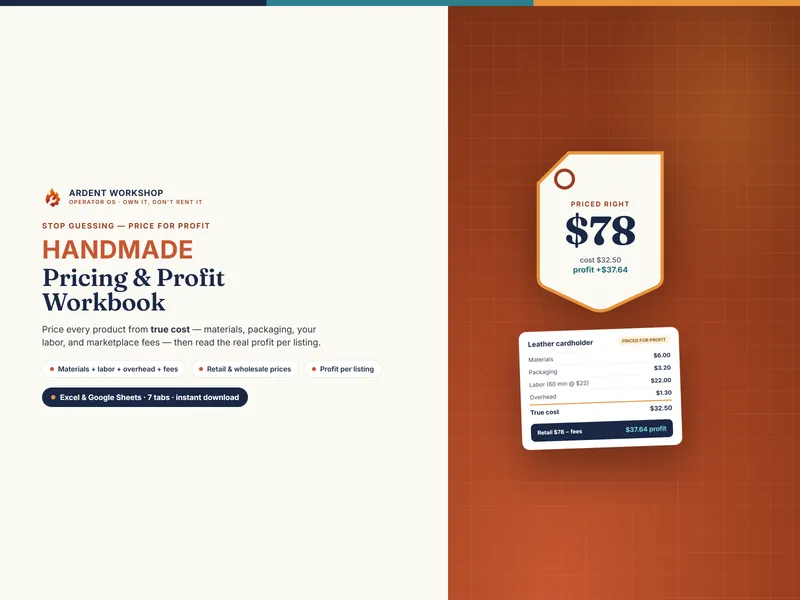
The idea is simple. The usual trap is the price. A box priced the way you would price a single item forgets the packing time, the inserts, the shipping and the payment fees, and each of those is paid again every month for every subscriber. Work the per-box number out before you announce anything. The Handmade-Seller Pricing & Profit Workbook builds a price from true cost (materials, labor, overhead and fees) and shows the real profit on each unit, which is exactly the figure a subscription tier rests on. The worked example below shows the math either way.
What is the Craft-as-a-Service business model?
Craft-as-a-Service is a craft business model that replaces one-time purchases with ongoing craft experiences sold as a subscription or membership. Instead of selling a single candle, kit or pattern, you offer a monthly “Scent Club,” a “Kit of the Month,” or a membership that bundles virtual craft workshops, exclusive designs and a community.
Common formats:
- Subscription boxes for crafters: monthly craft kits, yarn clubs, bead boxes, fabric fat-quarter clubs, candle scent boxes.
- Virtual craft workshops and online classes: live video workshops, pre-recorded tutorials, project challenges, Q&A sessions.
- Digital memberships: pattern libraries, SVG cut files, embroidery designs, Procreate brushes, laser-cut files, monthly project plans.
- Hybrid memberships: a quarterly craft box plus monthly online classes and a private community.
These models keep your brand in front of buyers between purchases and turn casual customers into regulars who expect each delivery or class.
Why recurring revenue matters for a handmade business
Recurring revenue matters because it makes next month’s income knowable. A shop that lives on one-off sales starts every month at zero; a shop with 100 subscribers starts every month with 100 orders already placed.
- Predictable income: monthly recurring revenue softens seasonal dips and lets you plan cash flow, supply orders and your own hours.
- Higher customer lifetime value: a subscriber who stays a year is worth twelve orders, not one, and you only paid to find them once.
- A real community: subscriber groups, online classes and member challenges create connection, customer photos and word-of-mouth.
- Smoother operations: a fixed member count means you know exactly how many kits to source, assemble and ship, so you can batch the work.
- Discoverability: searches like “craft subscription box,” “DIY kit subscription,” “virtual craft workshop” and “monthly craft club” are the queries people type when they are shopping for exactly this.
The math behind a craft subscription box
A craft subscription box is profitable when its per-box margin, multiplied by how long the average subscriber stays, is larger than what it costs you to win that subscriber. Three terms carry that sentence:
- Monthly recurring revenue (MRR) is the subscription income you can expect every month: price × active subscribers.
- Churn is the share of subscribers who cancel in a given month. If 10 of 100 cancel, monthly churn is 10%.
- Customer lifetime value (LTV) is the profit one subscriber brings in before they leave. With a steady churn rate, the average subscriber stays about 1 divided by the monthly churn rate, counted in months (10% churn means about 10 months), so LTV is roughly the per-box margin divided by churn.
Here is how it plays out with illustrative numbers for a candle scent club priced at $32 a month with shipping included:
| Cost per box | Amount |
|---|---|
| Materials (wax, fragrance, wicks, jars) | $7.50 |
| Packaging and printed inserts | $2.50 |
| Pick-and-pack labor (15 minutes at $20/hour) | $5.00 |
| Shipping | $6.50 |
| Payment and platform fees (6% of $32) | $1.92 |
| Total cost | $23.42 |
| Margin per box | $8.58 (26.8%) |
At 100 subscribers, that is $3,200 of MRR and $858 of monthly gross profit. Now look at churn:
| Monthly churn | Average subscriber lifetime | Lifetime value (margin × lifetime) | New subscribers needed each month to hold 100 |
|---|---|---|---|
| 10% | 10 months | $85.80 | 10 |
| 5% | 20 months | $171.60 | 5 |
The takeaway: halving churn doubles what every subscriber is worth and halves the marketing you need just to stand still. That is why the retention work later in this post matters as much as the launch. Notice too how thin the margin is: leave the 15 minutes of packing out of the price and the real margin falls from $8.58 to $3.58 a box, because that $5 of labor is still being paid, just by you. The how to price handmade goods guide walks through that unpriced-labor habit in detail.
Craft-as-a-Service ideas you can launch
The safest Craft-as-a-Service offer is one built on something you already make well. Pick from the format closest to your current work:
-
Product-based subscriptions
- Yarn of the Month with color inspiration cards
- Candle Scent Club with seasonal fragrances
- Bead or jewelry findings box with a project tutorial
- Watercolor paper and palette mini-sets with technique drills
- Kids’ craft kits with STEM or seasonal themes
- Eco-friendly craft supplies (recycled paper, plant-based dyes)
-
Digital memberships
- SVG and laser-cut file library for cutting-machine and laser owners
- Monthly embroidery or cross-stitch patterns with stitch guides
- Printable planner inserts and digital planner templates for crafters
- Quilt block of the month with cutting diagrams
- Polymer clay cane designs with video walkthroughs
-
Virtual craft workshops
- Live video classes with replays and supply lists
- Skill tracks (beginner to advanced) with certificates or badges
- “Finish-It Friday” accountability sessions to clear unfinished projects
-
Hybrid models
- Quarterly deluxe box plus monthly mini digital drops
- Core membership plus paid add-on kits or specialty masterclasses
How to start a craft subscription, step by step
Moving to a recurring model does not mean reinventing your business. It means packaging what you already make as something buyers can expect on a schedule.
-
Validate your niche
- Survey past buyers: what would they want monthly (theme, price, difficulty)?
- Run a limited founders’ cohort of 25 to 50 subscribers at a special rate.
- Soft-launch with a 3-month pilot instead of an annual commitment.
-
Choose your model and cadence
- Monthly boxes for consumables (wax melts, beads, paper goods).
- Quarterly boxes for higher-value handmade items.
- Monthly digital drops for patterns and SVGs; live workshops once or twice a month.
-
Write a value proposition worth renewing for
- What makes the subscription better than buying the same things one at a time? Themes, exclusivity, member discounts, early access, community and support.
- Map the member journey: onboarding email, unboxing checklist, tutorial access, community welcome and next month’s teaser.
-
Price for profit and retention
- Price each tier from its full per-box cost, as in the worked example above: materials, packaging, pick-and-pack time, shipping, fees and an allowance for churn.
- Offer tiers (digital only, box only, all-access with workshops).
- Anchor with annual plans and a founders’ discount.
-
Set up the tech
- Before you advertise a subscription on a marketplace, read its rules: check whether it supports recurring billing, and whether it allows sending buyers to an outside site. If either answer is no, a prepaid multi-month bundle (a 3-month kit) is one workaround.
- For true recurring billing, use your own storefront with a subscription app, or a membership platform such as Patreon. Course platforms like Kajabi or Teachable suit classes; Gumroad or MemberSpace suit digital libraries.
- Community: a private Facebook Group, Discord server or Circle space for discussions and challenges.
- Email: a tool such as Klaviyo, MailerLite or Kit for onboarding, renewal reminders and win-back messages. If writing those emails is the part you dread, the Maker’s Email Template Library has ready-to-edit launch, review-request and customer-service emails written for handmade sellers.
-
Design your operations
- Set a monthly cut-off date, charge date and ship window.
- Batch tasks: sourcing, kitting, printing, packing, label runs, replay uploads.
- Make a few spare kits each month for replacements and late joiners.
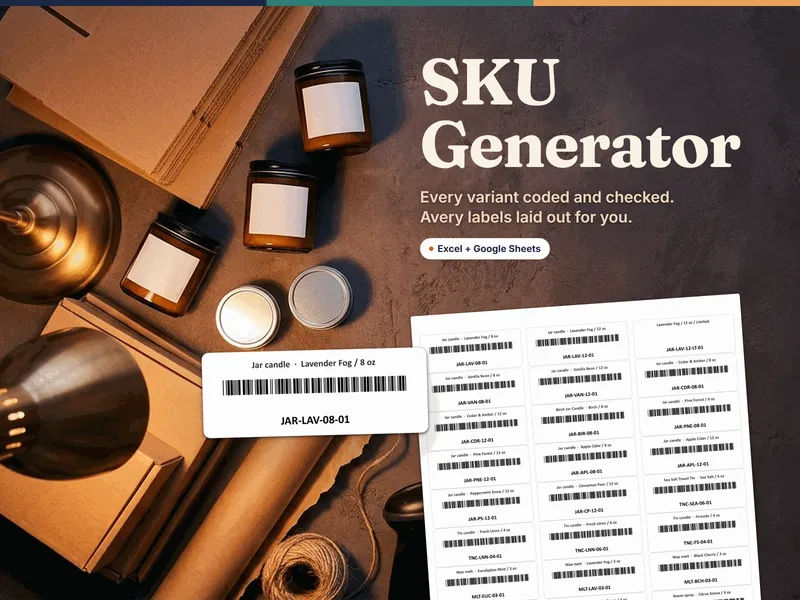
- Standardize SKUs and inserts so every month’s box ships the same way. A consistent SKU scheme is what keeps a subscription from turning into chaos by month four; the SKU Generator (Excel) or the SKU Generator (Google Sheets) builds a SKU for every variant from your own codes.
-
Market for acquisition and retention
- Search: publish content around “best craft subscription box,” “monthly DIY kit,” “virtual craft workshop for beginners” and “SVG membership.”
- Social: unboxing reels, behind-the-scenes kitting, member spotlights, before-and-after project posts, hashtag challenges.
- Lead magnets: a free mini pattern or SVG, a sample tutorial, a “30-day craft calendar.”
- Offers: a founders’ launch, gift subscriptions, refer-a-friend credits, an annual plan bonus.
- Retention: monthly theme reveals, progress posts, badges and “use your stash” prompts. A regular member newsletter does a lot of this work; the Maker’s Newsletter Year gives you 52 to start from.
-
Bring your craft fair audience with you
- At your booth: QR codes to join, sample mini kits, subscriber-only perks, “first box half-price” cards.
- Collect emails with a giveaway box and send a welcome sequence after the event.
- Offer local pickup pricing or a members-only in-person workshop.
Common craft subscription mistakes to avoid
Craft subscriptions tend to stumble on a handful of predictable problems:
- Too much complexity too soon: start with one tier and one reliable cadence before adding variants.
- Underpricing: include every per-box cost, especially packing time and shipping materials (see the math section above).
- Weak onboarding: send a clear start-here guide, a supply list and a 7-day check-in.
- No teaser loop: preview next month to reduce cancellations and encourage upgrades.
- Content sprawl: keep one searchable hub for replays, patterns and FAQs.
Quick launch checklist
- Define your core theme and promise in one sentence.
- Choose cadence and price, and plan 90 days of boxes or content.
- Build a founders’ offer and waitlist page.
- Set up subscription tech and your private community.
- Write onboarding emails, a shipping schedule and renewal reminders.
- Prepare photo and video assets: unboxing, tutorial snippets, member stories.
- Run a 3-month pilot, gather feedback, adjust, then scale.
Common questions about craft subscriptions
Is a craft subscription box profitable?
It can be, but only if each box is priced from its full cost, including packing time, inserts, shipping and payment fees, and only if subscribers stay long enough to repay what it cost to win them.
How many subscribers do I need to start?
Fewer than you think. A founders’ cohort of 25 to 50 subscribers is enough to test your theme, your cadence and your packing workflow before you commit to scale.
Should I start with physical boxes or a digital membership?
Start with whichever format you already make well. Digital memberships have almost no per-member cost but need a steady content pipeline; physical boxes carry real per-box costs but are easier to explain and gift.
Track a craft subscription’s costs in one workbook
A subscription adds a second layer of planning on top of the shop you already run: the same materials, the same production and the same costs, now committed a month ahead. Ardent Workshop’s Craft Business Manager connects materials, product costs, production batches, sales and invoices in one workbook, so each box’s cost sits in one place with the materials and production batches it draws on.
And when your business outgrows a spreadsheet, Ardent Seller (opens in new tab) is the next step.