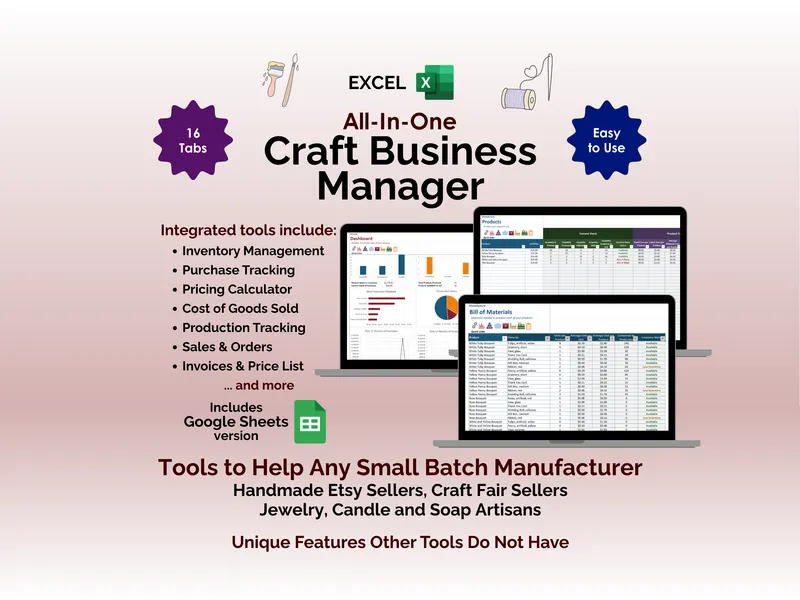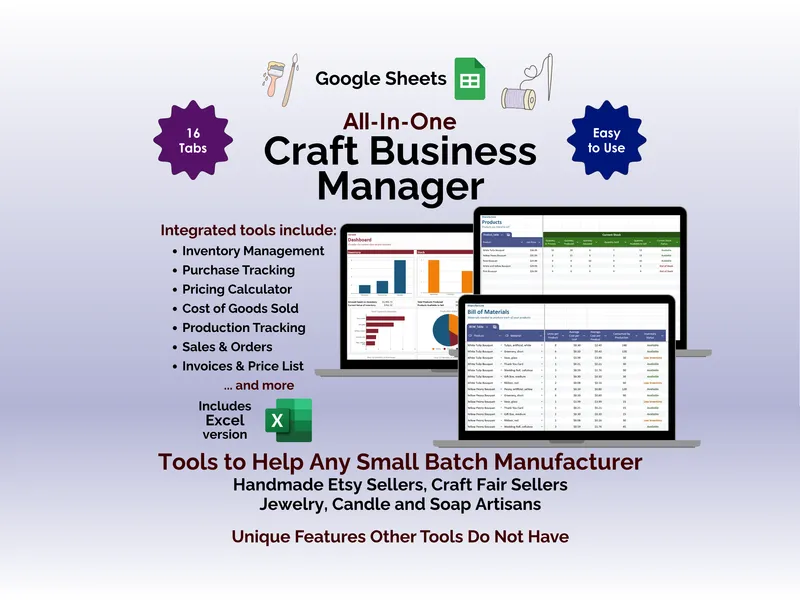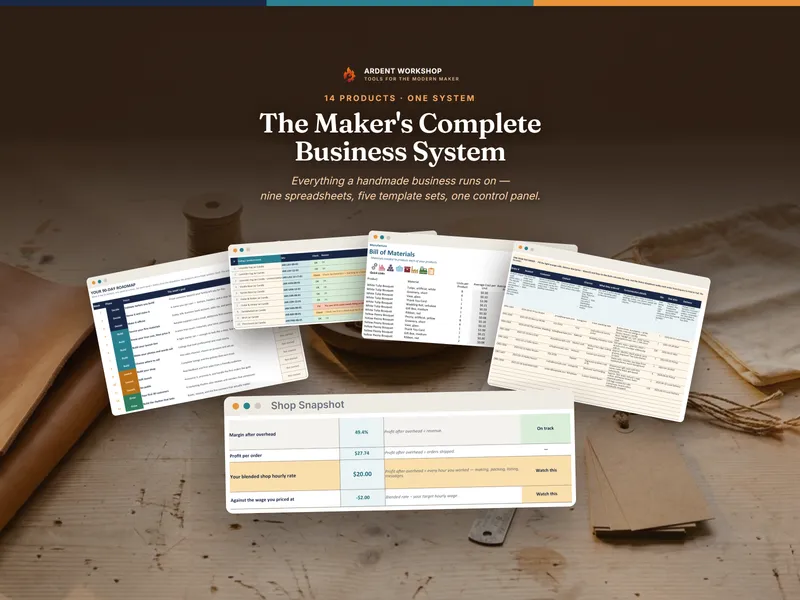
Most handmade sellers don’t lose money because they aren’t talented — they lose money because they make the same five business mistakes: guessing at product costs, ignoring inventory, missing components in the bill of materials, losing track of production batches, and mixing business and personal finances. Each one quietly erodes margin until a “best-selling” product is actually unprofitable. Below is the breakdown of all five, and how a structured tracker like Craft Business Manager prevents each one.
The Five Mistakes That Quietly Kill Margin
Mistake 1: Guessing at Product Costs
Too many sellers price their items based on what “feels right” or what competitors are charging. The problem? Hidden costs like packaging, shipping supplies, and even your time can eat away at profits. Craft Business Manager uses detailed costing to track every penny, from materials to labor, so you know exactly what each product really costs. No more guessing games — just clear, confident pricing.
Here’s what “feels right” actually costs. Take a 9 oz jar candle priced at $22 because that’s what the competition charges:
| Component | Qty | Unit cost | Cost |
|---|---|---|---|
| Soy wax | 9 oz | $0.28/oz | $2.52 |
| Glass jar with lid | 1 | $2.40 | $2.40 |
| Wick | 1 | $0.18 | $0.18 |
| Fragrance oil | 0.9 oz | $1.60/oz | $1.44 |
| Warning label (required) | 1 | $0.06 | $0.06 |
| Branded label | 1 | $0.22 | $0.22 |
| Shipping box | 1 | $0.85 | $0.85 |
| Filler / bubble wrap | 1 | $0.30 | $0.30 |
| Materials subtotal | $7.97 | ||
| Your labor (18 min @ $20/hr) | $6.00 | ||
| True cost per candle | $13.97 |
Illustrative unit costs — plug in your own supplier prices.
Now run the $22 sale all the way to the bank. Marketplace fees stack in three layers, and sellers routinely remember only the first:
| Line | Amount |
|---|---|
| Sale price | $22.00 |
| Listing fee | −$0.20 |
| Transaction fee (~6.5%) | −$1.43 |
| Payment processing (~3% + $0.25) | −$0.91 |
| Net revenue | $19.46 |
| Less true cost | −$13.97 |
| Actual profit | $5.49 |
Fee rates change — check Etsy’s current fee schedule (opens in new tab) rather than trusting any blog post, including this one.
Here’s the trap. The seller who skipped the labor line thinks their profit is $11.49 — a comfortable 52% margin. The real number is $5.49, or 25%. The missing $6 didn’t vanish; they paid it to themselves and then recorded it as profit. That’s not a business earning 52%. It’s a business earning 25% while its owner works for free half the time and calls it a win.
And it’s fragile. If that order triggers an offsite ads fee (commonly 12–15%), roughly another $3 leaves, and the profit falls to about $2.19 — under 10%. One advertised sale, and the candle is barely worth making.
There’s a second casualty nobody sees: wholesale is now impossible. Wholesale typically runs about half of retail — $11 on a $22 candle — which is $3 below the true cost of $13.97. The boutique that emails asking for 40 units can’t be served at any price the seller can say out loud. Underpricing retail doesn’t just cost margin on today’s order; it forecloses the channel that would have made the business scalable.
None of this is knowable without the $13.97. That’s the entire argument for costing.
Mistake 2: Ignoring Inventory Tracking
It’s easy to lose track of how many beads, jars, or skeins of yarn are left when you’re juggling orders. Running out of supplies mid-season is a nightmare for Etsy sellers. Craft Business Manager’s inventory tracking shows you what’s in stock, what’s running low, and when it’s time to reorder. It’s like having a personal assistant who never forgets.
The fix is a reorder point — the stock level that triggers a purchase, calculated rather than felt:
Reorder point = (average daily usage × lead time in days) + safety stock
Say you sell about 40 candles a month — roughly 1.3 a day — and your jar supplier takes 14 days to deliver. Carry 10 jars of safety stock for the weeks that run hot:
(1.3 × 14) + 10 = about 28 jars
When you hit 28, you order. Not when you hit zero and notice, which is the default system and the reason for every “why is nothing in my shop in October” post.
Two things this calculation makes visible that instinct never does:
- Lead time is the variable that matters most. A supplier who takes 30 days instead of 14 pushes your reorder point to 49 jars. Same sales, same product — nearly double the cash tied up in stock, purely because of who you buy from.
- Q4 changes the math. If November sales triple to 4 a day, your reorder point jumps to about 66. Sellers who don’t recalculate before the holidays run out at exactly the moment the traffic finally arrives.
Mistake 3: Forgetting the True Recipe Behind Each Product
Handmade sellers often underestimate how many little pieces go into a finished product — from the main materials to the tiniest embellishments. Skipping those details means your pricing and profit margins are never quite accurate. Craft Business Manager’s bill of materials tracking breaks every product down into its exact components, so you know the real cost of each item. Whether it’s the clasp on a necklace or the label on a candle jar, nothing slips through the cracks. That clarity helps you price smarter, avoid undercharging, and scale your shop with confidence.
Look again at the candle table. The wax and the jar — the two things anyone would remember — are $4.92. The other six lines add $3.05, which is 38% of materials cost, and every one of them is a thing sellers forget. Wick, fragrance, two labels, box, filler. Individually trivial; collectively they’re the difference between a healthy margin and a thin one.
A complete bill of materials also does a second job people miss: it turns purchasing into arithmetic. When your BOM says each candle consumes 0.9 oz of fragrance oil, a 100-unit run needs 90 oz, and you can order against a number instead of a hunch.
Mistake 4: Losing Track of What Was Made, When, and How Many
When orders pile up and production gets busy, it’s easy to forget which batches were made, how many units were completed, or which materials were used. That leads to missed shipments, inconsistent quality, and inventory headaches. Craft Business Manager’s production batch tracking keeps a clear record of every batch — from start date to materials used — so you always know what’s ready to ship, what’s in progress, and what needs restocking. It’s like having a backstage pass to your own production line.
Batch records earn their keep in three specific moments:
- When something goes wrong. A customer reports a candle tunneling. With batch records, you know that batch used a different wick lot and can check the other 40 units from it. Without them, you have one anecdote and no way to tell whether it’s a fluke or a recall.
- When your costs move. Wax prices rise 15% mid-year. Batch records tell you what each run actually cost, so your pricing tracks reality instead of the supplier invoice you remember from January.
- When you want your time back. Logging that a 40-candle batch took 4.5 hours gives you a real per-unit labor number — 6.75 minutes, not the 18 you assumed. Batch production is usually far more efficient per unit than making one at a time, and you can’t price that advantage in if you never measured it.
Mistake 5: Mixing Business and Personal Finances
Many solopreneurs start by running everything through one bank account. It feels simple, but it makes taxes and growth planning a headache. Craft Business Manager helps you separate business costs and revenue streams, giving you clean data. When tax season rolls around, you’ll thank yourself for not having to dig through coffee receipts to find your actual expenses.
The cost of mixing isn’t mainly the bookkeeping annoyance — it’s that you lose the ability to know whether the business works. If shop income and grocery money live in one account, “did I make money this year?” has no answer, only a vibe. Every other fix in this post depends on data that a commingled account destroys.
It also quietly costs you deductions. Business expenses paid from a personal card get forgotten at tax time — the shipping supplies bought during a Target run, the fragrance oil on a personal card, the mileage to the post office. Those are real, legitimate expenses that reduce taxable income, and they vanish because they were never recorded anywhere. A separate account makes the record automatic.
Opening a dedicated checking account takes an afternoon and is the cheapest structural upgrade available to a handmade business.
What to Do Next
Work them in order — each one depends on the one before it:
- Open a separate business bank account. Everything downstream needs clean data.
- Build a complete bill of materials for your best seller. Every component, including the ones under a dollar.
- Add your labor at a real hourly rate. This is the line that changes the answer.
- Run the fee math to a net number and find out what you actually earn per unit.
- Reprice if the math says so — and check that wholesale is still possible at your retail price.
- Set reorder points for your top five materials, and recalculate before Q4.
- Log every batch — time, units, materials — so next quarter’s numbers are measured instead of guessed.
The handmade world is full of creativity, but creativity alone doesn’t pay the bills. Avoid these five mistakes and lean on Craft Business Manager (available for Excel and Google Sheets) — you’ll protect your profits and free up more time to do what you love: making. Whether you’re an Etsy seller, a solopreneur, or a small business owner ready to scale, Craft Business Manager turns a craft hustle into a thriving brand.
None of this makes your work better. It makes your work sustainable — which is the only way the work continues.