The question layer is already free
Type a title into ChatGPT and it will hand back ten to twenty competent discussion questions in a few seconds, at no cost. LitLovers publishes broad fiction and non-fiction question sets and a guided-reading chart, also free, for use with attribution. The American Library Association's own discussion guidance goes further still for a host, adding ground rules, a way to handle a difficult participant, and a timed meeting structure. None of that is scarce anymore, and it hasn't been for a while. So the interesting question was never where do I get questions — it's what makes one actually work once it's on the table.
If you'd rather start from a set than write one: the free Ten Questions for Any Book card sheet is one click and ungated — ten questions that work on any book, each with its follow-up, written for the meeting where the club has finished. The Book-Club Host & Discussion Kit is the paid version, and it is the one that answers the fourth test: every set in it is split into a spoiler-safe track and a finishers-only track. The rest of this page is the reasoning behind both.
What a good book-club question does
A question that opens a room, rather than closing it, does four things at once:
- It's answerable by someone who isn't sure they fully understood the book. A question that only makes sense to the person who caught every thread quietly excludes everyone who read the book on a commute, at bedtime, or with three kids in the house — which in a lot of clubs is most of the room.
- It has no right answer the host is quietly waiting for. The moment a question has a correct destination, the room stops offering a reaction and starts guessing what the host wants to hear.
- It's answerable from the text, not from how much someone liked it. “Did you enjoy this book” is a real question, but it's a warm-up, not a discussion — it produces a rating, not a conversation about what the book is actually doing.
- It's answerable by a reader who hasn't finished. This is the one a general-purpose set cannot design for. Question sets are usually written as if every reader arrives at the meeting having read the whole book, which often isn't true of everyone in the room.
A question can satisfy three of the four and still stall — the fourth one is where a set is likeliest to fall down, because it's the one you can't fix by writing a better sentence. It has to be designed in from the start, which is the subject of the next two sections.
Why does a book-club question fall flat?
These are the specific, recognizable ways a question fails, not vague complaints about a “boring” discussion:
- The yes/no question. “Did you like the ending?” gets a one-word answer and the conversation has to be restarted from nothing right after it.
- The confident-reader-only question. Anything that assumes total recall of names, timelines, or a subplot from three chapters back hands the floor to whoever has the sharpest memory and nobody else.
- The disguised quiz. “What was the name of the town where the story is set” tests memory, not response — it has one correct answer, and getting it wrong in front of the group is a worse experience than staying quiet.
- The plot-summary invitation. “What happened in chapter nine” invites someone to narrate the book back rather than say what they made of it, which is a different, much less interesting task.
- The unaskable question. Any question that can't be put to the room without revealing how the book ends removes itself from play for every reader who is still catching up — unless it's held back until the boundary below has been crossed on purpose.
How do you handle spoilers when half the club hasn't finished?
A question set that treats “the ending” as one undifferentiated zone forces a choice nobody likes: skip the best questions, or spoil the book for whoever isn't done. The fix is a boundary, agreed before the meeting starts — a chapter or a specific event, not a vague “about halfway.” Every question then sorts cleanly into one of two groups: answerable using only what happens up to that point, or dependent on how the book resolves. Running the first group before the second, and marking the line between them out loud, is what lets a reader who is behind take a real turn instead of sitting out the meeting or skipping it entirely.
A follow-up is part of the question
A question that lands well is rarely a single sentence — it's a sentence with a second, narrower one behind it, ready if the first answer is short. “What did you think of the ending” followed by nothing is a coin flip: it either opens up or it stalls. The same question followed by “what's the first thing you'd have changed, and why that instead of something else” gives a one-word answer somewhere to go. Writing the follow-up in advance, alongside the question rather than improvised in the moment when the room goes quiet, is a small habit that changes how often a question actually works.
How do you write questions for a book with no discussion guide?
Plenty of the books a club picks aren't famous enough to have a ready-made discussion guide, which is also the kind of book an AI-generated set is more likely to get plot details wrong on. Building your own set for it takes the same four tests above, applied deliberately rather than left to chance:
- Agree the stop point for the meeting first, in a chapter number or a named event — this is what everything else sorts against.
- Write a handful of questions answerable from that stop point alone: what a character wants, what's changed since the start, a choice that felt earned or didn't.
- Set aside, separately, any question that only makes sense once the book resolves — how it ended, what it meant, whether it was earned. Mark where that group starts when you run the meeting.
- For each question, write one follow-up that narrows it, so a short answer has somewhere to go instead of ending the exchange.
- Read every question back and ask whether it has a right answer you're expecting. If it does, loosen it until it doesn't.
Where this fits
A question set is one piece of running a club, not the whole of it — the same room also has to agree who's reading what, whether the book is a reasonable length for the time left before the meeting, and whose turn it is to pick next. Four pages cover the rest of it:
- Free, right now. Ten Questions for Any Book — a printable card sheet, ungated and one click, no signup.
- The paid kit. Book-Club Host & Discussion Kit — a curated bank split into spoiler-safe and finishers-only tracks across 12 sets (one for any book, plus one for each of 11 genres), with the scheduling and selection machinery a set of good questions still needs sitting around it. Paper you print once and keep, not a subscription that stops working the month you stop paying.
- The evening itself. How to run a book-club meeting — the sequence end to end, from the stop point you set weeks earlier to the note you write down after.
- Paper or an app. Printable host kit vs. book-club app — where a paper kit and a subscription app each genuinely win.
More reading- and club-adjacent templates live on the templates for readers hub, and Reading Challenge & TBR Tracker and its reading-challenge prompt ideas cover the reader's side of the same shelf.
Templates that implement this
Templates for the club and the reading behind it
2 templates
One kit for running the meeting and asking better questions with the machinery to back it up; one workbook for keeping track of what you're actually reading between meetings.
- $9.95 PDF

Book-Club Host & Discussion Kit — 12 Printable Sheets, 88 Cut-Out Discussion Cards, and 236 Questions in 12 Sets
A print-first host's kit for book clubs: 12 print-and-fill sheets, 88 cut-out discussion cards, and 236 questions split spoiler-safe and finishers-only.
TrackersView details - $6.95 Spreadsheet
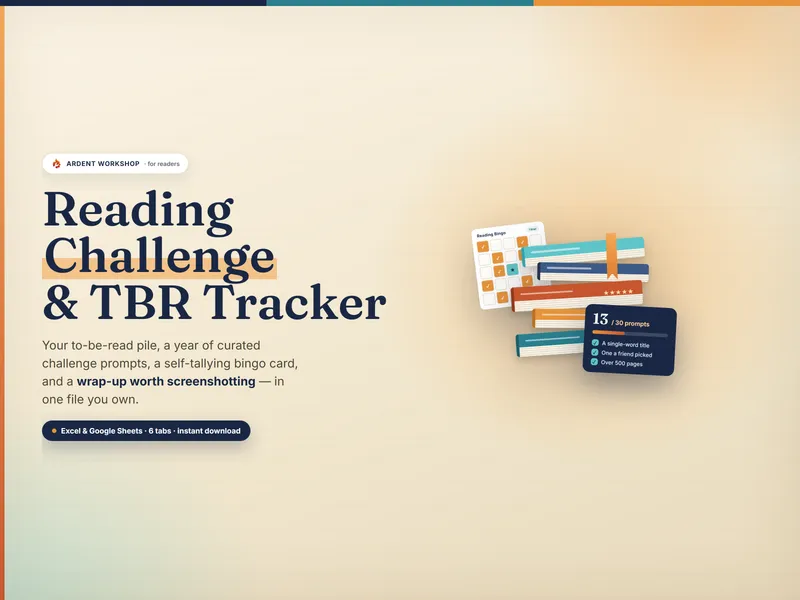
Reading Challenge & TBR Tracker — To-Read List, Reading Bingo & Yearly Wrap-Up (Excel + Google Sheets)
A reading challenge & TBR tracker for Excel & Google Sheets — a prioritized to-read pile, 30 curated prompts, a self-tallying bingo card, and a wrap-up.
TrackersView details
Frequently asked questions
- What makes a book-club discussion question good?
- Four things have to be true at once. It has to be answerable by someone who isn't sure they fully understood the book. It can't have a right answer the host is quietly waiting to hear. It has to be answerable from the text itself, not from how much someone happened to enjoy it. And it has to be answerable by a reader who hasn't finished — the test a generic question set has no way to be written against, because a question bank has no idea where your club stopped.
- Should a book-club question have a right answer?
- No. A question the host already has an answer to, and is waiting for someone to guess it, turns a discussion into a quiz — and the room can feel that shift even when nobody says so out loud. "What's the significance of the color red in this novel" is a right-answer question dressed up as an open one. "Where did you notice color doing work in this novel, and what did it do for you" asks for the same kind of attention without a single correct destination.
- How do I write book-club questions for people who haven't finished?
- Agree on a stop point before the meeting — a chapter or a page, not just "about halfway" — and sort your questions against it. Anything answerable using only what happens up to that point is spoiler-safe and goes first; anything that depends on how the book resolves goes after a clearly marked boundary, asked only once everyone still reading has had a turn on the safe set. That split is what lets someone three chapters behind stay in the conversation instead of going quiet or skipping the meeting.
- Is it fine to just ask ChatGPT for book-club questions?
- For a fast set of generic questions, yes — it will return ten to twenty competent ones for almost any title or genre in seconds, and that layer is genuinely commoditized now. It stops being useful past that: it has no idea where your club's stop point is, so it can't sort a set into spoiler-safe and finishers-only; it has no memory of last month's meeting or whose turn it is to pick next; and on anything less famous than a current bestseller it can invent plot detail that isn't in the book — which is exactly the kind of title a smaller club is likely to have picked.
- What do I do when a book-club question falls flat?
- Have a narrower follow-up ready rather than moving straight to the next question. A stalled "What did you think of the ending" can restart as "What's the first thing you'd have changed about it, and why that and not something else" — a second, more specific prompt that turns a one-sentence answer into an actual exchange. Planning the follow-up in advance, as part of the question rather than an improvised rescue, is the difference between a question that has one shot and a question that has two.
- Where can I find free book-club discussion questions?
- LitLovers publishes broad fiction and non-fiction question sets plus a guided-reading chart, free with attribution. The American Library Association's own discussion guidance goes further for a host specifically — ground rules, a way to handle a dominating or difficult participant, and a timed meeting structure. Both are genuinely useful for a generic list. Neither can sort its questions against the exact chapter your club happens to have stopped at, because neither knows what book your club picked or how far into it you are.