Whose turn is it to pick. How much of a 600-page book to read before Thursday. What the half of the room who did not finish are supposed to do for two hours.
This kit is built on a view about book clubs: they never run out of questions, they run out of machinery. This is that machinery, printed: 12 sheets you fill in with a pen, 88 cards you cut out once, and 236 questions written so the club can use them on whatever it reads next.
How many pages should a book club read before the next meeting?
That depends on two numbers — the book’s page count and how many meetings the club will give it — and the Pace Matrix is the printed sheet that turns them into an answer. Keep it at the front of the folder. Find the page count down the left and the number of meetings across the top, and it gives you pages per meeting. Take that figure to the second table and read across for how often your club actually meets — every two weeks, every three, monthly, every six — and it becomes a pages-a-day figure, with the heavy bands already marked by a printed symbol rather than a color.
Then the reading-pace worksheet does the part a page number cannot: nobody stops reading at page 138. A six-step method, printed beside the worksheet, walks a page target to the nearest chapter break and writes a stated stop point for every meeting — the line you copy into the group chat the night you pick the book. You do the snapping; the kit prints the method, the sanity checks, and the reason the boundary landed where it did.
The pace thresholds the sheet uses — over 15 pages a day is heavy, over 25 is over-loaded — are this kit’s own dial, stated as such on the sheet. They are a starting point to move once you have watched one book go past your own club.
Whose turn it is, and who has already spent a veto
The Selection & Veto Ledger is a year on one sheet: who nominated, who picked, how the book was chosen, whose turn is next, each member’s veto and whether it is spent, when vetoes reset, and the tie-break rule copied straight from the founding charter. It exists because this kit assumes that, somewhere in a club’s first year, “it’s my turn” and “you already used your veto” stop being settleable from memory — so the ledger writes them down instead.
Beside it sit blind nomination slips: a printed procedure for hearing a book’s pitch before anyone knows whose pick it is. And the kit splits the host from the facilitator — who feeds people from who runs the room — and rotates the two jobs on independent schedules, because this kit assumes doubling both jobs onto one person is what burns a host out.
The half of the room that did not finish
Every one of the 12 sets is printed in two tracks. Above a marked spoiler boundary: questions answerable from the stop point the club agreed. Below it: the finishers-only track. The meeting plan preprints the spoiler line and the order to run the two tracks in, so somebody who is fifty pages short takes part in the first hour instead of skipping the evening — which is the failure this kit is built around.
The spoiler-safe questions are written to be answerable mid-read, not relabeled from the finishers list. “Who do you suspect right now, and what’s your evidence?” only works before the end.
236 questions in 12 sets
One Any Book set to reach for every time, plus a set written for each of 11 genres:
- Literary fiction
- Mystery and thriller
- Fantasy and science fiction
- Romance
- Non-fiction
- Memoir
- Classics
- Young adult
- Short-story collections
- Translated fiction
- The book everyone hated
Every question carries a follow-up to ask next, and 15 icebreakers plus three games sit at the back for the night the discussion stalls.
The 88 discussion cards are the airtime device, not decoration. They come imposed with trim marks, each carrying its set name and its track in the header so a cut deck sorts itself back out. Deal one per member at the start of a round and everybody has something of their own to say — which is the quiet fix for the club where the same two people carry every discussion. The airtime tracker on the session sheet makes the gap visible round by round, so it is a mark on a page rather than something somebody has to say out loud.
Want to try the questions before you buy anything? Ten Questions for Any Book is a free printable card sheet — ten of these 236 questions, each with its follow-up, imposed with trim marks and ready to cut. It is one click, ungated, and does not ask for an email.
Every sheet, shown filled in
The kit ships a complete worked example: an invented club reading an invented book, with all 12 sheets answered in full from the founding charter through to the year-end retrospective. Ten minutes with it and nobody has to wonder how much detail is enough before picking up a pen. Every club, member, book and author in it is invented, and no real book is named anywhere in the kit.
Why paper, and not another account
A book club meets in a living room. A stack of paper works there in a way a login does not: nothing to remember, nothing to keep current on five other people’s behalf, and nothing that stops working when a company changes its mind. Print any sheet again whenever the club needs it, for as long as the club lasts.
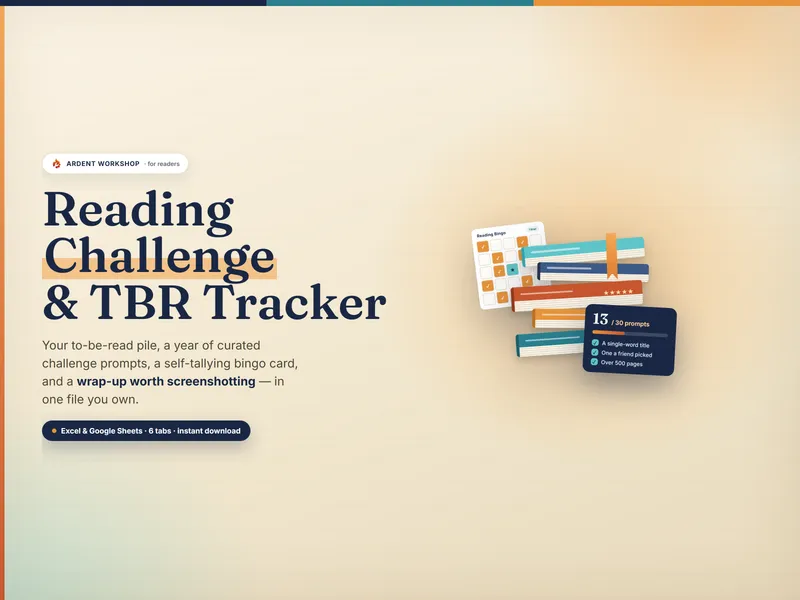
That is the whole idea behind Ardent Workshop — things you own outright, sitting between a blank notebook and a rented app. This kit runs the club. If you want the reading side of the year — what you finished, what is still on the pile, and whether the year’s goal is on pace — the Reading Challenge & TBR Tracker is that, in a workbook. Neither contains the other; they sit side by side.
Printing it
Two of the six documents are the ones you actually feed through a printer, and both ship in US Letter and A4, laid out for the sheet rather than scaled to it. The guides, the question sets and the worked example are read rather than printed, and ship in US Letter. Print at 100% (Actual size) — never “fit to page”, which moves the trim marks on the card sheets and shrinks the write-on lines everywhere else. Single-sided, so there is a back to write on. Card stock is worth it for the cards; ordinary paper still works. Black and white is fine throughout: nothing in the kit is told apart by color — every track, mark and legend is printed as a word or a symbol as well.