This isn't "the app is bad." Bookclubs.com and Fable both do their jobs well — one keeps a club's calendar and attendance straight, the other puts chapter-gated discussion rooms in front of people between meetings. The honest question isn't which is better; it's which problem you're actually trying to solve. Scheduling and paper serve two different halves of running a club.
The quick verdict
- Choose a club app if the thing killing your club is logistics — nobody can find a date, RSVPs never come in, reminders don't go out. Bookclubs.com's free tier covers that outright, and its Premium tier adds ranked-choice voting and calendar sync for clubs that have outgrown a group text.
- Choose a printable host kit if the meetings themselves are the problem — one person dominates, half the room hasn't finished, the same person always ends up hosting, facilitating and picking the book. That's a room-management problem, and it's solved with paper that structures the meeting, not software that structures the calendar.
- Many clubs end up wanting both — a free or Premium app for the schedule, and a printed kit for the meeting itself. They aren't competing for the same job.
If the paper half is the half you're missing: Ten Questions for Any Book is the free, ungated card sheet to print for the next meeting, and the Book-Club Host & Discussion Kit is the paid version — the full printable kit. The rest of this page is the evidence for that split.
Side by side
| What matters | Printable host kit | Book-club app |
|---|---|---|
| Cost | One-time purchase, print as many years as the club runs | Free tier for scheduling; Premium $60/yr per club at the time of writing |
| Scheduling, RSVPs, reminders | Not the job — pair with a shared calendar | Automated: events, RSVPs, reminders, attendance |
| Running the actual discussion | Dealt cards, a marked stopping point, a printed method | Not built for the in-person meeting |
| Spoiler handling | Every question set split spoiler-safe vs. finishers-only | Fable gates threads by chapter; Bookclubs.com does not advertise it |
| Turn-taking / airtime | Built into the paper — a card per person, an airtime tracker | Not a documented feature |
| Who hosts, picks, facilitates | Rotation and veto tracked on a ledger the club keeps | Not a documented feature beyond who created the event |
| Record if the tool goes away | Stays in a binder — no account, no subscription to lapse | Lives in the app account, for as long as the account lasts |
| Best for | The two hours everyone is actually in the room together | The weeks between meetings, keeping the calendar straight |
Where the app genuinely wins
Credit where it's due: scheduling is the first thing that decays in a club run on group chat, and it's the thing an app fixes outright. Bookclubs.com's free tier handles events, RSVPs, reminders and attendance without anyone having to chase the group by text, and its Premium tier — $60 per year per club at the time of writing, so check the current price — adds ranked-choice book voting and other extra polling options, automatic calendar sync and multiple club admins for a club with more moving parts. If scheduling is the reason your club keeps stalling, that's worth paying for.
Where a printable kit genuinely wins
None of that reaches the meeting itself. An app does not deal a question to each person, does not put a physical stopping point in someone's hand, and does not sit on the table where everyone can see whose turn it is. Hosts report the same handful of problems — the American Library Association's own discussion guidance devotes sections to several of them: one member dominates the conversation while others stay quiet, half the room hasn't finished the book and stays silent to dodge spoilers, discussion drifts into gossip and never comes back, and the same person ends up hosting, facilitating and choosing the book every month until they are worn out by it. None of that is a scheduling problem, so no amount of calendar sync fixes it — it needs a structure for the room, which is what a printed host kit is for.
And a printed record outlasts the tool it was made with. A club's selection history, whose veto is spent, and who's hosting next survive a canceled subscription, a discontinued app, or a club that moves to a different platform entirely — because none of that lives on a server you're renting space on.
Build the paper system
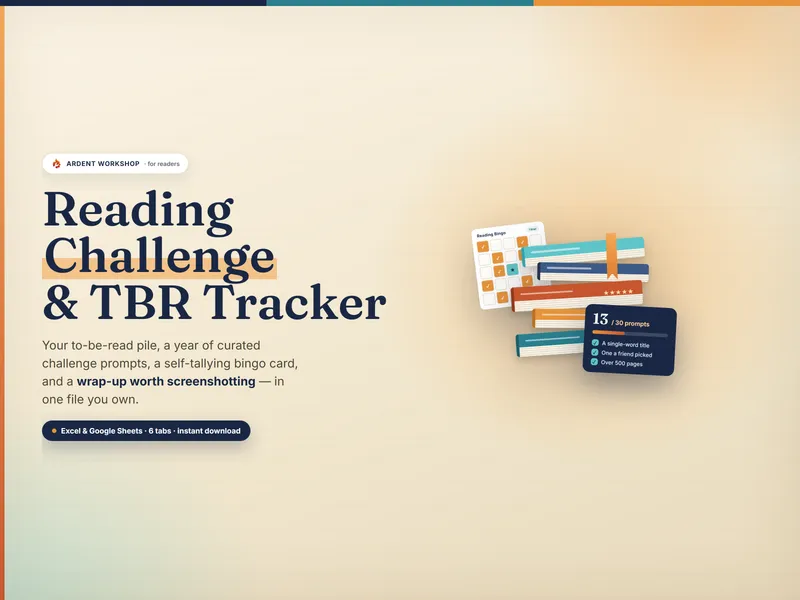
Start free with Ten Questions for Any Book — a printable card sheet that works on whatever the club is reading this month, no signup required. When you're ready for the full host's toolkit — the Pace Matrix, the Selection & Veto Ledger, blind nomination, and 236 questions split spoiler-safe and finishers-only — the Book-Club Host & Discussion Kit covers the room. For the reader's own side of the club, the Reading Challenge & TBR Tracker handles the to-be-read pile and the yearly wrap-up.
Two more pages sit either side of this one. What makes a good book-club question? is the test a prompt has to pass before it earns a place in the set, and how to run a book-club meeting walks the evening itself, from the stop point you set weeks earlier to the note you write down after. If you want a longer list to steal from, reading-challenge prompt ideas is a reading-challenge list rather than a discussion set, but it is a good well to draw on when the included sets run out. The rest of the reading shelf sits on the templates for readers hub.
Frequently asked questions
- Is a book-club app better than a printable host kit?
- They're better at different jobs. A club app like Bookclubs.com is genuinely better at scheduling, RSVPs, reminders and attendance tracking — logistics that decay fast when a club runs on group chat. A printable host kit is better at what happens once everyone is sitting in the room: dealt questions, a marked stopping point, visible turn-taking, and a paper record that keeps working after the meeting ends.
- Do I have to pay for a book-club app?
- Not to get started. Bookclubs.com runs a free tier that covers events, RSVPs, reminders, attendance and basic date and book polls. Its Premium tier — $60 per year per club at the time of writing, so check the current price — adds ranked-choice book voting and other extra polling options, automatic calendar sync and multiple club admins. Fable is the discussion-side option, with chapter-gated discussion rooms inside its own reader.
- Can an app run the discussion, not just the schedule?
- Fable comes closest, with chapter-gated discussion rooms inside its reader — but that's a written, asynchronous conversation, not what happens at the table. Neither Bookclubs.com nor Fable deals a question to each person, hands someone a physical stopping point, or gives the room a shared object everyone can see at once. That's a paper problem, not a scheduling one.
- What happens to a club's record if the app shuts down or the subscription lapses?
- It goes with it. A club app's history of picks, polls and attendance lives in that company's account, for as long as the account and the company last. A printed ledger — who picked what, who's hosting next, whose veto is spent — sits in a binder and survives a canceled subscription, a dead app, or a club that moves to a different platform entirely.