Why manhwa, manhua and manga are the same word
Manhwa (만화) is simply the Korean word for “comics.” Manhua (漫画) is the Chinese word for the same thing. Manga (漫画) is the Japanese word. All three come from the same pair of written characters, carried into Korean, Chinese and Japanese alike — so manhwa is the Korean pronunciation of what Chinese reads as manhua and Japanese reads as manga. They are not three different concepts that happen to sound alike; they are the same concept named three times.
English readers didn't inherit that overlap. Because each word arrived in English attached to comics from one specific country, the three have split into a loan-word convention: manhwa means Korean comics, manhua means Chinese (including Taiwanese and Hong Kong) comics, and manga means Japanese comics. None of the three describes an art style, a genre, or a level of quality — only where the comic was first published. A manhwa drawn in a manga-influenced style is still a manhwa. The word tells you the country, full stop.
Manhwa vs. manhua vs. manga: what actually differs
| Word | Country of origin | Usually |
|---|---|---|
| Manhwa | Korea | Full color, top-to-bottom scroll (webtoon format) |
| Manhua | China, Taiwan, Hong Kong | Full color, top-to-bottom scroll (webtoon format) |
| Manga | Japan | Black and white, right-to-left pages, chapters into volumes |
“Usually” is doing real work in that table — every row has exceptions, especially as manga moves online and picks up webtoon-format habits. The word itself still only ever tells you one thing reliably: which country the comic is from. The rest of this page is about why the other differences line up the way they do, and why they aren't as national as they look.
Why manhwa and manga get confused: format vs. country of origin
The vertical-scroll, full-color, phone-first format that so much manhwa and manhua reaches English readers in has its own name — a webtoon — and that name is a format, not a country. Plenty of the confusion between manhwa and manga actually starts here: people mean “the scrolling kind” when they say manhwa, and “the page-turning kind” when they say manga, and both of those are format guesses dressed up as country words. The rest of this page stays on what the country words do and don't tell you — including the format-driven differences people mistake for national ones. For the webtoon format itself — how it's drawn, why it scrolls, and how that differs from a page-based comic — see what a webtoon is.
Where manhwa's color and reading direction actually come from
Two practical differences a reader actually meets trace back to publishing format rather than nationality. Manga has a long print history and is traditionally read right to left, page by page. Manhwa and manhua published as vertical-scroll webcomics are read top to bottom, in the direction any phone already scrolls — which is a webtoon-format habit that happens to be common to Korean and Chinese digital comics, not a rule baked into the words “manhwa” or “manhua” themselves.
Color works the same way. Manhwa and manhua published digitally are usually in full color, because color adds no per-copy printing cost when the page is a screen. Manga is usually black and white, a convention that was set in print and has largely stayed put. Neither pattern is a national preference — it's a consequence of where and how each was built to be read.
Why a manhwa goes quiet: season breaks vs. hiatus
Korean and Chinese webcomics commonly run as regular episodes grouped into seasons, with a break announced in advance between one season and the next. That season structure is why a manhwa can go quiet for months and still be perfectly healthy: the silence was scheduled.
It's also exactly why the other kind of silence — a hiatus, where a series simply stops with no season break announced — is worth noticing. Unless you caught the announcement when it went up, nothing about the silence itself tells you which kind of quiet you're looking at. The signal you actually have is how long it has been since the last episode, counted and held up against what that series normally does.
Manhwa and manhua genres: regression, villainess, murim and cultivation
The country split shows up in genre labels as much as in format. A handful of setups recur often enough in manhwa to have names of their own:
- Regression — a protagonist sent back to an earlier point in their own life, now armed with foreknowledge of what's coming.
- Villainess and romance fantasy — a reader or side character reborn into the antagonist role of a story they already know, trying to escape the doom their old knowledge predicts.
- Murim — the Korean martial-arts world, a sect-and-rival setting distinct from (though related to) the Chinese wuxia tradition.
- Tower, gate, and hunter settings — worlds reorganized around a sudden fantastical threat, with ranked survivors who fight it for a living.
Manhua leans toward a different cluster: cultivation and xianxia stories, built on Daoist myth and immortality rather than the murim's grounded martial training, plus Chinese historical settings more broadly. If cultivation, xianxia, and the neighboring labels are new territory, what wuxia is draws the exact lines between wuxia, xianxia, and their cousins — the same distinctions that carry over into manhua. If you follow anime and manga alongside them, our page for anime and manga fans collects the other guides and trackers for them.
Manhwa chapter counts: the original language vs. official English
Here's the practical consequence of all of the above, and the reason it matters beyond trivia: manhwa and manhua are written and published in Korean or Chinese first, and the official English version is a separate release, on its own schedule, that reaches readers later. So while a series is still running, it usually has one chapter count in its original language and a lower one in official English — and how much lower varies enormously from series to series. On a finished series the two eventually meet, which is its own kind of good news. A reader following only the English release has no built-in way to see that gap, how large it is, or whether it's closing or widening.
Follow three or four series at once and that becomes its own kind of media backlog — except the number you'd need in order to sort it isn't written down anywhere you can see it.
The free manhwa & manhua starter is where to begin: one tab that stores all three numbers per series — the original-language chapter, the official English chapter, and where you personally are — and works out what you can read tonight and how much story is still untranslated. No signup.
The paid Manhwa & Manhua Tracker is the nine-tab version of that idea, and it answers the questions one tab can't: whether English is closing the gap or losing ground, measured from the two release rates; how many days each series has been quiet, banded so a stalled series stops looking like a season break; and which of your backlogs is shortest to clear. Own it, don't rent it — one file you keep, no account and no monthly fee.
Templates that implement this
Track what you're reading in two languages
3 templates
Manhwa and manhua run ahead of their official English releases by a different amount every series — which is why the Manhwa & Manhua Tracker holds all three numbers: the original-language chapter, the official English one, and where you are.
- $6.95 Spreadsheet

Manhwa & Manhua Tracker — Raws vs Official English for Excel & Google Sheets
A manhwa and manhua tracker for Excel and Google Sheets that holds three chapter numbers per series — the raws, official English, and you — and computes the gap.
TrackersView details - $6.95 Spreadsheet

Webtoon & Light-Novel Tracker — Catch-Up Hours for Excel & Google Sheets
A webtoon, manhwa and light-novel tracker for Excel & Google Sheets that turns every backlog into hours — and prices what your coin unlocks really cost.
TrackersView details - $4.95 Excel
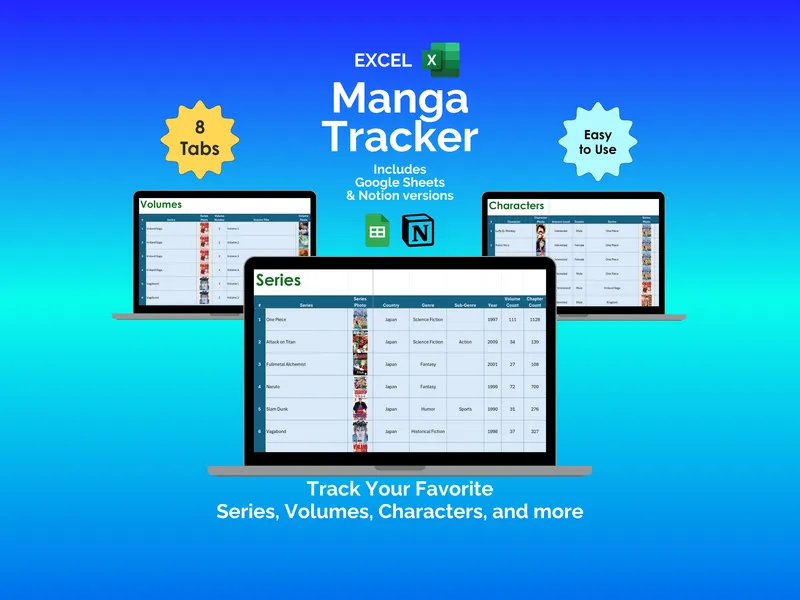
Manga Tracker - Excel
Nobody tells you the hard part of collecting manga is remembering it. This excel manga tracker turns your manga collection spreadsheet into one source of truth.
TrackersView details
Frequently asked questions
- What is the difference between manga, manhwa and manhua?
- They are the same word in three languages. Manhwa is the Korean word for comics, manhua the Chinese word, and manga the Japanese word — and in English each has come to name comics from that one country: manhwa means Korean comics, manhua means Chinese, Taiwanese and Hong Kong comics, and manga means Japanese comics. The difference is where a comic was published, not how it is drawn — a Korean comic drawn in a manga-influenced style is still a manhwa. The differences readers notice in practice, like full color or scrolling instead of page-turning, follow the publishing format rather than the country.
- Is manhwa the same as manga?
- No. Manhwa and manga are the same word — the Korean and Japanese readings of the same written characters for "comics" — but in English usage each has come to mean comics from one specific country. Manhwa means Korean comics; manga means Japanese comics. They share a linguistic root, not a national origin, so under that convention a manhwa isn't counted as a manga, or a manga as a manhwa, whatever their art styles have in common.
- Are manhwa read left to right?
- There's no single answer, because manhwa spans two different formats. Manhwa published as vertical-scroll webcomics aren't read left to right or right to left at all; you scroll straight down, and "reading direction" doesn't really apply. Manhwa published in a traditional page format reads left to right, which is the opposite of manga's traditional right-to-left page order.
- Why is manhwa in color and manga in black and white?
- It tracks where each is published rather than a national style choice. Manhwa reaching English readers today is commonly published digitally first, and full color adds no per-copy printing cost when the page is a screen, so it's the default. Manga's conventions were set in print, where black-and-white chapters collected into volumes became the standard — and that standard has largely carried over even as manga itself moves online.
- Why does a manhwa have more chapters in Korean than in English?
- Because a manhwa is written and published in Korean first, and the official English version is a separate release that comes later and moves at its own pace. While a series is still running the original language is normally further along than the English release, and how much further varies enormously — some are only a little ahead, others a great deal. Once a series has finished and the translation has caught all the way up, the two counts meet. That gap is normal, not a sign anything has gone wrong, and it's the reason a reader following the English release alone has no way to see how much more story already exists.