What a webtoon is
A webtoon is a comic drawn for a phone. Instead of pages you turn, it is one long vertical strip you scroll — panels stacked with deliberate gaps between them, so the scroll itself becomes the pacing. An episode is a single continuous image rather than a set of pages, it is nearly always in full color, and it is published on a schedule: a fixed weekday, usually weekly.
The format was popularized in South Korea, which is why the word is often treated as a synonym for “Korean comic.” It is not. A webtoon made in Los Angeles or São Paulo is still a webtoon. The word describes how it is drawn and read, not where it is from.
Webtoon vs manhwa vs manhua vs manga
These three are the country words, and this is where most of the confusion lives:
- Manhwa — Korean comics. In English usage it is often used interchangeably with webtoon, though some readers reserve manhwa for print or page-based releases and webtoon for the vertical-scroll format.
- Manhua — Chinese comics. In translation these are commonly vertical-scroll and full color, and frequently adapted from a Chinese web novel.
- Manga — Japanese comics. Typically page-based, usually black and white, and read right to left. Serialized as chapters, then collected into volumes — which is why a series can be on chapter 180 and volume 20 at the same time.
So webtoon answers “what shape is it?” while manhwa, manhua and manga answer “where is it from?” A Korean vertical-scroll comic is both a manhwa and a webtoon, and nobody will correct you for saying either.
Where a light novel fits
A light novel is not a comic at all. It is a Japanese novel published in short, fast-reading volumes with occasional illustration inserts, written for a young-adult readership rather than a literary one. The unit is a volume — one book, several hours of reading — not a chapter or an episode.
Its close cousin is the web novel: a novel serialized chapter by chapter online, usually free to start and often running to hundreds or thousands of chapters. Many light novels and manhua began life as web novels, which is why the same story can exist as a web novel, a light novel, a manhwa and an animation at once — each at a completely different point in the plot.
The practical difference: they are counted differently
Here is the thing that only becomes obvious once you follow several at once. Every one of these formats measures your progress in a different unit:
- A webtoon or manhwa — episodes, a few minutes each.
- A translated web novel — chapters, often ten to fifteen minutes.
- A manga — chapters, then volumes.
- A light novel — volumes, several hours each. Or, on a service that releases them early, prepub parts.
Which means “I’m 96 chapters behind” and “I’m 2 volumes behind” are genuinely not comparable statements, and the first one sounds far worse than it is. At twelve minutes a chapter, 96 chapters is about 19 hours. At four hours a volume, 2 volumes is 8. The crisis is roughly twice the Tuesday, not fifty times it.
The only way to compare backlogs across formats is to convert them all into the unit your week is actually measured in — hours. That is a small piece of arithmetic per series, and it is exactly what a reading tracker should be doing for you.
A few more words you will meet
- Fast pass — paying to read episodes ahead of the free release. You are buying time, not access; the same episodes reach everyone eventually.
- Binge wall — the point where the free back catalog runs out and the series drops from bingeable to one episode a week. A very common reason a reader stalls.
- Simulpub — a chapter published in English the same week as the original. Common for manga; rare for novels.
- Scanlation — an unofficial fan scan-and-translate release. Usually the only English version until a license lands, and usually gone the moment one does.
- Season break — a planned pause between arcs, announced in advance. Distinct from a hiatus, which is not.
Templates that implement this
Track the webtoons and novels you're following
3 templates
Log where you are in every series and see how far behind you are in hours — the one unit that compares an episode backlog with a volume backlog.
- $6.95 Spreadsheet

Webtoon & Light-Novel Tracker — Catch-Up Hours for Excel & Google Sheets
A webtoon, manhwa and light-novel tracker for Excel & Google Sheets that turns every backlog into hours — and prices what your coin unlocks really cost.
TrackersView details - $4.95 Excel
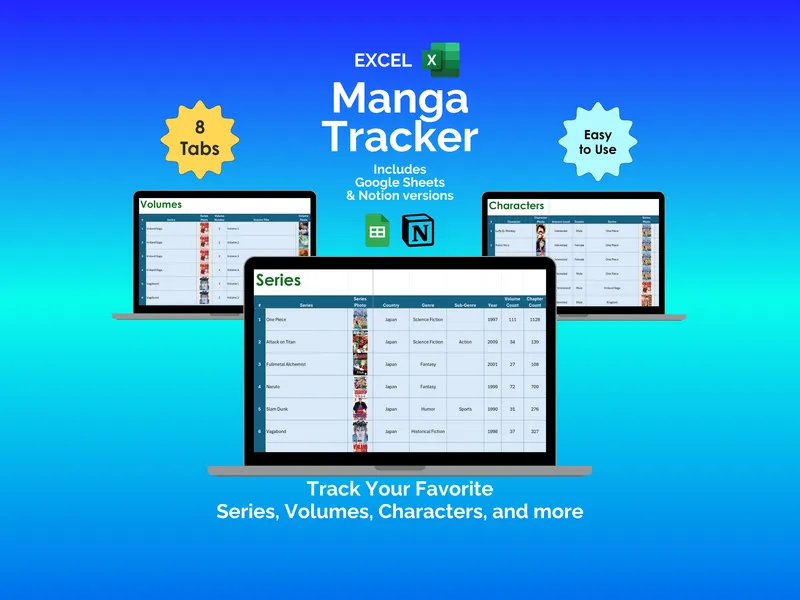
Manga Tracker - Excel
Nobody tells you the hard part of collecting manga is remembering it. This excel manga tracker turns your manga collection spreadsheet into one source of truth.
TrackersView details - $4.95 Excel
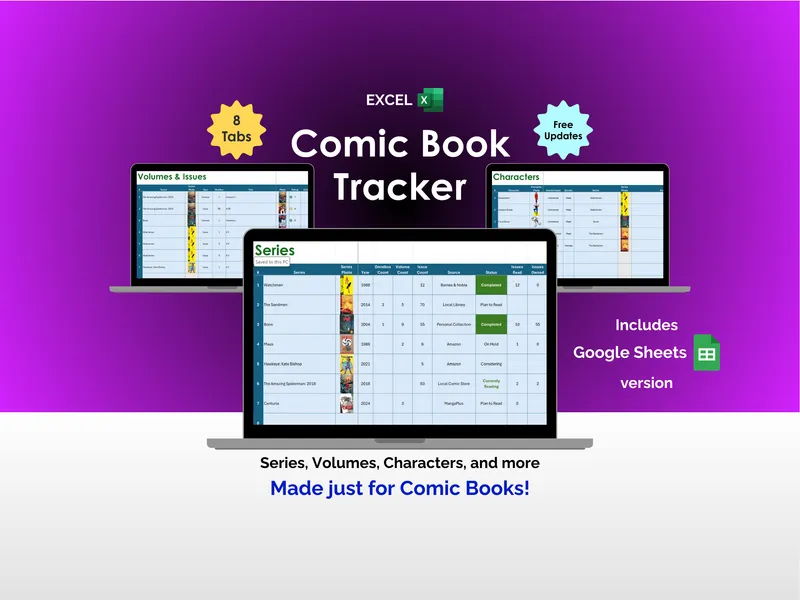
Comic Book Tracker - Excel
Tracking comics isn't about cataloging every issue you own -- it's about knowing what to read next. This Excel comic book tracker handles series, volumes, characters, and critics, and a Google Sheets version is in the same download.
TrackersView details