What goes into a pet records binder
A pet records binder gathers the information you reach for at the vet's front desk, at boarding drop-off, or handing your keys to a sitter — the details that live in scattered drawers and bags and text threads until you put them in one place:
- Identity and description — name, species, breed, age, weight, coloring and markings — the basics anyone would need to describe or identify the animal.
- The microchip number and its registration — the number itself, and separately, where and with whom it is registered. These are two different facts, and the second one is the one that actually matters. The number is an identifier for a vet, a shelter, or the registry, not something to post publicly.
- Vaccination certificates — the date each one was given, what it covers, the clinic, and the lot number off the certificate — the details a boarding kennel or a groomer commonly asks for. Confirm what yours asks for before you travel.
- Vet visit history — what happened at each visit, in plain terms, so a new vet or an emergency clinic isn't starting from nothing.
- Current medications — every medication your pet is on right now, the dose, and when it's given. A record you keep, not a prescription you write.
- The feeding routine — what, how much, how often, and anything a stranger feeding your animal would need to know.
- Insurance provider and plan — which company, which plan, and what it covers — never the policy number or a portal login.
- Adoption papers and license — where the adoption record, registration, or license is kept, and the date, for the animal that's licensed by where you live.
- What the care costs — what you've spent per animal and per category, which is otherwise hard to produce on demand without a running log behind it.
- A caregiver handoff — the one page that pulls the rest together for whoever is watching your pet while you're not there.
Microchip vs registration, the distinction a pet records binder makes obvious
A microchip is only as good as its registration, and the two are separate acts done by separate parties. A vet or a shelter implants the chip — that part happens once, and it doesn't expire. Registering it is a different, ongoing step: linking that chip's number, in a registry, to your current name, address, and phone number. The vet's office is not the registry. If you move or change your number and never update the registration, the chip still scans fine — it just returns contact information for someone who isn't reachable anymore. A pet records binder is where you note both facts side by side: the chip number, and where it's registered, so the second one is easy to check and easy to keep current.
Why a pet records binder isn't just a folder
A folder of vet paperwork answers "what happened" — this shot was given on this date, this visit cost this much. That's useful, but it isn't the question you actually need answered day to day, which is "what is due." Answering that takes two pieces of information working together: when something was last done, and how often it repeats. A folder gives you the first and leaves you to do the second piece of arithmetic yourself, for every animal, every time.
A binder built to compute that — a last-done date plus a repeat interval producing a next-due date, a day count, and a status — turns a household of paperwork into a single ranked list of what needs attention first. The same structure is what lets a caregiver handoff page assemble itself from the records you've already kept, rather than being rewritten by hand every time someone else has to step in. Alongside it sits a treatment authorization naming a spend cap you're comfortable with, so that a clinic that can't reach you has some direction rather than none. Treat that as a practical handover note, not a legal document — a clinic may still call to confirm before proceeding.
Who needs a pet records binder
It earns its keep for more households than you'd think:
- Multi-pet households, where "who's due for what" has to be answered for three or four animals instead of one.
- Anyone who travels or boards, where a kennel commonly asks for current vaccination proof before your pet is even off the leash — confirm what yours requires.
- A new adopter, starting a record from nothing.
- An owner of a senior animal on regular medication, where doses and timing matter and mistakes are easy to make from memory.
- Anyone changing vets or moving — a new practice starts with whatever history you can hand them, and "I think it was sometime last year" isn't much to work with.
If a sitter is part of the picture, the free Pet Sitter Sheet is worth starting with on its own — one animal's whole handoff on a single sheet, across two printed pages: feeding, medications, your vet, a 24-hour emergency clinic, and a veterinary treatment authorization with a spend cap you set. It opens on a worked example, then repeats the layout blank, ready before your next trip. Writing that page well is its own small skill: how to write pet-sitter instructions walks through it step by step.
Paper, spreadsheet, or pet app
A paper folder works, and plenty of good pet owners keep one — it's cheap, it's tangible, and it needs nothing to open. Its limit is that it only ever tells you what happened; nothing on paper works out what's due next without you doing the math yourself, for every animal, by hand. A pet app fixes the convenience problem — reminders on your phone, a camera to capture a certificate, one login — and if it is a hosted one, at the cost of putting your pets' history on someone else's server under terms you don't control. A spreadsheet splits the difference in your favor: a file you own outright, that computes the same due dates and the same handoff page, and keeps working exactly as it does today whether or not you ever pay anyone again. The full side-by-side is in pet records binder vs a pet care app.
How to start a pet records binder in an afternoon
- Start with identity and microchip for each animal — the basics, plus the chip number and a note on where it's registered. If you're not sure the registration is current, this is the moment to check it.
- Pull together vaccination certificates — dates, what each one covers, and the lot numbers, from wherever they've been filed or emailed.
- Write down current medications and the feeding routine as they actually are today, not as they were last year.
- Add vet visit history as far back as you can reconstruct it, and keep adding to it after each visit going forward.
- Finish with the caregiver handoff — the one page you'd hand a sitter tomorrow if you had to leave tonight.
If you'd rather not start from a blank page, the free Pet Sitter Sheet covers step five on its own at no cost, and the Pet Care & Records Binder has the due-date and handoff work above already done for you — you fill in what's true about your animals, and it works out what's next. This is a record-keeping approach, not veterinary advice: your veterinarian sets your pets' actual schedules and doses, and state and local law sets requirements like the rabies certificate where you live.
Templates that implement this
Build your pet records binder
3 templates
A workbook that organizes every animal's identity, microchip, vaccinations, medications, and cost of care — and hands off a sitter page it fills in for you.
- $19.95 Spreadsheet

Pet Care & Records Binder — Vaccination, Vet History, Medication & Sitter Handoff Tracker (Excel + Google Sheets)
Every pet's records in one spreadsheet you own — and it works out what each animal is actually due, then assembles the sitter handoff for you to print.
Life AdminView details - $24.95 Spreadsheet
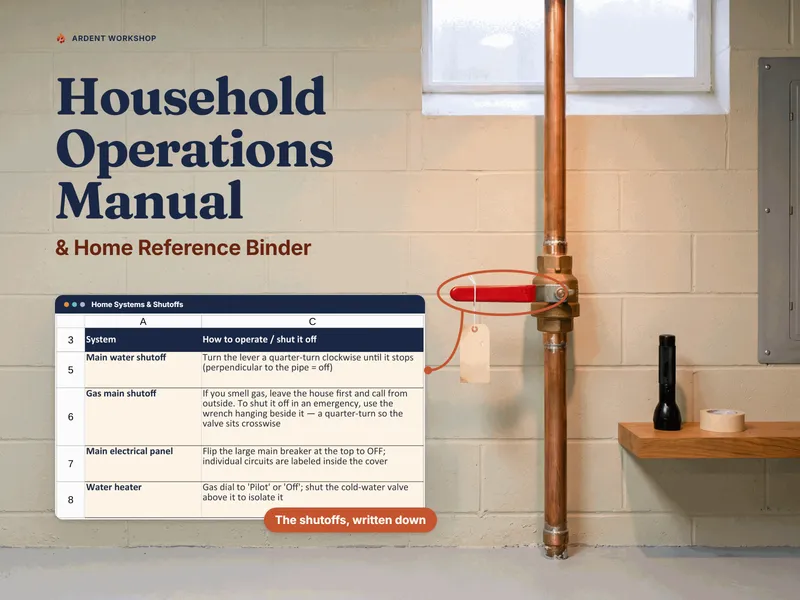
Household Operations Manual & Home Reference Binder — Utilities, Shutoffs, Maintenance, Emergency Contacts & House-Sitter Info (Excel, Google Sheets & Word)
Household operations manual for Excel, Google Sheets & Word: shutoffs, a maintenance schedule that computes what's due, and a house-sitter packet.
Life AdminView details - $19.95 Spreadsheet

Vehicle & Auto Records Binder — Car Maintenance Log, Service History & Registration Renewal Tracker (Excel + Google Sheets)
Keep every vehicle's records in one spreadsheet you own — and it works out what's actually due, by date and by mileage, whichever comes first.
Life AdminView details
Frequently asked questions
- Do I need a pet records binder?
- You need one wherever the answer to "what does my pet need, and when" currently lives in your memory instead of somewhere written down. A single dog with a settled routine can get by without one. A multi-pet household, an animal on regular medication, or anyone who boards, travels, or has ever handed a pet to a sitter has a real gap without one — because the moment someone else has to step in is exactly when the information in your head is out of reach.
- What should be in a pet's records?
- Ten things, and they fit on a short list. Identity and description — name, species, breed, markings. The microchip number and where it is registered. Vaccination certificates, with the date given and the lot number. Vet visit history. Current medications and doses. The feeding routine. The insurance provider and plan, but never the policy number or a login. Adoption papers or license. What the care has cost, per animal. And a caregiver handoff page that pulls the rest together.
- What does a pet sitter actually need to know?
- Six things. Identity, and any warnings a stranger would need. The feeding schedule, with amounts. Every current medication, its dose and its timing. Your regular vet and a 24-hour emergency clinic. The live vaccination status. And clear direction on veterinary treatment — a caregiver who is not the owner generally cannot authorize care on their own, so an owner-set spend cap gives the sitter and the clinic somewhere to go if you can't be reached. Treat that as a practical handover note rather than a legal document; a clinic may still call to confirm. Keep the page to what a sitter has to act on — never the insurance policy number, an account login, or an alarm code.
- What's the difference between microchipping and registering a pet?
- Microchipping is the one-time procedure that implants a small chip carrying an ID number, done by a vet or a shelter. Registering is the separate, ongoing step of keeping that number linked, in the registry, to your current contact information. The chip does not expire; the registration goes stale the moment you move or change your number and never update it — and a registry holding an old phone number or a previous owner's address returns nothing useful on the day it matters. That is why a chip on its own is not enough: the registration is what does the work.
- Is a spreadsheet enough, or do I need a pet app?
- A spreadsheet you own can do the record-keeping half — what is on file and what is due — and it keeps working, unchanged, whether or not anyone is still paying a monthly fee. An app genuinely wins the other half: a reminder that buzzes the phone you already carry, a camera to photograph a certificate at the vet's counter, and the same record on two people's phones without anyone syncing anything. Plenty of households use both — an app for the nudge, a file they own for the record.