What a league constitution actually settles
Almost every league argument comes from the same place: a gap between what people assumed and what was written down. A constitution closes those gaps in advance. A complete one runs to about thirteen sections, which group like this:
- The league itself. Who the commissioner is, who deputizes when the commissioner is a party to a dispute, and where the rules live.
- Scoring, rosters, and lineup locks. Written out rather than named, because "standard" means four different things depending on which platform and which decade the manager last played in.
- Waivers and acquisitions. The waiver system, the run day and time with a time zone, the tie-break for identical bids, and any acquisition cap.
- Trades. The review window, the veto method, and — the part that matters most — the standard for overturning a trade.
- Keepers, the draft, and the playoffs. Keeper costs and escalation, the pick clock, the missed pick, the absent manager, the playoff seeding, and a tie-break order that actually terminates.
- Conduct, collusion, and abandoned teams. What counts as collusion, and exactly what happens when a manager stops setting a lineup.
- Dues and prizes. The amount, the deadline, who holds the money, the payout structure, and what happens if someone does not pay.
- Amendment. How a rule gets changed, at what threshold, and when the change takes effect.
What are the four clauses leagues most often leave out?
Four clauses get skipped in almost every constitution, and for the same reason each time — writing them down implies distrust: what happens to an abandoned team, what the commissioner may not decide alone, what counts as collusion (as distinct from a trade you dislike), and how the rules themselves get changed. They are also the four that end leagues when they are missing, because each one is hardest to add after the argument it governs has already started. How to write a fantasy league constitution walks through the wording for each.
What makes a constitution actually hold?
Specificity and consent. A clause is finished when it would end a disagreement at 11 p.m. on a Sunday rather than start one: a deadline with a date, a time and a time zone rather than "before the playoffs"; a rule paired with its consequence rather than stated as a hope; and an explicit yes recorded from every manager, because silence is not ratification.
Then keep a second document alongside it: a log of the rulings the constitution did not anticipate, with the reasoning for each. That log is what makes a commissioner consistent, and consistency is what a league actually trusts — more than being right.
Start with a free one
The free League Constitution Starter is eight of the thirteen as a fillable PDF — no email, no signup — with one page shown filled in so you can see how specific a blank has to be. It deliberately leaves out the keeper, draft and playoff sections and the conduct-and-abandoned-teams section. The Fantasy-League Commissioner & Draft-Day Kit adds the five clauses that matter once something has gone wrong, plus the draft-day kit, the season logs, and a library of twenty-four disputes with the defensible ways to rule each. Step-by-step: how to write a fantasy league constitution. If your league carries players over, see what a keeper league is; and a printable commissioner kit compared with your platform's own tools covers which half each one does.
Templates that implement this
Tools for the person running the league
3 templates
A fill-in constitution, a draft-day kit, and the season logs that make next year easier than this one.
- $9.95 Mix

Fantasy League Commissioner Kit — League Constitution, Draft Board & 24 Rulings (Fillable PDF + Word)
A printable fantasy football commissioner kit: a fill-in league constitution, a wall draft board, a dues and payout ledger, and 24 disputes ruled.
TrackersView details - $6.95 Spreadsheet
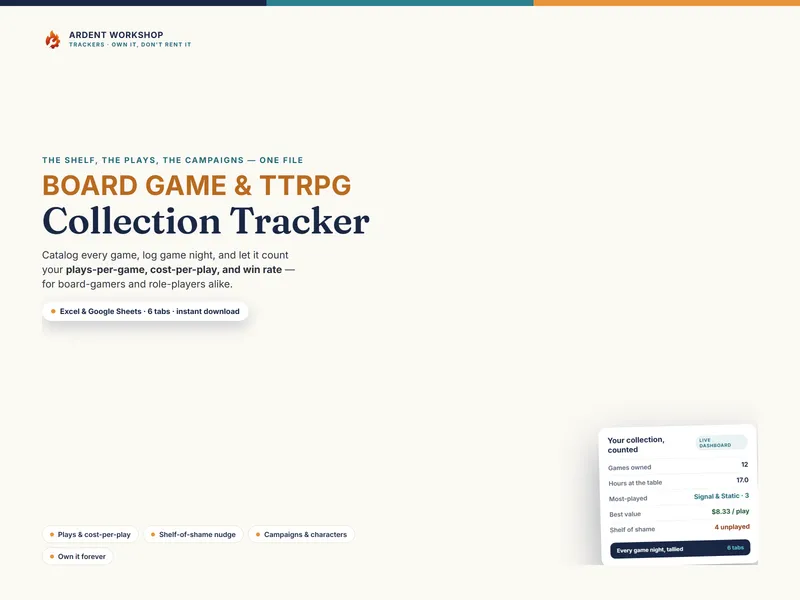
Board Game & TTRPG Collection Tracker — Excel & Google Sheets
A board game & TTRPG collection tracker for Excel & Google Sheets — catalog your shelf, log plays, and track cost-per-play, win rate, and campaigns.
TrackersView details - $12.95 Spreadsheet

Streaming-Service Value & Watchlist Workbook — Cost Per Hour Watched, Keep/Rotate/Cancel Verdicts & a Rotation Planner for Excel & Google Sheets
A streaming tracker for Excel & Sheets that joins what each service costs to what you actually watched — cost per hour, a verdict, and a rotation plan.
TrackersView details