Keeper, dynasty, and redraft
- Redraft. Every roster clears at the end of the season and nobody carries over. Simplest to run, and the format where a team out of contention has the least reason to keep setting a lineup.
- Keeper. Each team carries a small number of players — commonly one to three — at a stated cost, and everyone else re-enters the draft.
- Dynasty. Rosters carry over almost entirely, and the annual draft is a rookie or free-agent draft rather than a full one. The deepest format, and the most work to administer.
What does a keeper cost?
Four pricing methods are in common use, and each rewards something different.
| Method | What a keeper costs | Best for | Watch out for |
|---|---|---|---|
| Round cost | The round the player was drafted in, escalating each year held | Leagues running the draft by hand, or off a printed board | Prices a late-round hit generously — cheap stars for years |
| Round cost minus a fixed number | A round-10 keeper costs your round-8 pick | Shortening hold times without extra bookkeeping | Undefined once the escalation runs past round one |
| Auction salary | The keeper's price against next year's budget, plus a raise | Auction leagues that want precise, smooth pricing | Needs an auction, or a shadow salary you maintain by hand |
| Contract years | A set price for a set number of seasons, signed in advance | Deep leagues that want a real trade market | The most administration, and unforgiving of vague first rules |
The three gaps that decide a keeper league
- Escalation. A keeper held at the same price forever is a permanent asset, and one lucky late-round pick becomes a decade-long imbalance. Every keeper cost has to rise. Whether it rises by one round a season or three is the single most consequential rule in the format — and the difference is invisible in year one.
- The undrafted player. What does a free-agent pickup cost to keep? This is the most-argued gap in keeper leagues, it is one sentence to close, and the player in question is always excellent. A mid-round cost with the usual escalation from there is the common compromise; a last-round cost is popular and expensive later.
- The maximum hold. Without a limit, the league's best players never re-enter a draft, and a new manager arrives to a picked-over pool. Three consecutive seasons is the common answer.
Two more worth writing down before they bite: what happens when two of a team's keepers would cost the same pick (the standard answer is that the second moves up one round), and whether a keeper's cost travels with the player in a trade or resets for the acquiring team.
Publish the keeper board before the draft
Declarations close, and then every team, every keeper and every cost goes up where the whole league can read it — along with the picks those keepers removed from the draft. A keeper league where you find out at the table who kept whom is a league where half the room prepared for a draft that isn't happening.
Where to get the rules written down
The Fantasy-League Commissioner & Draft-Day Kit includes a fill-in keeper and dynasty addendum, a table showing what a keeper drafted in each round costs to hold for three seasons under three escalation rules, and a draft-order sheet that publishes the keeper board and the removed picks together. If you are starting from nothing, the free League Constitution Starter covers the eight clauses every league needs first — see also what a league constitution is, how to write one step by step, and how a printable kit and your platform divide the work.
Templates that implement this
Tools for the person running the league
3 templates
A keeper and dynasty addendum, the escalation table to read before you choose a rule, and the rest of the commissioner's paperwork.
- $9.95 Mix

Fantasy League Commissioner Kit — League Constitution, Draft Board & 24 Rulings (Fillable PDF + Word)
A printable fantasy football commissioner kit: a fill-in league constitution, a wall draft board, a dues and payout ledger, and 24 disputes ruled.
TrackersView details - $6.95 Spreadsheet
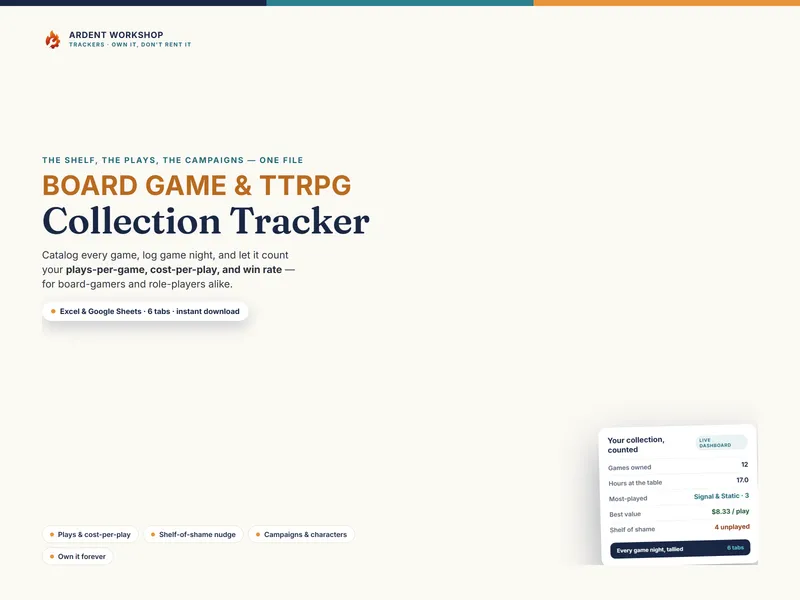
Board Game & TTRPG Collection Tracker — Excel & Google Sheets
A board game & TTRPG collection tracker for Excel & Google Sheets — catalog your shelf, log plays, and track cost-per-play, win rate, and campaigns.
TrackersView details - $5.95 Spreadsheet

Concert & Live-Show Log — Track Every Concert, Setlist, Wishlist & Spending (Excel + Google Sheets)
A concert tracker for Excel & Google Sheets — log every show's date, venue, setlist, and cost, rate the night, and see your whole live-music year.
TrackersView details