The framing is "own it, don't rent it" — but there is a sharper point here than ownership. A reminder app is an excellent tool for appointments: things with a fixed time, in the near future, that you already know about. Household renewals are none of those. They arrive once a year, they are decided months before their printed date, and the ones that cost you money are precisely the ones nobody thought to enter.
The positioning: a drawer → a wall chart → a rented app
Most households start with a drawer and an email filter, which is to say with nothing. From there, a printed wall chart is the structured middle ground: the whole year visible, with the lead times attached, on a sheet you own and reprint. A reminder app or subscription service is the hosted option — genuinely better at nudging, tied to an account, and only as complete as what somebody typed into it.
Wall calendar vs reminder app, side by side
"Reminder app" here means the phone-calendar and to-do category as a whole — the built-in reminders app, a shared family calendar, a subscription renewal tracker — not any one named product. Individual apps differ and change; check the one you are considering rather than taking a row below as a fact about it.
| Consideration | Printed wall chart (owned) | Reminder app (hosted) |
|---|---|---|
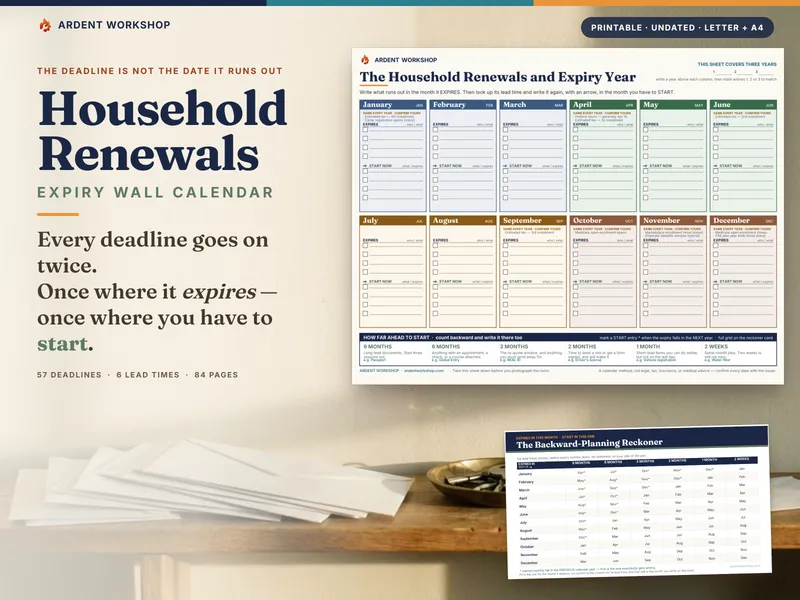
| What it knows about | Comes pre-printed with the deadlines a household has, so the pass is crossing out rather than remembering | Only what somebody typed in — which excludes the ones nobody thought of |
| When it prompts you | Carries a second, earlier entry: the month to start, counted backward from the expiry | Fires on the date entered, which is usually the printed expiry date |
| Lead times | Printed on the sheet with worked examples, plus a grid that turns an expiry month into a start month | Left to you to work out per deadline, in your head, across a year boundary |
| Who sees it | Everyone in the household, passively, without opening anything | One person, unless a shared calendar is set up and maintained |
| Same-week nudges | None — you have to walk past it | The genuine strength: a notification at the right hour on the right day |
| Survivability | Paper. No battery, no signal, no login, nothing to lapse | Depends on the account and the app still existing; an annual reminder can go missing for a year before anyone notices |
| Privacy | You choose what goes on the wall; the sensitive half can stay in a drawer | Entries typically sync to a provider's servers under their privacy policy |
| Cost | Paid once, reprinted as often as you like | Often free; renewal-tracking services frequently subscription-based |
Where a reminder app genuinely wins
The nudge itself. Nothing on paper will tap you on the shoulder at nine on a Tuesday, and for anything with a time of day — an appointment, a call, a payment that must clear today — a phone is simply the right tool. Apps are also better at the short horizon: this week, this month, the thing you will otherwise forget in four days. And a shared family calendar is genuinely useful for events, where the whole point is that several people need the same date.
Where the wall chart wins
Coverage and lead time — the two failures that actually cost money. Coverage, because a printed chart arrives with the deadlines already listed, so the pass is crossing out rather than remembering — in the pack's worked example that turned up annual subscriptions nobody could name and a domain from an abandoned project. Lead time, because the entry that changes an outcome is not the expiry date but the start date, and working that out reliably needs both a reference for how far ahead each kind of renewal has to begin and something that counts backward without an off-by-one across a January.
And visibility. A sheet inside a closet door is read by a second adult who did not have to be added to anything, on a day nobody decided to check.
Using both
Most households should. Fill the chart in once — every deadline written twice, the expiry month and the start month — and then set phone reminders on the start months, from the chart. That gets the app's nudge pointed at the date that changes the outcome instead of the one that reports it, and the chart stays as the complete list underneath, so a lost reminder is recoverable in thirty seconds rather than a year later.
Where to start
Take the free Renewal Lead-Time Card — twelve household deadlines with the lead time and the cost of missing each one — then read what a renewal lead time is, work through how to never miss a household renewal deadline, and put the whole year on a wall with the Household Renewals & Expiry Wall Calendar. See the templates for homeowners hub for the rest of the set. This is a calendar-method comparison — not legal, tax, insurance, immigration, or medical advice, and every date should be confirmed with the issuer.
Frequently asked questions
- Is a wall calendar or a reminder app better for household renewals?
- For the once-a-year deadlines, a wall chart usually wins, and not because apps are bad at reminding. It is because of what gets entered and when it fires. An app only knows about the renewals somebody remembered to type in, which are not the ones that cost money; and a reminder typed against a printed expiry date fires on the date the renewal is already due, which is the wrong date for anything with a real lead time. A wall chart is passive: it is read by everyone in the house, without anybody deciding to open it. For the day-to-day — a dentist appointment next Tuesday — a phone is clearly better.
- Why does a reminder on the expiry date not help?
- Because many once-a-year renewals are decided months before they expire. A passport application sits in a processing queue with mailing at both ends; an insurance renewal is only worth shopping while there is still time to move; a professional license usually cannot be renewed until continuing education is finished. A reminder set on the printed date tells you about a decision that has already been made for you. The fix is not a different app — it is writing down a second date, counted backward from the expiry.
- Can't I just set the reminder earlier?
- Yes, and you should — that is exactly the right instinct. The difficulty is knowing how much earlier for each kind of deadline, and doing that arithmetic across a January without an off-by-one. That is the part a printed lead-time reference and a backward-planning grid actually solve; the reminder itself is the easy half. Set them from the chart, on the start month.
- What happens to reminders when the household changes phones or plans?
- Recurring reminders are among the quietest things to lose. They can survive a phone change, or not, depending on which account they were created under and whether that account moved with you — and the failure is silent, because nothing fires. Annual reminders in particular can go a full year before anyone notices they are gone. A printed sheet has no such failure mode, and the household can see at a glance whether it is still there.
- Does anyone else in the house see my phone reminders?
- Usually not, unless the household deliberately runs a shared calendar and everyone maintains it. That is the practical argument for paper: a second adult who can see that the car inspection is due in February is a second adult who might book it. A sheet on the inside of a closet door is read by everybody without anybody being invited to an account.
- Is it safe to put renewal dates on a wall?
- Dates and initials, yes. A full record is a different matter: a completed list of a household's documents, their numbers, who the providers are and where the originals are kept is an inventory, and on a wall it is read by every visitor, every tradesperson, and every photograph taken in that room. The workable split is to put what, whose, when it expires and when to start on the wall, and keep numbers, providers, contacts, locations and costs in a booklet in a drawer.