Nobody misses a passport renewal because they do not care about the trip. They miss it because the deadline arrived once, quietly, in a year when nothing about it was visible — and because by the time it was visible, it was already too late to fix.
That last part is the bit worth sitting with. Many of the deadlines below are decided months before their printed date. A calendar full of expiry dates tells you what state you are in. It does not change anything.
The household deadlines that actually cost money
Not all of them are equal. These are the ones where missing costs real money, a real trip, or real time at a counter:
Identity and travel documents
Passports are the longest lead time in an ordinary household and the least forgiving. Processing is measured in weeks before an application is even opened, with mailing at both ends — and many destinations will not admit you unless the passport is valid for six months beyond your travel dates, so the date that matters to a trip is not the date printed in the book. A child’s passport is harder again: in most cases a shorter term, a fresh in-person application rather than a mail renewal, and usually both parents present. Processing times change through the year and entry rules are set by the destination, so check the current figures at travel.state.gov (opens in new tab) before you plan around either.
A REAL ID-compliant license or ID card needs original documents you may have to order from another state, which is the slow part; the required list is published by DHS (opens in new tab) and by your own state licensing agency, and a passport is an accepted alternative at a checkpoint. A driver’s license is often ten minutes online — and sometimes a vision test, a photo, or an address that no longer matches, and you find out which only when you start.
Vehicle
Registration is usually quick, but in many states it is gated behind an inspection or emissions test — so the real deadline is the test, and the test’s own lead time is not for the test. It is for the repair the test finds, and a failed inspection with two weeks left is a scramble for a parts order and a shop slot at once.
Insurance and policies
These rarely lapse. They auto-renew, and that is exactly the problem: the deadline that matters is not the renewal date but the date the renewal quote lands, which is the last comfortable moment to shop the same cover elsewhere. Home and auto both reward about three months. A term life policy deserves far more room. At the end of a level term many policies do not simply lapse — the premium steps up, often steeply — while others end outright; read your own contract for which yours does. Either way, replacing the cover means underwriting, and underwriting is easier while you are still a year younger.
Home, safety and devices
Smoke and carbon-monoxide alarms have a whole-unit service life, not just a battery, and the date is stamped on the back where nobody looks — the US Fire Administration (opens in new tab) publishes general replacement guidance, and your manufacturer’s stated life governs. Manufacturer warranties on major appliances are worth a note two months before they end — running the thing hard and reporting anything odd while somebody else still pays is the cheapest habit on this list.
Money, health and work
Open enrollment windows close hard, and outside them you generally need a qualifying life event to change anything — healthcare.gov (opens in new tab) defines which events count. An FSA balance is use-it-or-lose-it apart from whatever carryover or grace period your specific plan offers; IRS Publication 969 (opens in new tab) sets out the rules, and your own plan document decides which of them you get. Annually-billed subscriptions give no monthly reminder of themselves, which is the entire reason they are annual. And a professional license is really a deadline for the continuing education behind it, which is the one people discover in the last month of a one-to-three-year cycle.
Why the second date is the whole method
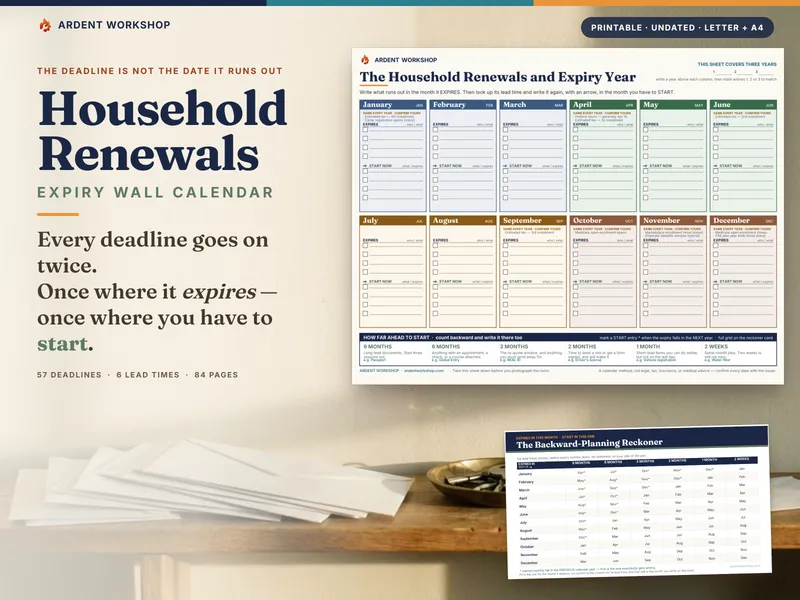
Every deadline above has two dates: the one printed on the document, and the one you have to act on. Writing only the first is what a drawer already does.
So write both. A glance at January should be able to say nothing expires this month, but three things start — which is the most useful sentence a household calendar can produce, and one no reminder app has ever said to anybody, because a reminder fires on the date that was typed in.
Lead times, roughly
Grouping renewals into a handful of named bands works far better than a bespoke number of days per item — a band is something you can hold in your head, and it makes a printed backward-planning grid possible at all.
| Start | What it is protecting against | Examples |
|---|---|---|
| 9 months | A processing queue with mailing at both ends, plus a validity rule you may not know about | Passports, immigration filings, end of a level term |
| 6 months | Anything with an interview, a background check, or a course attached | Professional licenses and their continuing education, trusted-traveler renewals, camp registration |
| 3 months | The re-quote window, and anything needing a document you have to send away for | Home and auto insurance, REAL ID, lease notice periods, school enrollment windows |
| 2 months | Time to book a slot, get a form signed, or fix what a test finds — and still make the date | Vehicle inspection, driver's license, open enrollment, the FSA year, appliance warranties ending |
| 1 month | Short-lead items you can do online, but not on the last day | Vehicle registration, pet vaccinations and licenses, property tax, annual subscriptions, cards behind auto-payments |
| 2 weeks | Same-month jobs — still not zero | Filter cartridges, estimated tax installments |
These are planning allowances, not published standards. Where an agency, an insurer, a licensing board, a manufacturer or your own state publishes a real figure, that figure wins — and those figures change through the year, so confirm them with the issuer rather than with a table.
The deadline behind the deadline
Several of these are two deadlines wearing one coat, and the earlier one is invisible:
- A professional license usually cannot be renewed until the continuing education is done.
- A vehicle registration cannot be renewed until the inspection has passed.
- A pet license usually needs a current rabies certificate.
- A REAL ID needs certified documents you may have to order from a vital-records office in another state.
In each case the entry that belongs on the chart is the inner one.
What goes on a wall, and what doesn’t
Once a household writes all of this down, the record becomes a complete inventory of its documents and the dates it will be dealing with them. On a wall, that is read by every visitor, every tradesperson, every delivery — and every photograph taken in that room.
The workable split is simple. On the wall: what it is, whose it is, the month it expires, the month to start. In a drawer: document and policy numbers, account references, who the provider is, who to call, where the original is kept, where the copy is kept, and what it cost. Where the original lives is on the private list for the same reason the location of a spare key is.
It has already lapsed. Now what?
Something on your list has probably already expired. That is the normal state of a household, and the order of operations is the same every time:
- Find out whether it is a grace period or a cliff. Many renewals have a window after the date where nothing bad has happened yet. A few have very little or none — some insurance policies carry a short payment grace period and some do not, so ask the insurer rather than assuming.
- Stop the thing the lapse blocks. If the car cannot legally be driven, do not drive it to the office.
- Ask the issuer what the reinstatement path is. There is almost always one, and it is almost never the same as the renewal path.
- Start whatever has a queue first, and do the paperwork while you wait.
- Write the new date down before you file the paperwork — at the one moment in the whole process when you actually know it.
Where to start
Take the free Renewal Lead-Time Card — twelve of these deadlines with the lead time and the cost of missing each one, plus a grid that turns an expiry month into a start month. No email, no signup.
Then read what a renewal lead time is, or wall calendar vs reminder app for why the once-a-year deadlines behave differently from the rest of your calendar. When you want the whole year on one sheet — all 57 deadlines, the lead time for each, and the grid that counts backward for you — that is the Household Renewals & Expiry Wall Calendar.