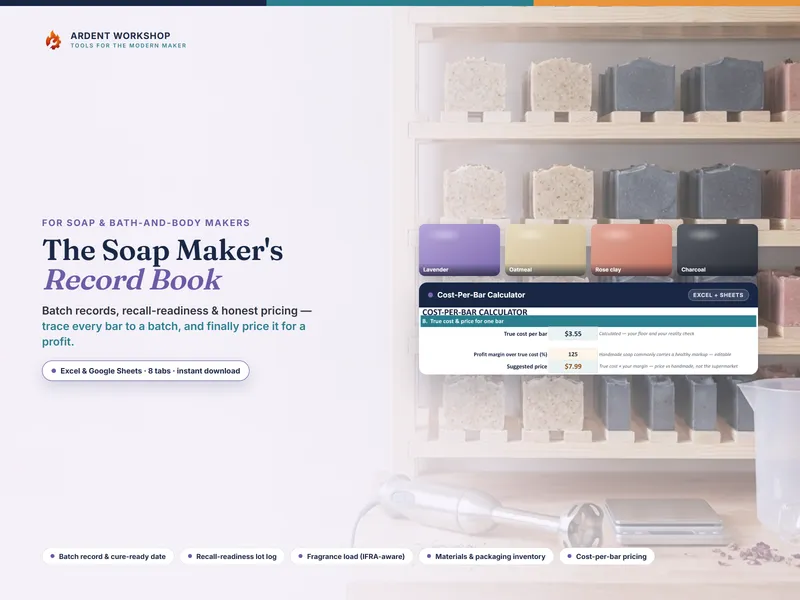
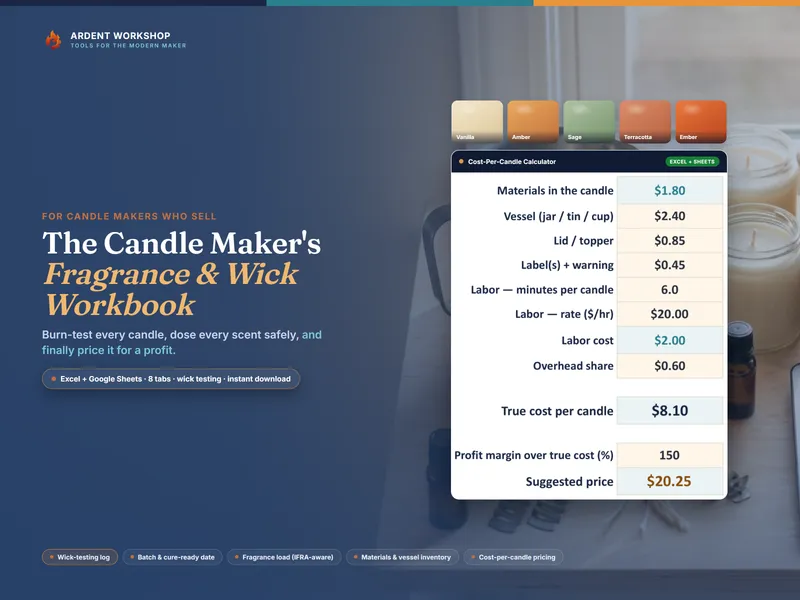
This isn't really spreadsheet-versus-software. It's "which of my problems is actually the expensive one." Makers tend to shop for software when they feel disorganized, and disorganized usually means stock — but the thing quietly costing them money is almost always pricing, and pricing is the half a spreadsheet does best.
When a workbook is exactly right
- You want to know what each scent truly costs, including your own time.
- You buy ingredients by the case and sell by the unit, and the conversion has never been written down properly.
- Several products share a base recipe, and you are maintaining the same oil lines in more than one place.
- A supplier raised prices and you are not sure which products stopped working.
- You are being asked for a wholesale price for the first time.
- You — and maybe one other person — touch the numbers.
The three things a workbook does better than an app
- It shows you the whole build. An app hands you a number. A workbook shows you materials, then labor, then overhead, then the margin at each tier — which is how you learn where a price came from and where it can move. That understanding transfers; a number does not.
- It reprices by category, the way prices actually rise. Supplier increases do not arrive one ingredient at a time. Freight lifts every glass vessel; a crop year lifts every essential oil. A workbook can raise a whole category and recalculate every product at once, then tell you which ones need a new price and what it should be.
- Your cost history stays yours. Cancel a subscription and you lose the record of what you paid for wax in 2025. That history is what lets you argue with a supplier, and it is worth keeping in a file you own.
When you've outgrown it
- You are selling the same stock through a shop, markets and two stockists, and reconciling it by hand.
- You have quoted a wholesale lead time you cannot check against your cure dates.
- "How many of that scent do I have?" requires walking to the shelf.
- You want an ingredient price change to update a live catalog rather than a file you remember to open.
- Someone else is making product, and they need to see stock without seeing your margins.
What the two tools are actually for
| The job | Costing & pricing workbook | Maker / inventory software |
|---|---|---|
| Cost per unit from pack prices | Yes — and it teaches you the method | Yes |
| Bill of materials per recipe | Yes, with batch vs. per-unit lines | Yes |
| Reprice a whole catalog by category | Yes, in one cell | Sometimes, per-ingredient |
| Retail and wholesale margin side by side | Yes, with a per-tier verdict | Usually via price tiers |
| Keystone and below-cost checks | Yes | Rarely |
| Live stock that decrements as you sell | No | Yes — the main reason to switch |
| Production scheduling against cure times | No | Yes |
| Multi-channel sales in one place | No | Yes |
| Lye / saponification math | No — use a dedicated calculator | Sometimes |
| Cost | One-time, yours forever | Monthly subscription |
The order that saves the most money
Settle your costs and prices first, in a file you own. Almost every maker who feels they need software discovers, once the costing is done, that two or three products were the problem — usually a wholesale price agreed in conversation, and a product whose labor was never counted. Fixing those is worth more than any subscription, and it costs once.
Then, when stock and scheduling genuinely become the bottleneck, move — and move with your numbers already right, so the software inherits good costs instead of enshrining bad ones.
Related reading
Start with what keystone pricing is — the arithmetic that decides whether wholesale is possible at all — and what belongs in cost of goods sold for handmade work. For a walkthrough, see how to cost a candle and how to price handmade products. The broader stock question is covered in spreadsheets vs inventory software, and every maker tool is on the templates for craft sellers and templates for Etsy sellers hubs.
Frequently asked questions
- When should a soap or candle maker move from a spreadsheet to an app?
- When production scheduling and stock across several channels — a shop, markets and stockists — is the thing eating your evenings, not pricing. The tells: you are counting oils by walking the shelf, you have promised a wholesale lead time you cannot verify against cure dates, and you cannot answer 'how many bars of that scent do I actually have?' without going to look. Pricing itself is a solved problem in a spreadsheet, often for years.
- What can soap-making software do that a spreadsheet can't?
- Two things properly. It keeps a live stock level that decrements as you make and sell, across every channel at once — so a market sale and a shop order draw down the same inventory without you reconciling anything. And it schedules production against cure times and real stock cover, so it can tell you what to make this week. A spreadsheet can model either one, but it cannot keep them in sync on its own or update itself when a sale happens somewhere else.
- Is a spreadsheet good enough for costing and pricing handmade soap and candles?
- For costing and pricing, yes — and for longer than most makers expect. A well-built workbook handles cost-per-unit from pack prices, a bill of materials per recipe, labor and overhead allocation, retail and wholesale margin, keystone checks, and repricing the whole catalog when a supplier raises prices. Where a spreadsheet lags is live multi-channel stock and production scheduling. Price in the workbook; consider software when stock and scheduling become the bottleneck.
- Do I still need a lye calculator if I have a costing workbook?
- Yes, always, and they are not the same tool. A costing workbook tells you what a bar costs and what it should sell for; a saponification calculator tells you how much lye a specific blend of oils needs, which is a safety question. Run every cold-process recipe through a lye calculator before you pour, no matter what your pricing file says. Free ones exist and are linked from the workbook itself.
- How much does soap-making software cost vs a workbook?
- A one-time workbook is a single low cost you own forever, with your recipes and cost history in a file you keep. Dedicated maker or inventory software is typically a recurring monthly subscription. The subscription earns its keep once the time it saves on stock and scheduling exceeds what it costs — but paying monthly while your real problem is 'I have not repriced since 2024' buys capability you are not using.