You already know how to pour a candle. This workbook is for the other half of a candle business — testing every candle until it burns clean, keeping a clean record of every batch, dosing fragrance safely, and the one that quietly decides whether it pays: knowing what a candle truly costs you, so you can price it for a profit instead of a guess. It turns the back-room chaos into a calm, repeatable system without getting in the way of the part you love.
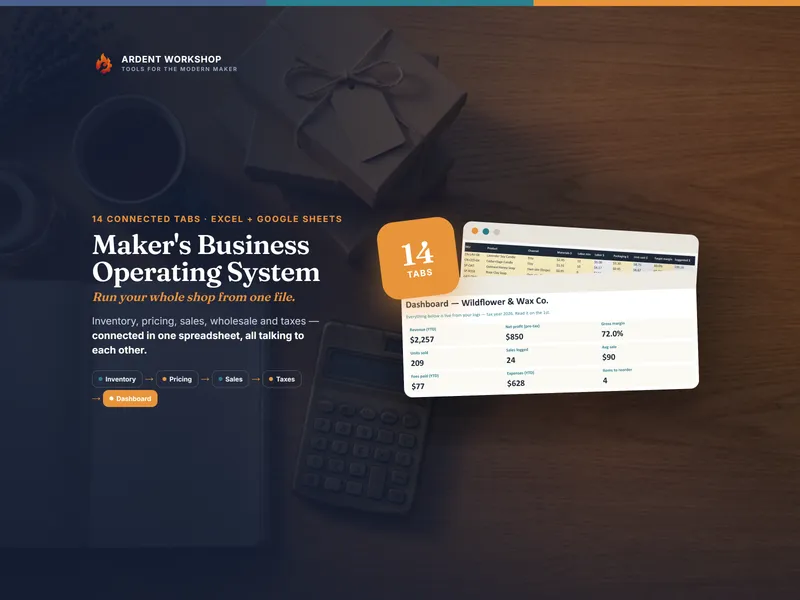
One workbook, the whole selling side of the bench. Test every wick, log every batch with a cure-ready date, keep your wax and vessels stocked, dose fragrance safely, and finally price your candles for a profit — with the jar and your labor counted, the two lines many makers leave out.
What’s inside:
- A wick-testing log (Excel + Google Sheets) — one row per burn test for the wax and vessel, the wick series and size, the fragrance load, the full-melt time, the melt pool / flame / soot, the hot and cold throw, the burn rate, and a PASS / SIZE UP / SIZE DOWN verdict — because a candle is an open flame in someone’s home, and only a tested one is safe to sell
- A batch record log (Excel + Google Sheets) — one row per batch: the pour date, a unique lot code, the candle type, the wax and vessel, the wax weight, the fragrance and its load, the wick, and the cure days — and the workbook works out the cure-ready date, so nothing sells before it’s ready
- A wax, fragrance & supplies inventory + a vessels & packaging inventory (Excel + Google Sheets) — track materials by supplier lot and vessels & packaging by a reorder point; it auto-flags low stock so a recall is traceable and a tested batch never strands
- A fragrance load calculator (Excel + Google Sheets) — turn a target percentage into a fragrance weight for a batch and per candle, with a check that flags whether your rate is within the wax’s stated maximum usage rate
- A cost-per-candle calculator (Excel + Google Sheets) — your material cost per candle (the batch’s material cost divided by the candles it yields), then your true cost per candle (materials, the vessel, packaging, labor, overhead), then a fair price
- A wax & candle type reference — every candle from a soy jar to a flameless wax melt, with its cure time, typical fragrance load, and how it burns
- A Wick-Testing, Burn-Safety & Labeling guide + printable records — the burn-test method, wick sizing, fragrance load and flashpoint, the fire-safety warning label, the batch-and-test workflow, troubleshooting, and print-and-use wick-test / batch / receiving sheets
The working part really works: the workbook has eight tabs with live calculators — type your numbers and the cure-ready dates, the fragrance weights, the costs, and the prices compute for you.
Excel or Google Sheets — both are ready. The .xlsx opens natively in Microsoft Excel and LibreOffice Calc, and the download also carries a link to a ready-made Google Sheets version. Click “Make a copy” and all eight tabs land in your own Google Drive with every formula, dropdown, and safety flag already working — no importing, nothing to rebuild. It’s the same workbook either way, so use whichever you actually work in.
Evergreen — use it any year: candle types, cure times, the batch and fragrance math, the wick-testing method, and the pricing method are timeless, and the logs use a date column you fill in yourself.
Instant digital download. Nothing ships. The files are yours to use in your own candle business.
Created with AI assistance under Ardent Workshop’s creative direction, then reviewed and edited before release. This is a record-keeping & testing book and maker’s reference, not a recipe book or fire-safety, regulatory, or legal certification. A candle is an open flame in someone’s home, so your own burn testing — not this workbook — is what proves a particular candle is safe to sell. Always burn-test every wax, wick, vessel, and fragrance combination, follow each fragrance’s stated maximum load and flashpoint for your wax (fragrance suppliers publish these, generally following IFRA — the International Fragrance Association — guidelines), use heat-safe vessels, and confirm the labeling and fire-safety rules for your country with the current standard (in the US, ASTM F2058 for candle fire-safety labeling), the relevant safety body (such as the US Consumer Product Safety Commission, the CPSC), and your insurer. Cure times, fragrance loads, and burn rates are typical starting points; confirm with your own testing and your scale. The costing and pricing examples are illustrative, not financial or tax advice. Not affiliated with or endorsed by any standards body, supplier, or marketplace.