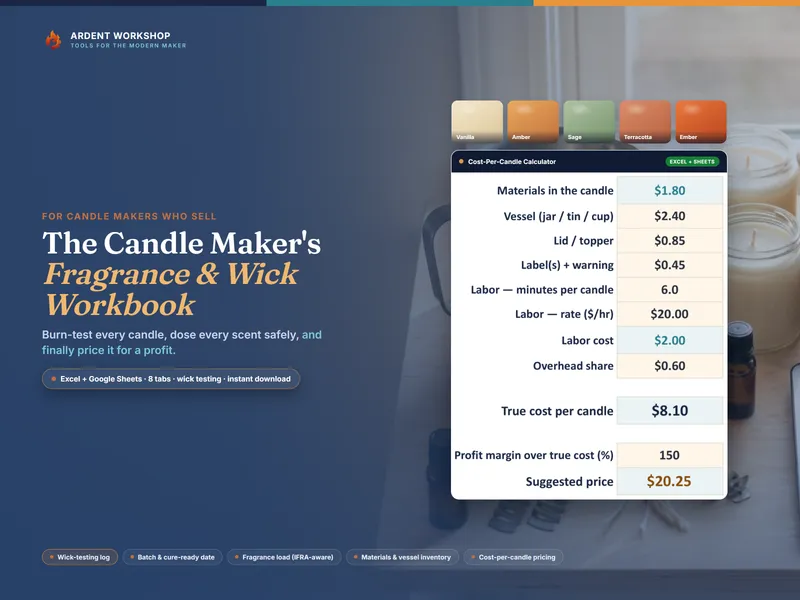
Most makers can tell you what a candle’s wax and fragrance cost. Far fewer can tell you what the candle costs — because four of the six numbers that make up a unit cost never appear on an invoice.
Here is the whole thing, worked end to end on a single product: an 8 oz soy tin, poured twelve to a batch. Every figure below is illustrative — use your own invoices — but the order is the part worth copying.
Step 1 — Turn every pack price into a cost per unit
You buy by the case and sell by the unit, so nothing can be costed until both are in the same unit. For each ingredient, divide what the pack cost by how much is in it:
| What you buy | Pack price | Pack size | Cost per unit |
|---|---|---|---|
| Soy wax, 45 lb case | $109.00 | 720 oz | $0.1514 / oz |
| Fragrance oil, 16 oz bottle | $27.00 | 16 oz | $1.6875 / oz |
| 8 oz seamless tin, 96-count case | $118.00 | 96 ea | $1.2292 / ea |
| Pretabbed wick, 500-count | $62.00 | 500 ea | $0.1240 / ea |
| Wick sticker, 1000-count | $14.00 | 1000 ea | $0.0140 / ea |
| Front label, 250-count | $46.00 | 250 ea | $0.1840 / ea |
| Warning label, 500-count | $22.00 | 500 ea | $0.0440 / ea |
| Kraft box, 100-count | $58.00 | 100 ea | $0.5800 / ea |
| Care card, 250-count | $28.00 | 250 ea | $0.1120 / ea |
Do the conversion once, here, in the unit you weigh with. A 45 lb case is 720 oz, not 45. Entering 45 with a recipe written in ounces makes every candle sixteen times cheaper than it is — and it is the single most common costing error in handmade pricing, because nothing about it looks wrong.
Two lines people leave out and shouldn’t: freight (a $146 case of glass plus $34 of shipping is a $180 pack) and retail packaging (the box the candle sits in on a shelf is part of what the candle costs). One line people put in and shouldn’t: the mailer you post it in. That is fulfillment, it varies by order, and a wholesale buyer isn’t creating it.
Step 2 — Split the recipe into batch lines and unit lines
This is the step that decides whether the rest of your numbers mean anything.
- Batch lines are spent once per batch. Pour a bigger batch and each candle’s share gets smaller — so a batch line divides by the yield.
- Unit lines are spent once per finished candle. Pour a bigger batch and each candle still needs its own — so a unit line does not divide by anything.
For our twelve-tin batch, at 7 oz of wax per tin and fragrance at 8% of wax weight:
| Line | Per | Qty | Cost/unit | Line cost |
|---|---|---|---|---|
| Soy wax | Batch | 84 oz | $0.1514 | $12.72 |
| Fragrance oil | Batch | 6.7 oz | $1.6875 | $11.31 |
| Batch total | $24.02 | |||
| 8 oz tin | Unit | 1 | $1.2292 | $1.23 |
| Wick | Unit | 1 | $0.1240 | $0.12 |
| Wick sticker | Unit | 1 | $0.0140 | $0.01 |
| Front label | Unit | 1 | $0.1840 | $0.18 |
| Warning label | Unit | 1 | $0.0440 | $0.04 |
| Kraft box | Unit | 1 | $0.5800 | $0.58 |
| Care card | Unit | 1 | $0.1120 | $0.11 |
| Unit total | $2.29 |
So: $24.02 ÷ 12 tins = $2.00 per tin from the batch, plus $2.29 of per-unit lines.
Material cost = $4.29 a tin.
The mistake worth naming
Mark the tin as a batch line and the workbook charges each candle a twelfth of it — $0.10 instead of $1.23. The candle now looks $1.13 cheaper than it is, which is about 26% of its material cost. Every wholesale price you set from that number is wrong in the same direction, and it’s wrong in the direction that flatters you.
The test, whenever you’re unsure: if I doubled the batch, would I need twice as many of these? If yes, it’s a unit line.
Step 3 — Count the yield honestly
Yield means candles you could put a price on and hand to a customer. Not tins poured.
If a twelve-tin pour gives you eleven good candles and one with a sinkhole you’ll burn at home, the yield is 11, not 12 — and the material cost per tin rises from $4.29 to $4.47. Count one real batch out once per recipe, write the real number down, and you never have to think about it again.
Step 4 — Add your own labor
Now the first number that never appears on an invoice.
Total your hands-on minutes for the batch and divide by the yield, then add anything you do to each candle individually. For this batch: about 70 minutes of melting, weighing, pouring and cleanup across twelve tins is roughly 6 minutes each, plus about 2 minutes each to trim the wick, label and box. Eight minutes a candle.
At a rate of $28/hour — the number you’d have to pay a competent person to do it instead, not a wish and not whatever’s left over — that’s $3.73 a candle.
Do not count cure time. You aren’t standing there.
Step 5 — Allocate overhead by time, not by unit
The second invisible number: the cost of having a workshop at all. Space, utilities, insurance, licensing, software, marketing, market fees, and the tools you reuse — a silicone mold, a pouring pitcher, a heat gun, a scale.
Say $1,450 a month across 90 production hours. That’s $16.11 an hour, so eight minutes carries $2.15.
Allocate it by time, not evenly per unit. Splitting overhead equally across units would charge a two-minute lip balm the same as an eight-minute candle — making the balm look unsellable and the candle look cheap. Time is what your workshop is actually consumed by.
And never put ingredients or packaging into the overhead figure. They’re already costed per unit in Step 2. Listing a wax invoice as overhead too charges every candle for the same wax twice and makes your whole catalog look like it loses money.
Step 6 — The true unit cost
| Materials | $4.29 |
|---|---|
| Labor (8 min at $28/hr) | $3.73 |
| Overhead (8 min at $16.11/hr) | $2.15 |
| True unit cost | $10.17 |
Note how the numbers land: materials are only 42% of what the candle costs. A maker pricing off “wax plus fragrance plus the tin” is pricing off less than half their cost — which is exactly why so much handmade work is quietly unprofitable at a price that feels reasonable.
Step 7 — Set retail from a target margin
Retail isn’t cost times a habit. It’s cost divided by what you intend to keep:
Retail = unit cost ÷ (1 − target margin)
At a 65% target: $10.17 ÷ 0.35 = $29.06, so call it $29.50.
Pick 65% deliberately rather than 50%, and the reason is the next step.
Step 8 — Check it against keystone before you ever quote wholesale
Keystone means wholesale at half of retail, and most shops won’t move off it. At a retail margin of R, a keystone wholesale price leaves you 1 − 2(1 − R):
| Your retail margin | Keystone wholesale leaves you |
|---|---|
| 50% | 0% — you’d sell at cost |
| 60% | 20% |
| 65% | 30% |
| 70% | 40% |
Our $29.50 retail halves to $14.75 wholesale, which on a $10.17 cost is a 31% margin — workable. Had we set retail at a 50% margin ($20.34), keystone would have been $10.17: exactly cost, for every case, forever.
Every point of retail margin above 50% buys you two points of wholesale margin. Nothing below 50% can be wholesaled at keystone at all. That’s worth knowing before a shop asks, not after they reorder.
Step 9 — Then do it again in eight weeks
The part nobody plans for. Wax goes up 12%, fragrance 8%, and vessels 5% on freight — a realistic quarter. Our candle’s cost moves from $10.17 to $10.43, and at the same $29.50 retail the margin slips from 66% to 65%. Survivable here. The wholesale tier is where it bites, because 30% of cushion erodes more than twice as fast as 65% does.
Doing this by hand for one candle is an afternoon. Doing it for eleven products is why most makers don’t, and why prices set two years ago quietly stop covering what the products now cost. The fix is structural: cost everything from one ingredient table, so changing a pack price moves every product at once.
That’s exactly what the Candle & Soap Recipe, Repricing & Wholesale Workbook does — this whole walkthrough is one of its eleven pre-loaded products, and its Price-Change Simulator runs Step 9 across a catalog in a single cell.
What this walkthrough deliberately didn’t cover
Fragrance load limits and wick sizing. Those are quality and safety questions, not costing ones, and free calculators do them well — a fragrance load calculator (opens in new tab) and a wick size selector (opens in new tab) are both free and ungated. Dose within your wax’s stated maximum and burn-test every combination regardless of what any chart says.
Batch and lot records. Pour dates, lot codes, cure-ready dates and wick-test verdicts are a different job with a different shape — the Candle Maker’s Fragrance & Wick Workbook keeps those.
Every figure above is illustrative. Supplier prices, pack sizes, yields, your hourly rate and your overhead are yours to enter, and this is a costing framework rather than tax, accounting or legal advice.