The formula
Keystone is one multiplication:
Keystone price = cost × 2 (a 100% markup, a 50% gross margin)
The classic retail ladder stacks two keystones — one for the shop, one for the maker:
- Wholesale ≈ 2× cost — what a shop pays you.
- Retail (MSRP) ≈ 2× wholesale, or 4× cost — what the shop charges the public.
That 4× ladder lets a stockist double your wholesale and still land at a price that matches your own. It's clean math — and it assumes cost is mostly materials.
Markup is not margin
The reason keystone gets quoted as "100% markup = 50% margin" — and the reason so many sellers underprice — is that markup and margin are measured against different things.
- Markup is what you add on top of cost: (price − cost) ÷ cost.
- Margin is what you keep out of the price: (price − cost) ÷ price.
A 50% markup is not a 50% margin. Add 50% to a $20 cost and the price is $30 — but the $10 you kept is only 33% of that $30 price, a 33% margin. To hit a margin you choose, convert it:
Markup = Margin ÷ (1 − Margin)
A 50% margin needs a 100% markup (keystone). A 60% margin needs a 150% markup. Charge a markup as if it were a margin and you underprice every piece you make.
Where keystone fits for handmade — and where it doesn't
Keystone assumes your cost is almost all materials. Handmade cost isn't: once you pay yourself a real wage, your labor sits inside cost alongside materials, packaging, and overhead. A piece with $6 of materials but an hour of work can cost $32.50 to make — and a full 4× retail on that ($130) is usually more than the market will pay.
- Low-labor goods (simple, fast-to-make items): keystone is a sensible floor. Doubling a mostly-materials cost still leaves room.
- Labor-heavy goods (as most handmade work tends to be): treat keystone as a reference, not a rule. Set a target margin you can defend, convert it to a markup, and let the price follow from your real cost — not from a fixed multiple.
- Wholesale: if you sell to shops, keep your own retail at or near the MSRP a stockist needs (about 2× your wholesale) so you don't undercut the stores carrying you.
Read from the other end: what keystone leaves you
The ladder above works forwards, from cost. It is worth running the same rule backwards, from the retail price you already charge, because that is the version that decides whether you can take a wholesale order at all.
If your retail price is built on a retail margin of R, then a keystone wholesale price — half of that retail — leaves you a wholesale margin of:
Wholesale margin = 1 − 2(1 − R)
| Your retail margin | So retail is | Keystone wholesale leaves you |
|---|---|---|
| 40% | 1.67× cost | −20% — you lose money on every case |
| 45% | 1.82× cost | −10% — you lose money on every case |
| 50% | 2.00× cost | 0% — you sell at cost |
| 55% | 2.22× cost | 10% |
| 60% | 2.50× cost | 20% |
| 65% | 2.86× cost | 30% |
| 70% | 3.33× cost | 40% |
| 75% | 4.00× cost | 50% |
Two things fall out of that table, and they are the whole reason to learn it. Every point of retail margin above 50% buys you two points of wholesale margin. And nothing below a 50% retail margin can be wholesaled at keystone at all — not thinly, not tightly. At cost or below.
So if your wholesale numbers look impossible, the problem is almost never wholesale. It is upstream, in a retail price that was never set high enough to be halved — which is a much more useful thing to discover before you quote a shop than after they reorder. The honest responses are to raise retail, cut the unit cost, negotiate off keystone (some shops will take 40%), or decline the account. "My minimum is higher than that" is a complete sentence.
A worked example
Take a hand-stitched leather cardholder: $6 materials, $3.20 packaging, an hour of work at a $22 wage, and $1.30 of overhead — a $32.50 true cost. A straight keystone (×2) would price it at $65; at 4× it'd be $130. In practice a maker might price it at $78 (a 2.4× multiplier — a 58% margin before fees, about 48% after), clearing about $37.64 of profit after the marketplace's cut. Keystone gave the starting point; the margin target set the real price.
Price it without doing the math by hand
You don't have to convert margins and multipliers in your head. The free Handmade Pricing Calculator turns a product's cost into a suggested retail price and the real profit, right in your browser. And the Handmade-Seller Pricing & Profit Workbook does it for your whole shop — a Pricing Lab that converts any margin to its markup, a wholesale builder, and a catalog that shows which listings actually make money.
If you make candles, soap or bath-and-body products, the Candle & Soap Recipe, Repricing & Wholesale Workbook runs the keystone check on every scent for you — and because every product is costed from one shared ingredient table, it re-runs the whole catalog when a supplier raises a price, flagging anything that has quietly slipped below cost at wholesale.
It sits where you want a pricing tool: between a blank spreadsheet (free, but you build every formula) and a rented monthly pricing app (overkill for a small shop). A workbook you buy once and keep — your numbers stay in your file. See the templates for craft sellers and templates for Etsy sellers hubs for the full maker toolset.
Templates that implement this
Templates that price with margin
8 templates
Cost it from true cost, convert the margin you need into the markup to charge, and see the real profit per listing — built for the sellers who need to get the number right.
- $24.95 Spreadsheet

Candle & Soap Maker Pricing Spreadsheet — Recipe Costing, Ingredient Repricing & Wholesale Margin Calculator | Excel + Google Sheets
Cost every candle and soap from one ingredient table, reprice the whole catalog at once, and see margin at retail and wholesale. Excel + Google Sheets.
Operator OSView details - $24.95 Spreadsheet
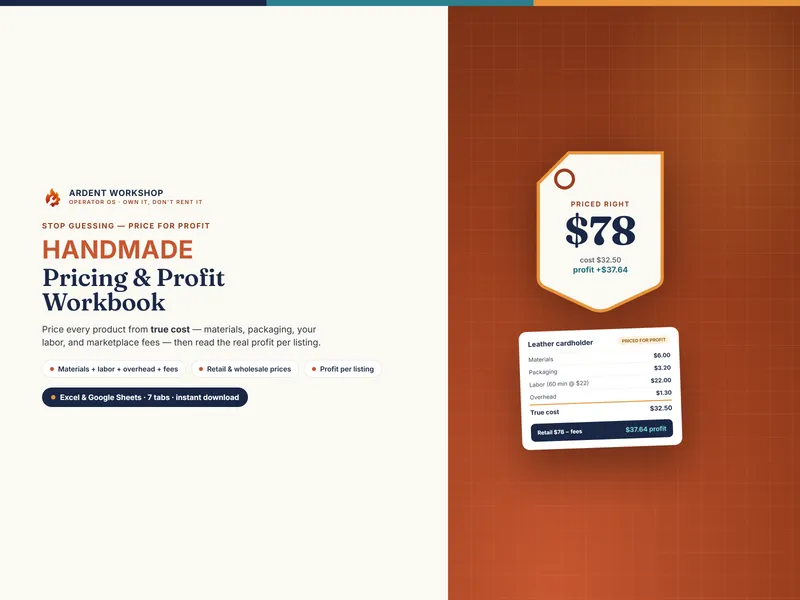
Handmade-Seller Pricing & Profit Workbook — Price Your Craft from True Cost, Markup vs Margin, Marketplace Fees & Wholesale (Excel + Google Sheets)
A handmade pricing workbook for Excel & Google Sheets — price every product from true cost (materials, labor, overhead, fees) and see the real profit on each.
Operator OSView details - $29.95 Excel
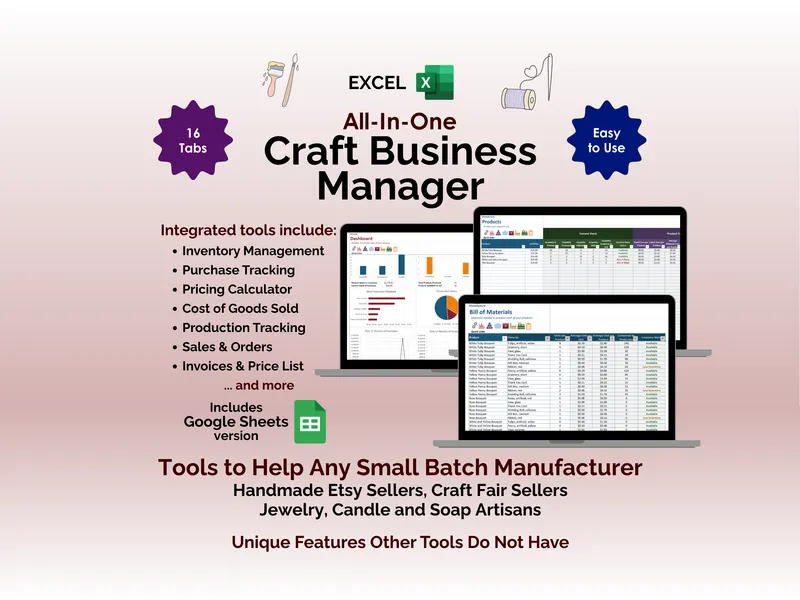
Craft Business Manager - Excel
Craft Business Manager is a 16-tab workbook for handmade sellers, connecting materials, product costs, production batches, sales, and invoices. Excel and Google Sheets versions are included.
Operator OSView details - $29.95 Sheets
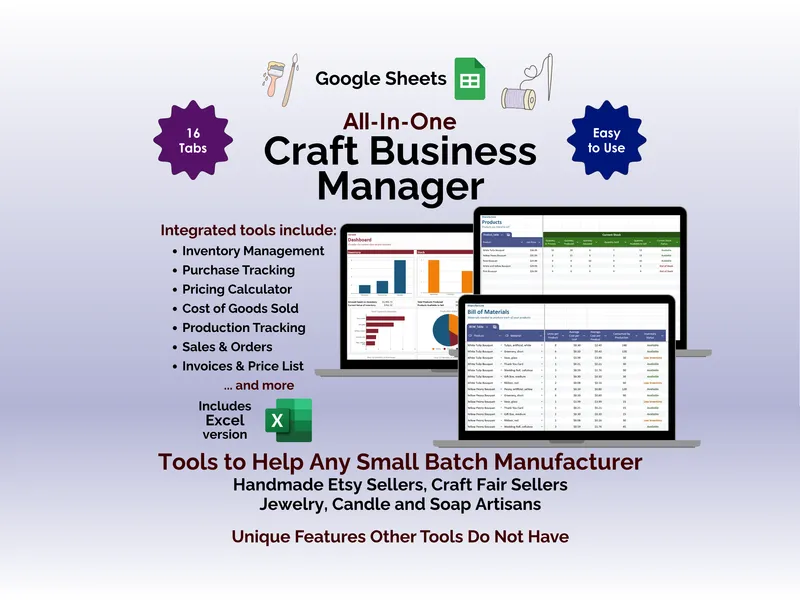
Craft Business Manager - Google Sheets
Sit ten craft sellers down and you'll get two answers about margin. This google sheets craft business manager turns raw material costs into priced products automatically.
Operator OSView details - $7.95 Excel
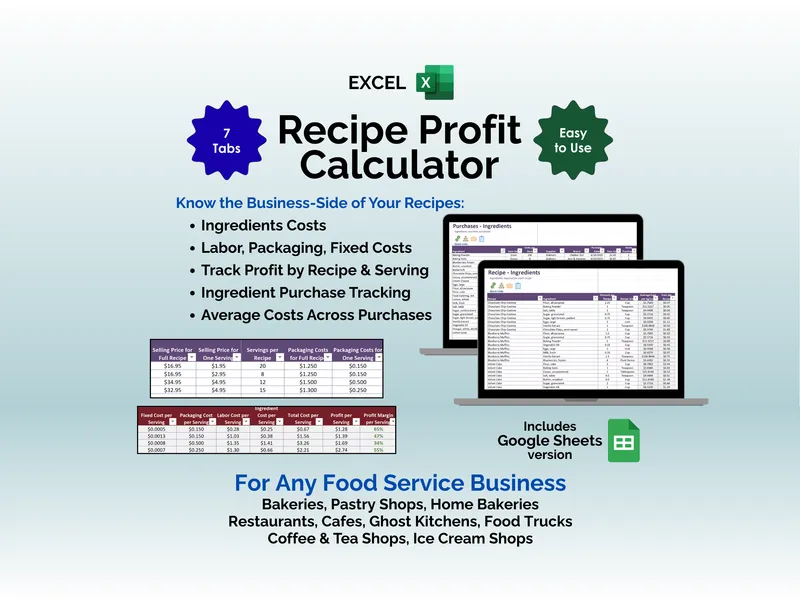
Recipe Profit Calculator - Excel
Pricing cakes by gut feel and hoping it covers cost? This excel recipe profit calculator turns ingredients, yield, and labor into a real margin per recipe and per serving.
Operator OSView details - $7.95 Sheets
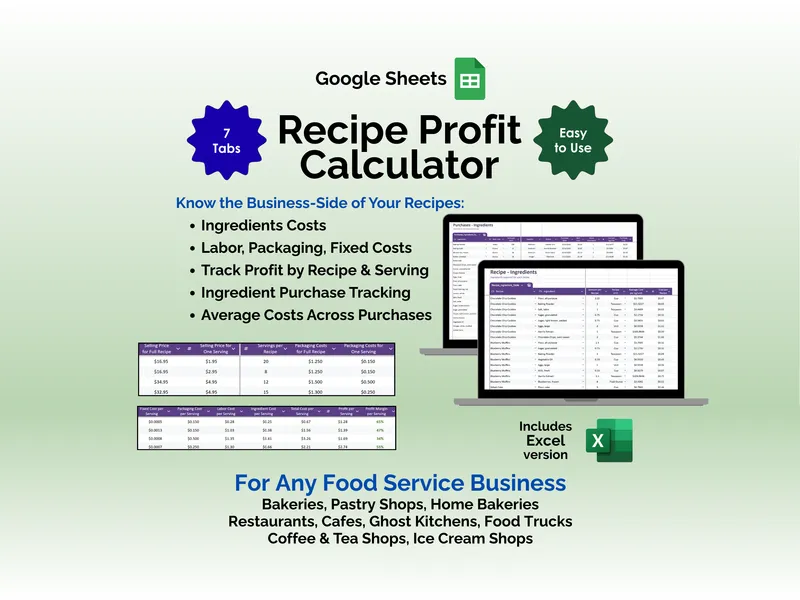
Recipe Profit Calculator - Google Sheets
Food businesses guess at pricing because the costing math is annoying. This google sheets recipe profit calculator returns per-recipe and per-serving margins automatically, with unit conversions and purchase averaging.
Operator OSView details - $14.95 Spreadsheet
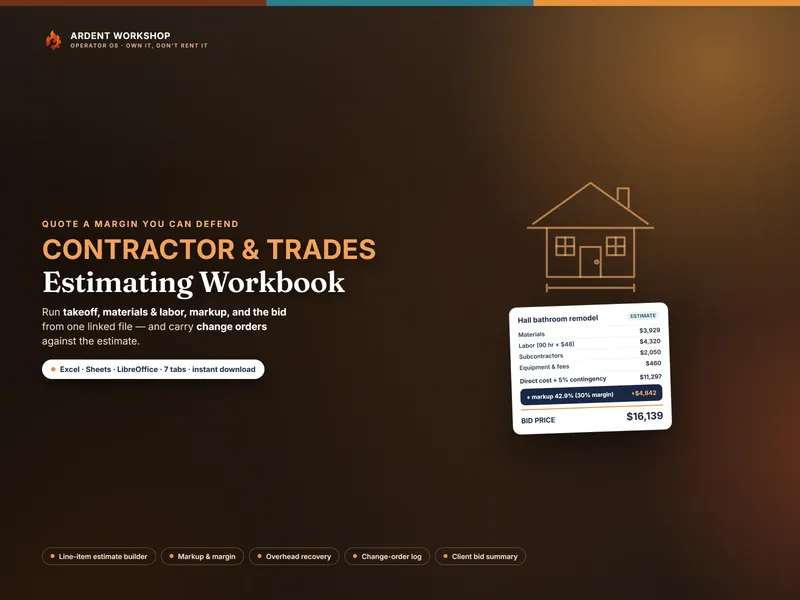
Contractor & Trades Estimating Workbook — Construction Job Costing, Bid Markup & Margin, Overhead & Change Orders (Excel + Google Sheets)
A contractor estimating workbook for Excel & Google Sheets — line-item job costing, bid markup vs margin, overhead, and change orders in one file.
Operator OSView details - $99.00 Bundle

Maker's Complete Business System — 14-Product Bundle for Handmade Sellers (Excel + Google Sheets + PDF)
The Maker's Complete Business System: a handmade-seller bundle of 14 products — pricing, orders, inventory, listings, shop policies and legal templates.
Operator OSView details