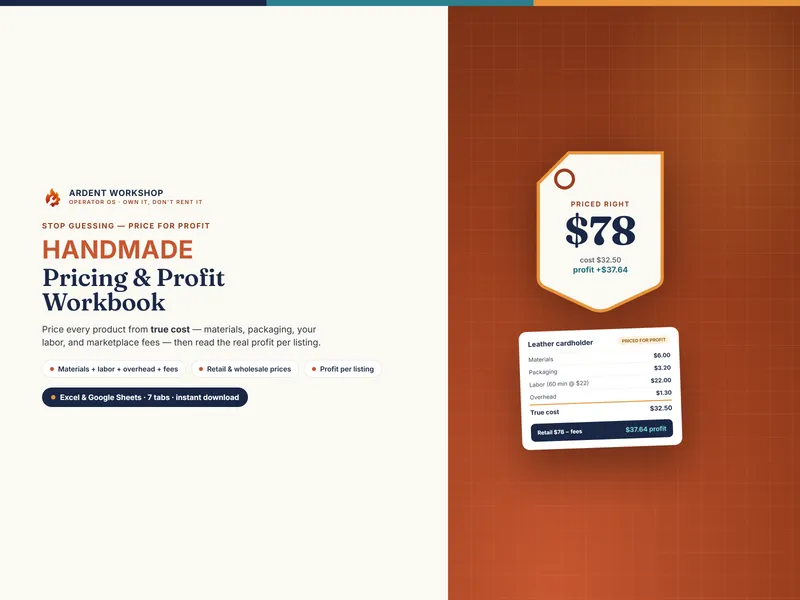
A lot of handmade pricing advice stops at materials and multiplies by a comfortable-sounding number. That’s how a price that looks healthy ends up paying you almost nothing — because three real costs got left out: your labor, your overhead, and the cut the marketplace takes on every sale. Here’s the whole thing, built one number at a time on a hand-stitched leather cardholder.
Step 1 — Cost your materials per unit
List everything that physically goes into one finished piece. The trick that trips up most sellers is dividing bulk packs down to one unit: a $90 hide isn’t “$90 of leather” in a cardholder — it’s the few square feet that product actually uses. Price each material at its true per-unit cost.
| Material | Cost |
|---|---|
| Veg-tan leather (the panels this product uses) | $4.50 |
| Waxed thread | $0.40 |
| Snap & rivets | $0.80 |
| Edge paint & finish | $0.30 |
| Materials | $6.00 |
This is cost of goods sold at the unit level — the foundation every other number sits on.
Step 2 — Add the packaging
The box or mailer, the tissue, a hang tag or care card, the thank-you note — all of it ships with the product, so all of it is a cost of the sale. For the cardholder: a kraft gift box and tissue ($1.40), a cotton dust bag ($0.95), a care card and thank-you note ($0.35), and a padded mailer and label ($0.50) — $3.20 in packaging.
Step 3 — Pay yourself a wage
This is the step that decides whether handmade pays. Your time is a real cost, and it belongs in the price at an hourly wage you’d genuinely accept for skilled work — before you add a cent of profit. Count the making, the finishing, and the photo-and-listing time honestly.
The cardholder takes 60 minutes. At a $22/hour wage, that’s $22.00 of labor — more than three times the materials. Leave it out and “materials × four” prices the cardholder at $24: below what it costs to make. Counted in, the math is honest.
Step 4 — Add per-item overhead
Overhead is every cost that keeps the shop running but can’t be pinned to one product — booth and market fees, your marketplace and software subscriptions, tools, your camera, the studio. Add up a year of it and divide by the items you make in a year. Say $3,900 of overhead across 3,000 items: $1.30 per item.
| True cost | Amount |
|---|---|
| Materials | $6.00 |
| Packaging | $3.20 |
| Labor (60 min @ $22/hr) | $22.00 |
| Overhead (per item) | $1.30 |
| True cost per item | $32.50 |
That $32.50 is your floor. No sale should ever fall below it.
Step 5 — Mark cost up to a retail price
Cost is what the piece takes out of your account; price is what you charge. The gap is your markup, and it covers the overhead no single sale pays for plus your profit. But here’s one of the most expensive confusions in handmade pricing: markup is not margin. Markup is measured against cost; margin against price. A “50% markup” is only a 33% margin. A 50% margin needs a 100% markup — that’s keystone pricing, the old retail rule of doubling your cost.
Keystone is a fair starting point, but the classic “4× cost” retail ladder was built for shops reselling goods, where cost is almost all materials. Once your labor is counted in, a full 4× is usually more than the market will bear — so for handmade, treat keystone as a floor and pick a multiplier that fits your craft. At a 2.4× multiplier, the cardholder’s $32.50 cost becomes a $78 retail price.
Step 6 — Net out fees, then set a wholesale price
The price on your listing is never the money you keep. The marketplace takes a listing fee, a transaction percentage, and the payment-processing slice on every sale. Build that cut into the price so it comes out of your markup, not your wage.
| From price to profit | Amount |
|---|---|
| Retail price (2.4× cost) | $78.00 |
| True cost | −$32.50 |
| Marketplace fees (≈$7.86) | −$7.86 |
| Real profit per sale | $37.64 |
That’s a 48% margin — real profit, on top of the $22 wage you already paid yourself for the hour. Selling to shops too? Set a wholesale price at about 1.5–2× cost — here, $49 — which still clears $16.50 over cost, and keep your own retail at or near the suggested retail so you don’t undercut the stores carrying you.
Skip the labor line and “materials × four” would have priced this cardholder at $24 — a loss on every sale that felt like a sane price. That’s the whole difference: $24 of hope versus $37.64 of profit, on the same piece.
Try it on your own product
Want to run these numbers on something you make? The free Handmade Pricing Calculator does Steps 1–6 for one product right in your browser — no signup. When you’re ready to price your whole shop, the Handmade-Seller Pricing & Profit Workbook runs this exact flow for every product in one connected file — a markup-vs-margin Pricing Lab, an overhead calculator, a marketplace-fee profile, a materials price book that divides bulk packs down for you, and a catalog that shows which listings actually make money.
It’s a workbook you own, not a monthly app you rent — the structured middle between a blank spreadsheet and a pricing SaaS. For the same method in other trades, see how to price a photography package or how to bid a remodeling job.