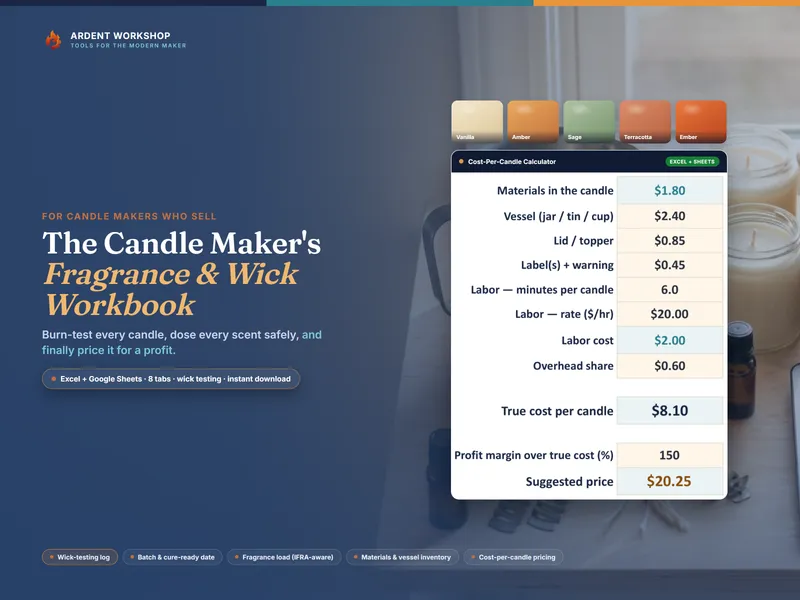
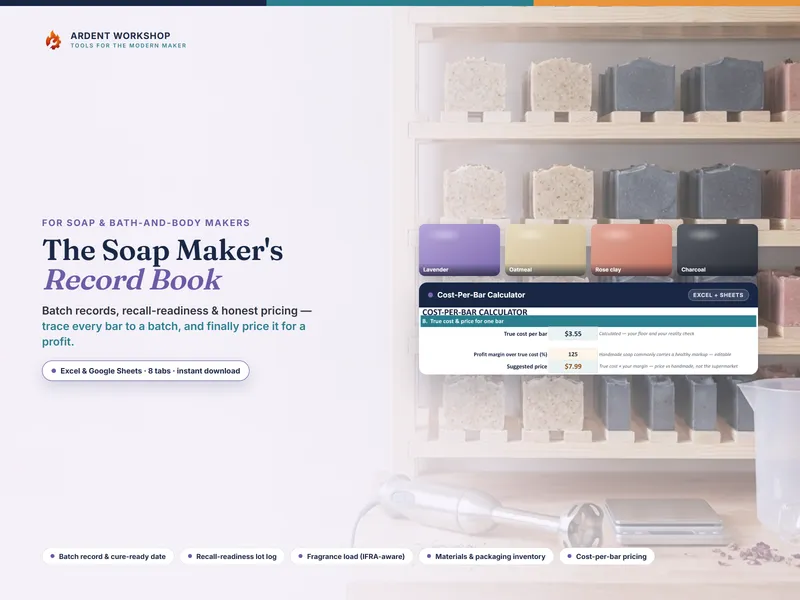
A supplier email arrives: wax is up 12%, fragrance up 8%. You have eleven scents on the shelf. Which of them still make money — at retail, and at wholesale?
This workbook answers that in about twenty minutes, because every price in it is built from a single table of what your ingredients cost. Change one pack price and the whole catalog reprices itself.
Why costing one product at a time stops working
A cost-per-bar calculator is fine for one bar. The trouble starts at eleven products, when the same eight oils appear in three recipes, the same jar appears in two, and a freight increase touches every glass vessel you buy. Recosting by hand takes an evening you don’t have, so it doesn’t happen — and prices you set two years ago quietly stop covering what the products now cost.
So this file is built the other way round. One ingredient table, one bill of materials per recipe, and every price downstream reads from them.
Pack price in, cost per unit out
You buy by the case and sell by the unit, so the first tab does the only conversion that matters: enter what a pack cost and how much is in it, in the unit you actually weigh with at the bench. A $109 case of soy wax holding 720 ounces is $0.1514 an ounce — and that figure is what every candle in the catalog is built from.
It ships with 53 illustrative ingredients across nine categories — waxes, oils and butters, lye and additives, fragrance and essential oils, colorants, wicks, vessels, packaging and labels — each with a par level and an automatic reorder flag.
Batch or Unit — the column that decides whether your costs are right
Every line of every recipe is marked one of two ways, and this is the idea the whole workbook turns on:
- Batch lines are spent once per batch — wax, oils, lye, water, fragrance, clay. Pour a bigger batch and each unit’s share gets smaller, so a Batch line divides by the yield.
- Unit lines are spent once per finished unit — the tin, the jar, the lid, the wick, the label, the band, the box. Pour a bigger batch and each unit still needs its own, so a Unit line does not divide by anything.
Put a vessel in the Batch column on a twelve-tin pour and the workbook charges each candle a twelfth of it — about a dollar less than it really costs. Every wholesale price you set from that number is wrong in the same direction, and it’s wrong in the direction that flatters you.
One base, three scents
Products can also share a base recipe. Write your cold-process oil base once, write each scent’s extras as a small add-on recipe, and point a product at both. Three bars in the worked example ride on one base — so an olive-oil price change moves all three at once, instead of you maintaining the same eight oil lines in three places that slowly drift apart.
A true unit cost, then two prices
Materials are the easy part, because someone sent you a receipt. The two costs that sink handmade pricing are the ones nobody bills you for: your own time, and the workshop.
So you set what you pay yourself per hour, your monthly overhead, and the hours you’re genuinely at the bench. Overhead becomes a cost per production hour, and each product absorbs it in proportion to the minutes it takes — which is why a two-minute lip balm isn’t charged the same as a nine-minute candle.
Materials plus labor plus overhead is your true unit cost. Your target margins then give the retail and wholesale price that hit them, and your own prices are scored against both with a four-state verdict: On target, Under target, Thin, or Below cost. Read the two flag columns together — a product can be perfectly healthy at retail and lose money at wholesale, and that’s the combination makers discover late, usually after a stockist has reordered.
The keystone arithmetic nobody explains
Keystone means wholesale at exactly half of retail, and most shops won’t move off it. What it does to your margin isn’t intuitive, so the guide spells out the whole table. At a retail margin of R, a keystone wholesale price leaves you 1 − 2(1 − R):
- At a 50% retail margin, keystone leaves you 0% — you’d be selling at cost.
- At 60%, it leaves 20%.
- At 65%, exactly 30%.
- At 70%, 40%.
Every point of retail margin above 50% buys you two points of wholesale margin, and nothing below 50% can be wholesaled at keystone at all. So if your wholesale numbers look impossible, the problem is almost never wholesale — it’s upstream, in a retail price that was never set high enough to be halved. That’s a much more useful thing to know before you quote a shop than after.
When a price list lands
Supplier prices don’t rise one ingredient at a time. Freight moves and every glass vessel goes up together; a crop year turns and every essential oil does. So the Price-Change Simulator raises prices the way they actually rise — by category.
Set wax +12%, fragrance +8%, vessels +5%, and the entire catalog recalculates: new unit cost, new margins at both tiers, a Hold / Watch / Reprice verdict on every product, and the exact retail and wholesale price that restores your target. Watch which products move most and it won’t be the expensive ones — a wax melt is almost all wax and fragrance, while a room spray is mostly a sprayer bottle and water. Which is precisely why “raise everything 10%” is a worse answer than it feels like.
What it deliberately does not do
It doesn’t keep your production records. There are no pour dates, lot codes, cure-ready dates, wick tests or recall traceability in here — that’s a different job with a different shape, and two companion workbooks already do it properly: the Candle Maker’s Fragrance & Wick Workbook and the Soap & B&B Maker’s Batch & Recall-Readiness Record Book.
It also doesn’t rebuild tools that are already free. Fragrance load percentages, saponification and lye quantities, wick sizing, and a buyer-facing wholesale line sheet all have free, ungated calculators and templates at ardentseller.app (opens in new tab), and the download links you straight to each one. Nothing here asks you to pay twice.
Own it, don’t rent it
This is a file you keep. No subscription, no login, no monthly fee, no feature that vanishes when someone else changes their pricing. It sits where it should — past a blank spreadsheet you’d have to build yourself, and well short of inventory software you don’t need yet.
When you do outgrow it — tracking stock across a shop, a market and two stockists, and wanting an ingredient price change to update a live catalog rather than a file you remember to open — Ardent Seller is the living version of this workbook: recipes, inventory, and retail and wholesale price tiers in one connected place, with a free plan to start.
Works with what you already have
Excel, Google Sheets and LibreOffice Calc. The Google Sheets version is a real native copy you make with one click — not an import that mangles your formulas. Everything arrives pre-loaded with a complete worked example: 53 ingredients, 77 recipe lines, 12 recipes and 11 products across candles, wax melts, cold-process and melt-and-pour soap, body butter, sugar scrub, lip balm and room spray. Nothing is blank when you open it.
Every figure in the examples is illustrative — supplier prices, pack sizes, yields, your hourly rate and your overhead are yours to enter. This is a costing and pricing framework, not tax, accounting or legal advice, and it is not formulation, safety or compliance guidance: saponification values and lye quantities, fragrance load limits and skin-safe usage rates, preservative systems, allergen and net-weight labeling, and the cosmetic rules where you sell are set by your suppliers’ documentation and by law, and are yours to meet. Run every cold-process recipe through a lye calculator before you pour.