The number a phone call can’t tell you
You call every few days. Your brother calls on Sundays. The aide sends a note. Everyone says she’s fine — and she says she’s fine, because that’s what parents say to children who live eight hundred miles away.
Then you fly in, and the fridge tells you a different story.
That gap is the whole problem of long-distance caregiving, and it is not a problem a contact list solves. This binder does something a blank spreadsheet and a free template can’t: it counts the things nobody in the family volunteers, and puts them at the top of one page.
What it computes
Days since anyone visited in person. Not phoned. Not video-called. Visited — and who it was. Plenty of families have a version of the same story: the month they all spoke to Mom weekly and nobody realized she had stopped cooking. This number is the first thing on the dashboard, colored so you can’t miss it climbing past a month.
An eight-week coverage map. One row per week, counting contacts against actual visits. A run of weeks marked Calls only is the pattern that hides a decline — and here it shows up as a pattern instead of a feeling.
Areas of care with nobody’s name on them. Fifteen areas come pre-loaded, from the daily check-in and medications through bills and mail, insurance and benefits, transportation, home safety, and the paperwork. They’re pre-loaded on purpose: the areas you haven’t thought about are exactly the ones without an owner. Long-distance care almost never fails dramatically — it fails quietly, in the areas nobody realized they’d stopped covering.
Who is quietly carrying the most. Every person in the care circle, with the areas they own and the areas they back up, side by side. That second column is the invisible second-line load nobody counts, and reading both aloud on a family call ends more sibling arguments than a year of group texts.
The handoffs it catches
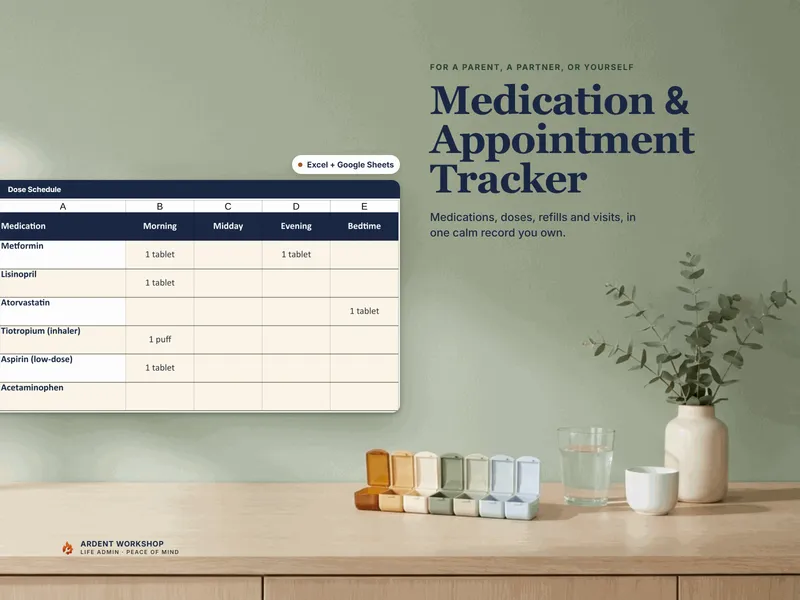
- An appointment that’s booked with nobody assigned to take her.
- A past appointment where nothing was ever written down about what the doctor actually said — the half of the job families reliably drop.
- A prescription past its refill date, because nobody ordered it, because everyone assumed someone else had.
- A care area with an owner but no backup. One person deep is fine right up until they’re on vacation, ill, or on a plane.
- A helper who has quietly stopped checking in, measured against the cadence you set for them.
Write down what you saw, not what you concluded
The Check-In Log is where the binder earns its keep, and it asks one thing of you: record the observation, not the conclusion. “Asked me what day it was three times in ten minutes” is worth keeping — six months from now, in a doctor’s office, that dated note is the useful thing and “she’s getting confused” is not. It’s also kinder: a record of specific dated moments leaves room for your parent to be having a bad week rather than a decline.
Every contact goes in the same log — yours, your sister’s, the aide’s note, the care manager’s report — and the “how they seemed” column colors itself, so a run of Off or Concerning stands out at a glance.
Not just a grid — the method comes with it
A whole tab carries the thinking: six principles for care at a distance, what each kind of contact actually tells you, an in-person visit checklist (the fridge, the pill bottles, the route from the bed to the bathroom at night, the mail pile), what to notice and what to do with it, an escalation ladder, how to run the family conversation, and six questions to ask before you hire an aging life care manager. Thirty-two more pages of it ship as PDFs, including a printable who-has-what grid you work through with your siblings until nothing is left unassigned.
One rule keeps it safe to share
This file gets shared — with siblings, an aide, sometimes a neighbor. So it records what your parent needs and where things are kept: never logins, PINs, account numbers, or a Social Security number. A record of care, not a set of keys. Real credentials belong in a password manager the family shares.
Try the free version first
Not ready for the whole binder, or need something to send a sibling today? The free Long-Distance Care Contact Sheet puts your parent’s point person, the local helpers who can be there today, who has a key, and every provider in one place you can print and share. No email, no signup — it’s just there.
Own it, don’t rent it
Take the one-click Google Sheets copy and share it with your siblings — everyone logs into the same file, and there’s no seat to buy for each of them. Or keep the Excel file in a shared folder, or print the pages and fill them in by hand; it opens in LibreOffice Calc too.
Unlike a subscription caregiving app, this file is yours. It doesn’t live on a company’s server, it doesn’t charge per person, and it won’t vanish when a service changes its plans. Buy it once, and it stays your family’s record for as long as you need it.
A record-keeping and coordination tool for a family — not medical, legal, or financial advice, not a care plan written by a professional, and not a substitute for your parent’s doctors, an attorney, or a licensed care manager. The example family, providers, medications, and appointments throughout are fictional and illustrative.