What a DVIR covers
Under 49 CFR 396.11, a driver prepares a written report at the completion of each day's work on each commercial motor vehicle operated. The report has to identify the vehicle and list any defect or deficiency the driver finds that would affect safe operation or could result in a mechanical breakdown, covering at least:
- Service brakes, including trailer brake connections
- Parking (hand) brake
- Steering mechanism
- Lighting devices and reflectors
- Tires
- Horn
- Windshield wipers
- Rear vision mirrors
- Coupling devices
- Wheels and rims
- Emergency equipment
Not every vehicle or every operation falls under this rule — 396.11 applies to commercial motor vehicles operated by motor carriers subject to FMCSA regulation, and some operations, including certain single-vehicle carriers, are exempt. It does not automatically cover, say, a pickup truck used for local contracting work. Check whether the rule applies to your vehicles and operation before assuming it does.
The paid Vehicle & Equipment Pre-Use Inspection Log uses the same checklist items — coded so a printable tear-off pad and the workbook stay in sync — for every odometer vehicle in the fleet: trucks, vans, and trailers.
The rule that changed: no defect, no report
A common misconception is that a DVIR is required after every single day a vehicle is driven, defect or not. That was true once, but no-defect reports are no longer required — a driver only has to prepare and submit a written report when a defect or deficiency is actually found or reported. On a clean day, there is nothing to file.
That relief cuts paperwork, but it also raises the cost of getting the log itself wrong: if a real DVIR only shows up on the days something is wrong, a register that cannot tell "no report needed" apart from "report forgotten" is no better than no log at all.
Defect, repair, certification, sign — the loop
A DVIR is only useful if it closes. Under 396.11 and 49 CFR 396.13, the sequence is:
- Defect found. The driver notes it on the written report at the end of the day.
- Repair, before the vehicle moves again. The carrier must repair any listed defect or deficiency likely to affect safe operation before the vehicle is operated again.
- Certification. The carrier certifies, on the report, either that the repair was made or that repair was not necessary.
- Review and sign. Before driving, the next driver has to be satisfied the vehicle is in safe operating condition, review the last DVIR when one was required, and sign it to acknowledge that review.
A spreadsheet or a paper pad can record steps one and three easily and let steps two and four quietly not happen — the repair never gets logged against the report that named it, or the next driver signs without ever seeing what was flagged. A register built for the loop turns every FAIL into a work order and keeps that asset flagged out of service until the repair is certified and a reviewer signs off, rather than trusting that someone remembered.
How long to keep them
Retain the original DVIR and its certification of repair for three months from the date it was written. A defect-driven filing pattern — reports exist only for the days something was wrong — makes it easy to lose track of which reports are still inside that window; a dated log that flags what's aging out is simpler to audit than a folder of loose paper.
Equipment that isn't a DVIR at all: forklifts and hour-meter equipment
396.11 is a trucking rule — it does not cover forklifts, aerial lifts, mowers, or generators. Forklifts fall under OSHA's powered industrial truck standard, 29 CFR 1910.178, which is a different rule with a different record requirement — or none. Aerial lifts, mowers and generators are not powered industrial trucks, so 1910.178 is not the rule for them — some equipment types carry their own OSHA standard and some are named by no rule at all, so check what applies to the machines you actually run rather than assuming this one does. Under 1910.178(q)(7) a forklift must be examined before being placed in service and at least daily, and not placed in service if the examination turns up a condition that adversely affects safety; a truck used around the clock is examined after every shift. Under 1910.178(p)(1), any truck needing repair is taken out of service until it is restored to safe operating condition.
OSHA does not require that examination to be written down. An OSHA letter of interpretation dated February 7, 2000 says so directly. A written record is proof the check happened and is treated as best practice, not a paperwork mandate — never take a written forklift log to be OSHA-required. See how to run a forklift pre-shift inspection for the visual-then-operational sequence and what counts as a take-out-of-service condition.
One register instead of one per asset type
A DVIR and a forklift pre-shift check are legally two different things — one is a federal trucking requirement, the other is voluntary documentation of an OSHA-required examination — but operationally they're the same habit: check the asset before it's used, write down what's wrong, and don't use it again until that's fixed. Running them as two separate systems, or as a stack of paper pads nobody ever tallies, is how a missed inspection goes unnoticed until something breaks.
The Vehicle & Equipment Pre-Use Inspection Log puts odometer vehicles and hour-meter equipment in one workbook: it computes, per asset and per shift, which scheduled inspections were missed, turns every FAIL into a work order, and keeps an asset with a defect on an item marked Critical flagged out of service until the repair is certified and reviewed. Printable tear-off pads use the same item codes as the workbook, plus an out-of-service tag, so the pad in the cab and the register are naming the same items. It works in Excel, Google Sheets and LibreOffice Calc, and ships with printable PDFs.
If you only need a single free printable to start today, the Free Daily Vehicle Inspection Checklist covers one asset type — pre-filled with a worked example — with no register, defect tracker, or out-of-service flag. Compared with a fleet-inspection app that bills for every asset, every month, the workbook is a single purchase that covers the whole fleet.
For the training side of the same crew — talks delivered and certifications tracked — see what a toolbox talk is and the Safety-Training & Toolbox-Talk Compliance Tracker that keeps the record. To log an incident that does happen, see the Workplace Incident, Near-Miss & Injury Log Workbook and what a near miss is. For a contractor building out a full compliance stack, see tools for contractors.
Templates that implement this
Workbooks for the safety record a small crew has to keep
3 templates
One register that puts odometer vehicles and hour-meter equipment on the same defect-to-repair loop, plus the two records a crew usually keeps alongside it: the incident log and the training tracker.
- $19.95 Spreadsheet
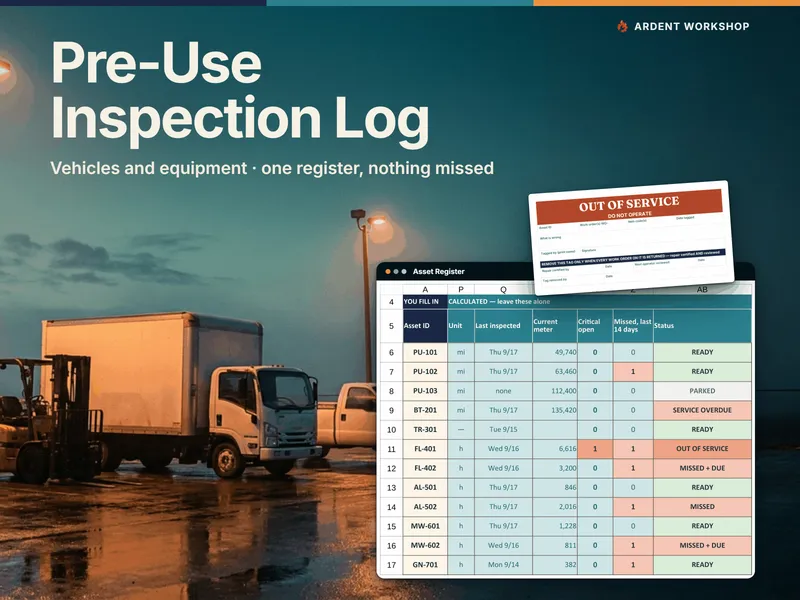
Vehicle & Equipment Pre-Use Inspection Log - Missed-Inspection Grid & Out-of-Service Work Orders (Excel + Google Sheets)
Pre-use inspection log for Excel & Google Sheets: one register for vehicles and equipment, a missed-inspection grid, critical defects held out of service.
Team & TalentView details - $29.95 Spreadsheet
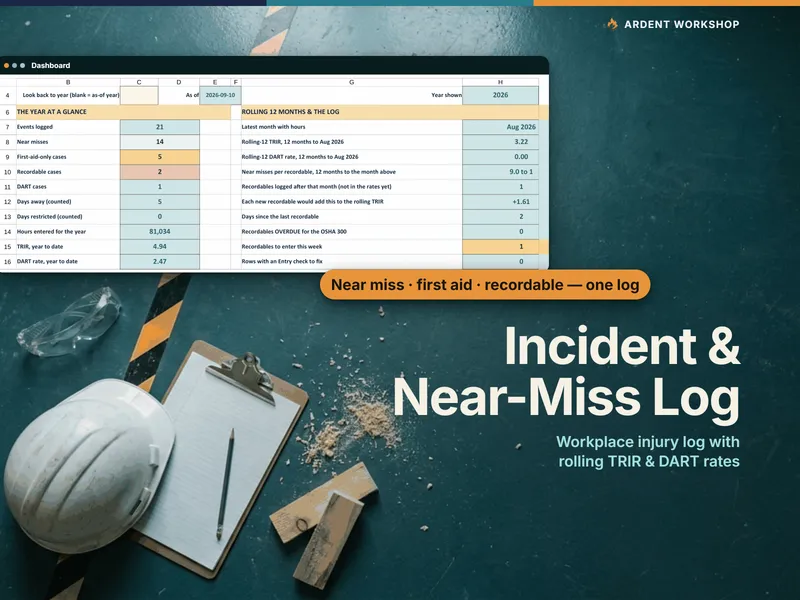
Workplace Incident, Near-Miss & Injury Log Workbook - Rolling TRIR & DART Rates (Excel + Google Sheets)
Incident and near-miss log for Excel & Google Sheets: one log for every event, rolling TRIR and DART rates, linked fixes and 300A-shaped totals.
Team & TalentView details - $29.95 Spreadsheet
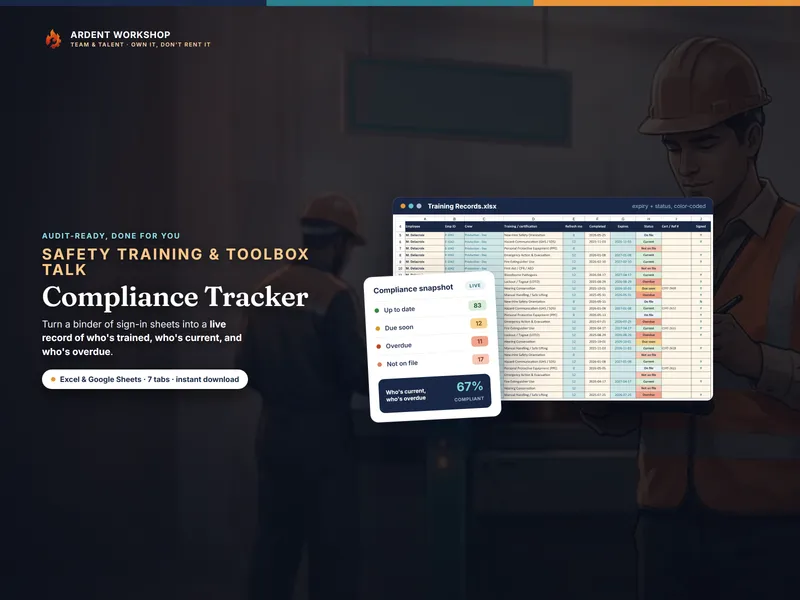
Safety-Training & Toolbox-Talk Compliance Tracker — Excel & Google Sheets
A safety-training & toolbox-talk tracker for Excel & Google Sheets — automatic refresher expiry, color-coded status, and audit-ready compliance dashboard.
Team & TalentView details
Frequently asked questions
- Is a DVIR required every day, even with no defects?
- No. No-defect reports are no longer required: a driver does not have to file a written report on a day when no defect was found or reported. What the rule requires is that a report be prepared covering the listed systems whenever a defect or deficiency is found — not a signed blank sheet on every trip.
- Does 396.11 apply to my pickup truck or van?
- Only if the vehicle and the operation meet the federal definition of a commercial motor vehicle operated by a motor carrier under FMCSA rules, and some operations — including certain one-vehicle carriers — are exempt outright. A pickup used for local contracting work is often outside the rule entirely. Check whether 49 CFR 396.11 applies to your specific vehicles and operation before assuming it does or doesn't.
- What has to happen before the vehicle is driven again?
- Before the vehicle is operated again after a defect is reported, the carrier must repair any defect or deficiency likely to affect safe operation, and certify on the report — in writing — that the repair was made or that repair was not necessary. The next driver then reviews that certified report and signs it to acknowledge the review before driving.
- How long do we have to keep DVIRs?
- The original driver vehicle inspection report and its certification of repair must be kept for three months from the date it was written.
- Does OSHA require a written forklift inspection log?
- No. OSHA's powered industrial truck standard requires the examination itself — under 29 CFR 1910.178(q)(7), before the truck is placed in service and at least daily, and after each shift for a truck used around the clock — and 1910.178(p)(1) requires an unsafe truck to be taken out of service. But an OSHA letter of interpretation dated February 7, 2000 confirms the examination does not have to be documented in writing. A written log is proof the examination happened and is widely treated as best practice, but it is not itself the legal requirement.