Base child support vs. an extraordinary expense
Base child support is the regular payment a parenting plan, order, or agreement sets to cover the ordinary, everyday cost of raising a child — housing, food, routine clothing, the day-to-day. An extraordinary expense, sometimes called an add-on expense, is a real cost that doesn't fit that pattern: it's uneven, it varies in amount, and it doesn't show up every month for every child. Rather than trying to fold an unpredictable cost into a fixed monthly number, a plan may split it out separately — at its own agreed percentage, which can differ from the one base support uses.
Whether your own plan or order treats a given cost as an extraordinary expense, and what percentage applies, is set by the agreement itself and by the rules where you live — this page describes how families commonly structure and record these expenses, not what any particular order requires.
Common categories
The exact list varies by family and by agreement, but the same handful of categories come up again and again as expenses parents specifically agree to split:
- Uninsured medical, dental, and vision costs — the portion insurance doesn't cover: copays, deductibles, orthodontia, glasses.
- Therapy or counseling — for the child, whether ongoing or short-term.
- Childcare — daycare, before- and after-school care, a sitter needed for work.
- School fees and supplies — tuition add-ons, class fees, required supplies and materials.
- Activities and sports — registration, equipment, travel for a team or a lesson.
- Other agreed one-offs — anything else the parents specifically agree, in writing, to split rather than treat as one parent's cost.
These are examples of what plans and families commonly use, not a rule. Some agreements name only two or three of these categories; others name a dozen and split each one differently.
Why the split can be a percentage per category
Rather than one flat percentage for every extraordinary expense, some agreements set a separate percentage per category — one for medical, a different one for childcare, another for activities — because the parents agreed to different terms for different kinds of cost. Some plans go a step further and let one category run at a different split for one child than another: a plan might set therapy at one percentage generally, but a specific override for a particular child's ongoing treatment.
That's the practical reason a simple 50/50 note in a group chat stops working once more than one category is in play: each expense needs to resolve which rule applies to it — its category, and any per-child override — before it can be split correctly.
What to record for each one
Whatever it's split by, the same handful of details make an extraordinary expense a record instead of a memory later:
- Date the expense was incurred or the bill was received.
- Which child it was for.
- Category — medical, childcare, activities, and so on.
- Total amount of the expense.
- Who paid it, and whether there's a receipt.
- Agreed share — the percentage or rule that applied to this particular expense, recorded alongside it rather than left to be recalled later.
Writing down the rule that applied, not just the dollar amount, is what lets a disputed row be checked six months later without reopening a conversation about what was originally agreed.
Partial and on-account reimbursements
Extraordinary expenses aren't always repaid in one clean transaction. A parent might pay a share in full, pay part of it now and the rest later, or carry a balance "on account" against future expenses. The workable approach is to log each payment against the specific expense it's paying down — not as a lump sum against nothing in particular — and let every expense share and every payment, in either direction, net into one running balance. That balance is also where two common mistakes surface: a reimbursement recorded as coming from the same parent who paid the original expense, and a repayment larger than what was actually owed. Both quietly move the balance the wrong way if nothing flags them.
Where it all lands: the year-end summary
Because extraordinary expenses arrive unevenly all year, a single summary that pulls every category, every child, and every month onto one page turns a year of scattered entries into something organized — a record to hand to a mediator, an attorney, or a tax preparer, rather than a stack of receipts and a group chat to scroll back through.
Keep the split and the record in one file
An agreement about how extraordinary expenses split is only as reliable as the arithmetic that follows it. The Co-Parenting Expense & Records Log gives each of 12 expense categories its own agreed percentage, with an optional override per child, so every expense row resolves its own split and nets into one running who-owes-whom figure — alongside a scheduled-vs-actual overnight count, a holiday rotation, and the communication and handover records that tend to get lost between two households. Not ready to buy? The free Co-Parenting Shared Expense Ledger covers a single agreed split percentage and a running balance, pre-filled with a worked example, at no cost. For the trade-off against a subscription co-parenting app, see spreadsheet vs. a co-parenting app, and for the wider toolset see tools for co-parents.
Separated but not yet down to co-parenting logistics specifically? The Divorce & Separation Records Organizer holds the same kind of shared-bill balance alongside the asset, debt, income, and document picture a separation asks for, and organizing your records for a separation walks through the method end to end.
Templates that implement this
Record and split these without the hand math
2 templates
The Co-Parenting Expense & Records Log gives each of 12 expense categories its own agreed percentage, with an override per child, so every expense row resolves its own split and nets into one running who-owes-whom balance — the Divorce & Separation Records Organizer covers the same shared-bill balance alongside the wider asset, debt, and document picture for a separating household.
- $16.95 Spreadsheet
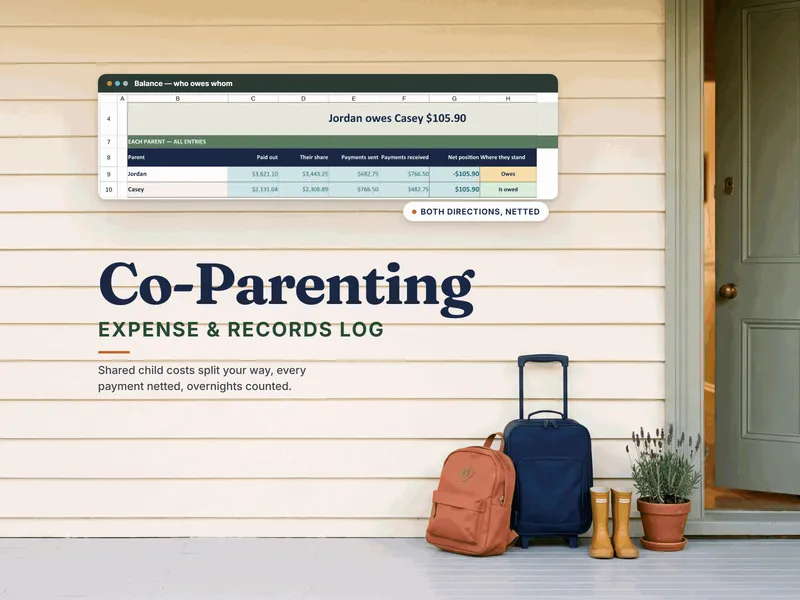
Co-Parenting Expense & Records Log — Shared Child Expense Tracker, Who Owes Whom & Overnights (Excel + Google Sheets)
A co-parenting expense tracker for Excel & Google Sheets. Split each child expense your way, net every payment into one balance, and count overnights.
Life AdminView details - $24.95 Spreadsheet
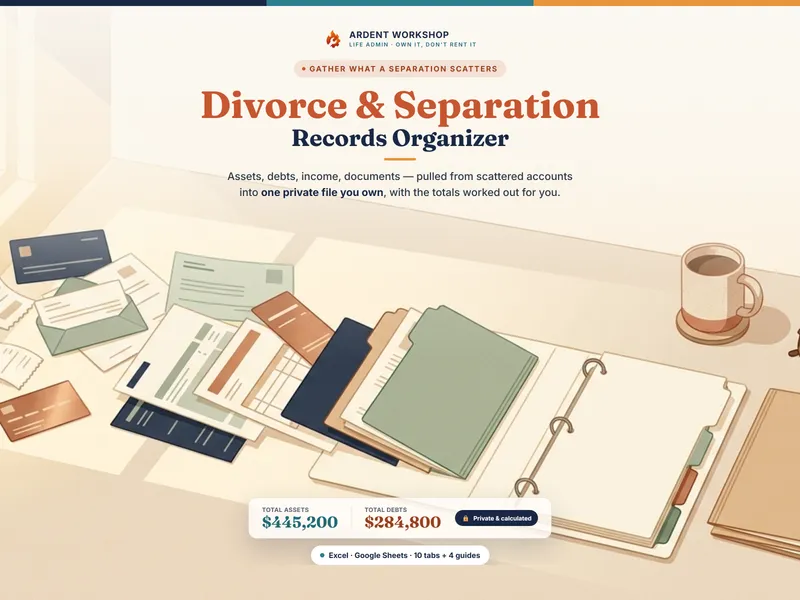
Divorce & Separation Records Organizer — Assets, Debts, Income & Documents in One File (Excel + Google Sheets)
A divorce & separation records organizer for Excel & Google Sheets — your assets, debts, income & documents in one private file, totals done for you.
Life AdminView details
Frequently asked questions
- What's the difference between child support and an extraordinary expense?
- Base child support is the regular, predictable payment set by a parenting plan, order, or agreement — it's meant to cover the ordinary, everyday cost of raising a child. An extraordinary (or "add-on") expense is a real cost that doesn't fit that pattern: it shows up unevenly, in a different amount each time, so plans commonly split it separately — often at its own percentage — rather than folding it into the base support figure.
- What counts as an extraordinary (add-on) expense?
- Families and parenting plans commonly treat these as separate, split expenses: uninsured medical, dental, vision, or therapy costs; childcare; school fees and supplies; extracurricular activities and sports; and other one-off costs the parents specifically agree to share. That's a description of common categories, not a legal definition — what actually qualifies as "extraordinary," and the exact terms used for it, are set by each family's own parenting plan, court order, or agreement, and both the categories and the terminology differ by state and country.
- Why might extraordinary expenses be split by a percentage rather than 50/50?
- Some agreements assign each parent a percentage per category — sometimes based on income, sometimes just what the two parents agreed to — rather than an even split, and some plans let one category run at a different percentage for one child than another (a sibling's therapy split differently than another sibling's activity fees, say). That's why a workable record needs a split per category, with room to override it per child, instead of one flat percentage for everything.
- What details should I record for each extraordinary expense?
- Enough that neither parent has to reconstruct it from memory later: the date, which child it was for, the category, the total amount, who actually paid it, whether there's a receipt, and the agreed share — the percentage or rule that applied to that expense. Recording the rule alongside the amount is what lets a disputed row be checked later without a new conversation about what was originally agreed.
- What happens when a reimbursement only covers part of an expense?
- Log the payment against the specific expense it's paying down rather than as a lump sum, and keep one running balance that nets every share and every payment — in full, in part, or on account — from both parents. That balance is also where a mistake shows up: a payment recorded as coming from the same parent who paid the original expense, or a repayment bigger than what was actually owed, both quietly move the running total the wrong way if nothing flags them.
- Why keep a year-end summary of extraordinary expenses?
- Because the expenses land unevenly through the year, a single summary that rolls every category, child, and month onto one page turns a year of scattered entries into something organized to hand to a mediator, an attorney, or a tax preparer. It's a summary of what was recorded, not a determination of what any of it means for a filing or a case.