Nobody in a big transaction is lying to you. The problem is structural: most of the people in the room — the agent, the dealer, the venue coordinator — are compensated on the transaction happening, and often on how large it is. Nobody in the room is paid to hand you a smaller number. That is not a conspiracy. It is an absence. And an absent check feels exactly like an approved one.
Approved vs affordable: the quick verdict
- Approved tells you the purchase can happen. Use it as a gate.
- Affordable tells you whether it should. Use it as the number you actually shop against.
- When the two disagree, the gap between them is the amount of risk somebody else is comfortable with you taking.
Approved vs affordable, side by side
| What matters | Approved (a lender's number) | Affordable (your number) |
|---|---|---|
| Income basis | Gross — before tax, retirement and health premiums | Also checked against take-home pay, which is what you spend |
| Expenses counted | Debts on your credit report, plus court-ordered support | Childcare, commuting, tuition paid in cash, family support — the real month |
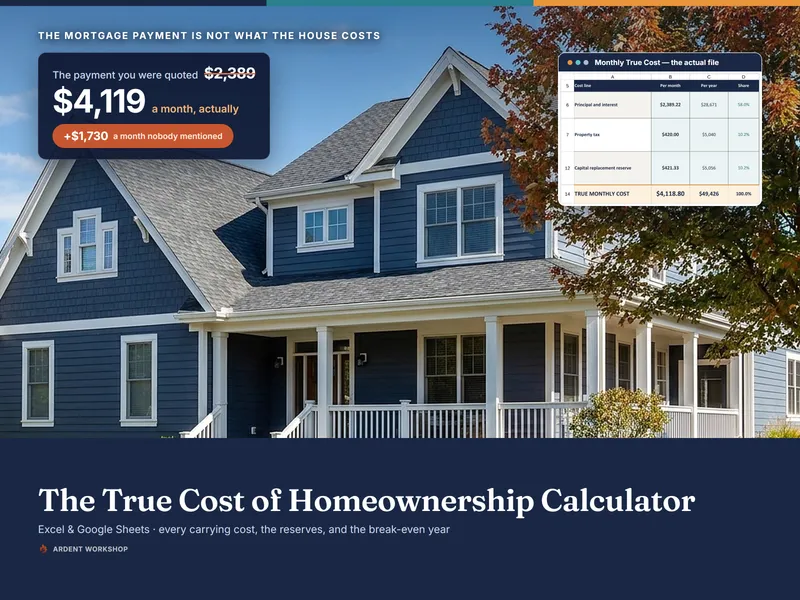
| Cost of the purchase | The loan payment — plus tax, insurance and dues where the loan is a mortgage, and nothing beyond that | All of that plus what it costs to run: upkeep, utilities, fuel, repairs |
| Emergency reserve | Rarely protected — savings count mainly as a source of down payment, and only some programs require reserves at all | Protected first; only what's left over can reach the closing table |
| Time horizon | Complete when the loan closes | Has to keep working through a bad year |
| Whose risk is measured | Theirs | Yours |
What "approved" actually measures
Every choice in an underwriting model is correct for its purpose. Gross income is used because gross income is verifiable and net is not. Your credit report is used because it is what a lender can see. The cost of the loan is where it stops because the loan is what they are owed — on a mortgage that reaches further than people expect, taking in property taxes, insurance and association dues, but it stops at upkeep and never reaches childcare. None of that is careless. It is simply a different question from yours, and for most households the answer to it comes out larger, because the things it can't see are things you still have to pay.
It is also not a promise. The CFPB is explicit that a prequalification or preapproval letter is not a guaranteed loan offer, and that lenders use the two words differently.
The three tests that give you a real ceiling
Affordability is not one number. It is the lowest of three, and which one is lowest is the most useful thing you can learn about your own position.
- What your income will carry. Gross monthly income times a debt-to-income cap, minus everything you already owe, turned back into a price through the loan's own payment factor. This is the lender's test — see debt-to-income ratio for how it works.
- What your cash can reach. Liquid savings, less anything already spoken for, less an emergency reserve of several months of essential spending, divided by the down payment plus the upfront costs. This is the test online affordability calculators rarely turn into a price cap — they take your down payment as an input rather than asking whether the cash survives an emergency reserve — and it is the one that turns a purchase into a crisis when it is skipped.
- Whether the purchase is a sensible size at all. A blunt multiple of income. Payment math can be satisfied by stretching a loan out long enough and cash math by a generous gift; neither notices that the thing is simply too large for the income underneath it.
Take the same invented household as the debt-to-income explainer — $8,250 a month gross, $741 of existing payments — and give it $62,000 saved and $2,450 a month of essential spending, which the other two tests need. On a $96,000 salary plus $250 a month of other income, all three are worth following through:
- Income: $277,863. A 36% cap on $8,250 leaves $2,970, minus the $741 already owed = $2,229 a month. At 6.5% over 30 years with 10% down and 2.8% a year of ownership costs, a dollar of price costs $0.008022 a month, so $2,229 buys $277,863.
- Cash: $333,077. $62,000 saved, less $4,000 already spoken for, less a six-month reserve of essential spending ($14,700), leaves $43,300 — divided by the 13% needed at the table (10% down plus 3% upfront costs).
- Comfort: $336,000. 3.5 times the $96,000 salary — the blunt multiple, which deliberately ignores the other income.
The ceiling is therefore $277,863, and debt-to-income is what binds. Every cap, reserve and multiple above is a planning convention you would set yourself rather than a rule anyone is bound by, and the household is invented; the point is the spread between the three answers and which one came out lowest, not the digits.
To run the first of the three on your own numbers, the free Big-Purchase Affordability Estimator is a spreadsheet that does it for a home purchase. No email, no signup.
Which one binds is the line that changes what you do
Knowing your ceiling is useful. Knowing which of the three is holding it there is what turns a vague plan into a specific one, because the levers that move one do nothing at all to the others.
- If cash binds, saving longer is your lever, and shopping for a better rate is worth almost nothing.
- If debt-to-income binds, another six months of saving buys you nothing at all — the cash limit was never the one stopping you. Clearing a payment is the lever.
- If the comfort rule binds, both of the above are noise. The purchase is too big for the income, and the honest move is a smaller one.
Signs the number is too big, whatever the model says
- It only works with income that hasn't started yet — a raise, a promotion, a partner returning to work. Buy at today's income.
- It only works with a longer loan. If the payment fits at seven years and not at five, the purchase is too big. The term is a lever for total cost, not for affordability.
- It leaves you under a few months of essential spending. That converts a manageable emergency into a debt spiral you haven't had yet.
- It depends on selling or refinancing later. Both need a future market. If it only works after a refinance, you're buying a rate nobody has offered you.
What to do with the gap
Use the pre-approval for what it is worth — it confirms the purchase is possible — and then decide, on your own numbers, where inside it you want to sit. Write down one figure you will not go past before you walk into a showing, onto a lot, or into a venue tour, because the arithmetic is the easy part. The hard part is holding the number in a room where somebody is paid by the outcome.
The free Big-Purchase Affordability Estimator is a spreadsheet that runs the first of the three tests for a home purchase and returns an estimated maximum price — no email, no signup. The full Big-Purchase Affordability Calculator runs all three across six purchase types, names the binding constraint, and prices twelve rungs around your ceiling.
Not lending advice
This page compares two ways of measuring the same purchase. It is not financial, tax, or lending advice, nothing here is an offer of credit or a prediction of approval, and every rule of thumb described is a planning convention you can adjust rather than a rule anyone is bound by. The dollar figures above belong to an invented household used to show the arithmetic. Confirm what applies to you with your own lender.
Frequently asked questions
- Why is the amount I'm approved for higher than what I can afford?
- Because the two numbers answer different questions. A lender's model estimates how much you can repay without defaulting often enough to cost them money. It runs on gross income and counts the debts on your credit report plus the cost of the loan itself — on a mortgage that does include property taxes, insurance and association dues, but it stops there. Your model also has to cover upkeep, utilities, childcare, the commute, the tuition you pay in cash and the parent you help, none of which appears in an underwriting file. For most households the approval figure therefore comes out larger, and the gap is the amount of risk somebody else is comfortable with you taking.
- Should I ever borrow the full amount I'm approved for?
- Rarely, and never by default. A pre-approval is a gate, not a target — it tells you the purchase can happen, not that it should. If you do decide to buy near the top of your approval, do it deliberately, with the monthly figure and the remaining emergency reserve written down in front of you, rather than because a number in a letter felt like permission.
- How do I work out what I can actually afford?
- Run three tests instead of one and take the smallest answer. First, what your income will carry once every existing payment is subtracted — the lender's test. Second, what your cash can reach after protecting several months of essential spending rather than spending it on the down payment. Third, whether a purchase that size is sensible for what you earn at all. The lowest of the three is your ceiling, and knowing which one is lowest tells you what to do about it.
- Does a bigger down payment always help?
- No, and this surprises people. A larger down payment lowers the payment, which raises what your income can carry — and at the same time it raises the cash you need per dollar of price, which lowers what your savings can reach. Which effect wins depends entirely on which constraint was limiting you in the first place. It is worth modeling rather than assuming.
- Is a pre-approval the same as a guarantee?
- No — and the two words are less standardized than they sound. The CFPB notes that lenders use "prequalification" and "preapproval" differently: some issue the first on figures you simply stated and the second only after verifying income, assets and credit, while others don't follow that split at all. So ask yours what they actually verified. Either way, the CFPB's prequalification-vs-preapproval explainer is blunt about it: such a letter is "not a guaranteed loan offer". Final approval still depends on the property, the appraisal, and a re-check of your file at closing — and because lenders re-check your credit before closing, opening a new credit line in between is a common way to lose one.