What zakat means
Zakat (sometimes written zakah) is one of the five pillars of Islam — an act of worship, not an optional donation. Traditionally it is understood as an obligation to give away a set share of the wealth you have held for a full year, once that wealth passes a minimum threshold, to people who are entitled to receive it. The word carries a sense of purification and growth: the giving is often described as purifying the wealth that remains. Because it is a religious obligation with a long scholarly tradition, the practical details below are given as background — how the term is commonly explained — and not as a ruling for your own situation.
How much is zakat?
On monetary wealth — cash, savings, and things treated like money — the rate is most commonly a fortieth, or 2.5%, of the qualifying amount you hold at the end of the year. Different rates traditionally apply to other kinds of wealth (for example, agricultural produce or livestock are treated under their own rules), and scholars differ on how some modern assets — pensions, investments, business stock — should be counted. Rather than assume, most people settle the rate and the categories with a scholar or a trusted zakat authority, then apply the arithmetic to their own numbers.
What is the nisab?
The nisab is the minimum amount of wealth you must hold before any zakat is due. It is defined by a weight of precious metal — commonly given as roughly 87.48 grams of gold or 612.36 grams of silver — not by a fixed sum of money. That matters: because the nisab is a weight of metal, its value in dollars, pounds, or any currency moves with the gold or silver price, so there is no fixed figure that is true every year. When you work out whether you have reached nisab, you convert the current metal price into your currency yourself, using a source you trust. Scholars also differ on whether to use the gold or the silver nisab — the silver figure is usually lower, so it brings more people into giving — which is one more reason to follow your own scholar's guidance rather than a single number online.
Who receives zakat?
The Qur'an names the categories of people entitled to receive zakat — commonly understood to include the poor and the needy, among others such as those administering it and those in debt or hardship. In practice many people give through a mosque, a recognised zakat fund, or a charity that distributes to eligible recipients on their behalf. Who qualifies, and whether a particular organisation's work counts, are exactly the kinds of questions a scholar or your community's zakat committee is there to answer.
When is zakat due — the hawl
Zakat on wealth is traditionally due once that wealth has been held for a full lunar year, a period called the hawl. Many people pick a fixed date in the Islamic calendar — Ramadan is a common choice — and settle their zakat on the same day each year, comparing what they hold then against the nisab. Note that the lunar year is shorter than the Gregorian one, which is part of why a fixed anniversary date, rather than a running tally, is the usual approach.
Zakat vs sadaqah
It helps to keep two ideas apart. Zakat is the obligatory, calculated giving described here — a specific share, above a threshold, once a year. Sadaqah is voluntary charity, given in any amount at any time, over and above zakat. Many people give both: zakat as the obligation they calculate, sadaqah as generosity on top. In the same way, a tithe in the Christian tradition is a proportional obligation of a different faith — a related idea of giving a set share, worked out and recorded the same practical way, even though the rules and reasoning behind each are their own.
How to work out and record your zakat
The religious questions — your nisab, your rate, what is zakatable — are for your scholar. Once those are settled, what is left is arithmetic and record-keeping, and that part you can do calmly on your own:
- Total your zakatable wealth — the cash, savings, and other assets you and your scholar count, as held on your chosen date.
- Subtract the liabilities you treat as deductible, to reach the net amount.
- Check it against your nisab — the current value of the gold or silver threshold, entered from a source you trust.
- Apply your rate — commonly 2.5% — to get the amount, and record what you give, to whom, and when.
You can do the sums in your browser with the free Zakat / Tithe Calculator — it nets your assets against your liabilities, checks them against the nisab you enter, and shows the amount at your rate, with nothing saved or sent. To keep a year of giving for your own records and for tax time, the Charitable-Giving & Zakat/Tithing Records Workbook holds a zakat worksheet where you set your own nisab and rate, alongside a donation log that totals itself.
Own your giving records — don't rent them
Giving records are worth keeping for years — for your own peace of mind, for tax deductions where the law allows, and to see your giving over time. The advantage of a workbook you own over a subscription app is exactly that ownership: the file can't be locked behind a lapsed payment or vanish if a service shuts down, it lives on a drive or a trusted cloud account you control, and you decide who ever sees it. You set every threshold and rate; the tool only does the arithmetic and holds the record.
This is general background, not religious advice
This page explains a term so you can understand and prepare with confidence; it is general background, not a religious ruling, and it is not legal, financial, or tax advice. Zakat is an act of worship with a rich scholarly tradition, and knowledgeable people differ in good faith on the details — the nisab to use, what is zakatable, how debts are treated, and how it applies to your circumstances. For anything that decides your own obligation, follow your own scholar, imam, or trusted zakat authority and your community's teaching. A workbook or calculator only does the math you ask it to and keeps the records you choose to keep.
Templates that implement this
Work out and record your zakat
3 templates
A workbook you own that lets you set your own nisab and rate, nets your zakatable wealth, and keeps a year of giving totalled for your records — the math and the records, never the ruling.
- $19.95 Spreadsheet

Charitable Giving Tracker & Zakat/Tithe Calculator — Donation Log with Year-End Totals (Excel + Google Sheets)
A charitable-giving tracker with a zakat & tithe calculator for Excel & Google Sheets — log every gift, total it automatically, get year-end records.
Life AdminView details - $5.95 Excel
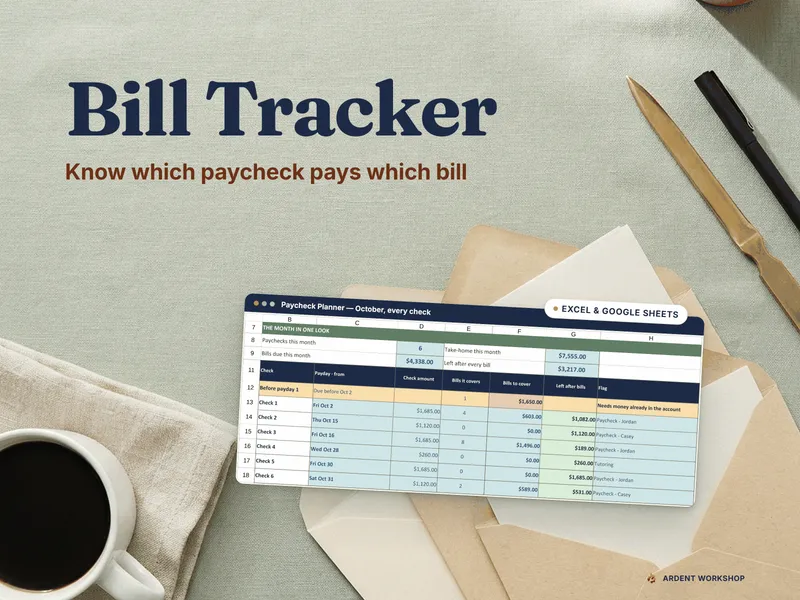
Bill Tracker Spreadsheet for Excel - Paycheck Planner, 90-Day Cash-flow Forecast, Late Payment Log & Sinking Funds
Excel bill tracker that assigns each bill to the paycheck that pays it, forecasts your balance 90 days out and catches late payments. Sheets copy included.
Life AdminView details - $29.95 Spreadsheet

Estate & Life-Admin Binder — Important Documents, Accounts, Insurance & Final Wishes Organizer (Excel + Google Sheets)
An estate & life-admin binder for Excel & Google Sheets — organize important documents, accounts, insurance, and final wishes in one file you own.
Life AdminView details