What a tithe means
The word tithe simply means a tenth. In its most common use today it refers to giving a tenth of your income to your church or faith community as a regular, proportional commitment. The practice has deep roots in the Hebrew scriptures and is carried into Christian giving, where many believers treat a tenth as their baseline of giving. Because tithing sits inside a religious tradition — and because different churches and believers understand it differently — the practical points below are offered as background on how the term is commonly used, not as a rule for what you personally should do.
How much is a tithe?
Traditionally, a tithe is 10% of income. That figure is where the word comes from and remains the common reference point. In practice, how strictly the ten percent is held varies: some believers and churches teach it as a firm commitment, while many describe it as a conviction and a starting point for generosity rather than a rigid law. Some give more; some who are stretched give what they can and build toward a tenth. The number is well established; how you apply it is personal.
Tithe on gross or net income?
One of the most common questions is whether to tithe on gross income (before taxes and deductions) or on net income (your take-home pay). There is no single answer that everyone agrees on — it is a personal and traditional choice, and sincere people land on both. The practical move is to decide your basis once, be consistent, and — if it helps — talk it through with your church or a trusted leader. A calculator or workbook can total whichever basis you choose; it doesn't decide the basis for you.
Tithes vs offerings
It helps to keep two ideas apart. A tithe is the proportional giving described here — traditionally a tenth, given regularly. An offering is additional giving on top of the tithe: a gift to a special cause, a building fund, a missionary, or a person in need. Many people give both — the tithe as their steady commitment, offerings as generosity beyond it. In a broadly parallel way, zakat in the Islamic tradition is an obligatory proportional giving of a different faith — a related idea of giving a set share, worked out and recorded the same practical way, even though the rules and reasoning behind each are their own.
Is a tithe tax-deductible?
In many places, gifts to a qualifying religious organisation can be tax-deductible if you keep the right records and meet the rules — but whether any given gift qualifies, and whether it helps you at tax time, depends on your country, your tax situation, and how you file. This page can't tell you that; a tax professional or your tax authority can. What you can do regardless is keep clean records of what you gave, to whom, and when — which is what makes claiming a deduction, if you're eligible, straightforward rather than stressful.
How to work out and record your tithe
The convictions — whether to tithe, on what basis, and how much — are yours and your community's. Once you've settled them, what's left is arithmetic and record-keeping, and that part is simple:
- Total your income on the basis you've chosen — gross or net — for the period you're giving on.
- Apply your rate — traditionally a tenth, or whatever you've committed to — to get the amount.
- Record each gift — to your church or community, by date, so the year adds up.
- Track given versus intended, so you can see where you stand at any point in the year.
You can do the sums in your browser with the free Zakat / Tithe Calculator — enter your income and your rate and it shows the figure, with nothing saved or sent. To keep a year of giving for your own records and for tax time, the Charitable-Giving & Zakat/Tithing Records Workbook holds a tithe worksheet where you set your own basis and rate, alongside a donation log that totals itself and a year-end summary built for tax season.
Own your giving records — don't rent them
Giving records are worth keeping for years — for your own peace of mind, for tax deductions where you're eligible, and to see your generosity over time. The advantage of a workbook you own over a subscription app is exactly that ownership: the file can't be locked behind a lapsed payment or vanish if a service shuts down, it lives on a drive or a trusted cloud account you control, and you decide who ever sees it. You set the basis and the rate; the tool only does the arithmetic and holds the record.
This is general background, not religious advice
This page explains a term so you can understand and prepare with confidence; it is general background, not religious advice, and it is not legal, financial, or tax advice. Tithing lives inside a faith tradition, and sincere believers, churches, and denominations understand it differently — whether it's a firm tenth or a guiding conviction, whether on gross or net, and how it applies to your life. For anything that touches your own giving, follow your own conviction and your church or community's teaching. A workbook or calculator only does the math you ask it to and keeps the records you choose to keep.
Templates that implement this
Work out and record your tithe
3 templates
A workbook you own that lets you set your own basis and rate, totals your income and your giving, and keeps a year of records for tax time — the math and the records, never the doctrine.
- $19.95 Spreadsheet

Charitable Giving Tracker & Zakat/Tithe Calculator — Donation Log with Year-End Totals (Excel + Google Sheets)
A charitable-giving tracker with a zakat & tithe calculator for Excel & Google Sheets — log every gift, total it automatically, get year-end records.
Life AdminView details - $5.95 Excel
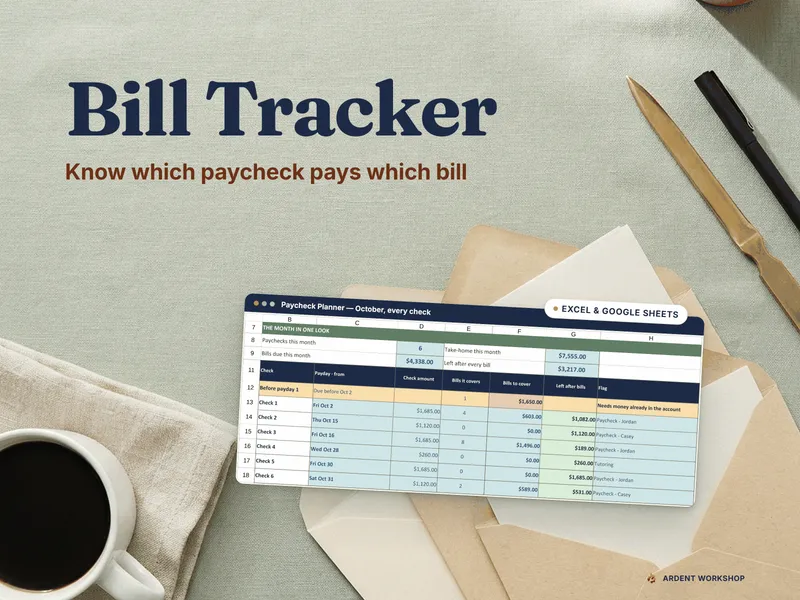
Bill Tracker Spreadsheet for Excel - Paycheck Planner, 90-Day Cash-flow Forecast, Late Payment Log & Sinking Funds
Excel bill tracker that assigns each bill to the paycheck that pays it, forecasts your balance 90 days out and catches late payments. Sheets copy included.
Life AdminView details - $29.95 Spreadsheet
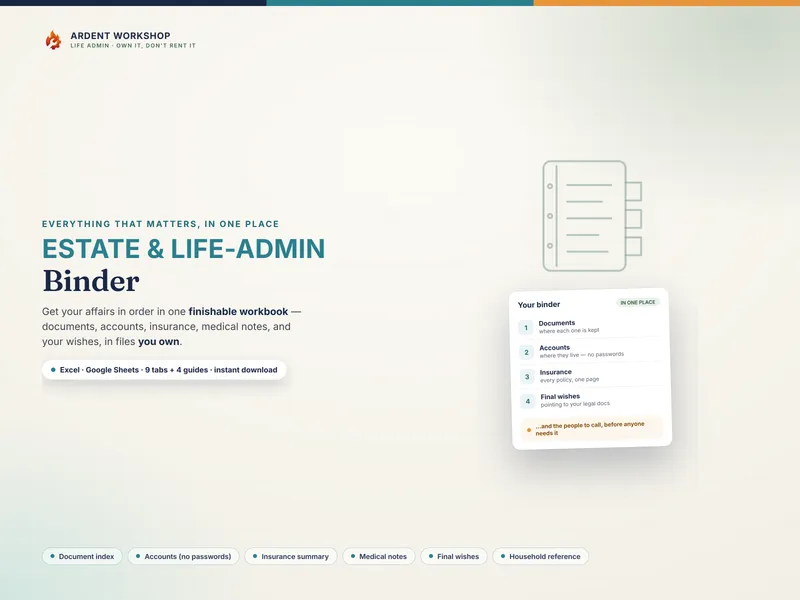
Estate & Life-Admin Binder — Important Documents, Accounts, Insurance & Final Wishes Organizer (Excel + Google Sheets)
An estate & life-admin binder for Excel & Google Sheets — organize important documents, accounts, insurance, and final wishes in one file you own.
Life AdminView details