This isn't really matrix-versus-LMS. The two tools record different things, and plenty of teams run both. The mistake is paying for a per-seat learning platform when the question you actually need answered — who can run this task right now, on their own? — is a grid you can own outright.
What each one is for
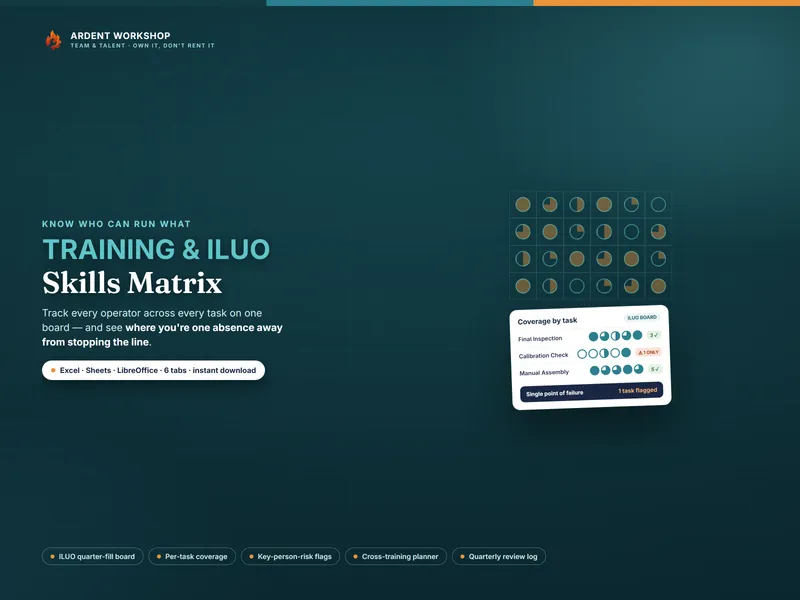
- An ILUO matrix records competence. Demonstrated, on-the-job ability scored as In training, Limited, Unsupervised, or Operator — and rolled up into per-task coverage and key-person-risk flags. It answers "who can do what, and where am I exposed."
- An LMS records training delivery. Course catalogues, enrollments, completions, quiz scores, and certificates. It answers "who took which course, and when."
Completing a course and being signed off to run a task are not the same thing — which is exactly why a matrix and an LMS can both be "training records" and still not replace each other. A full explanation of the ILUO scale is in the glossary.
When an ILUO matrix is exactly right
- Your training is mostly hands-on sign-offs — someone watches the work and signs.
- You need to see coverage and single points of failure across a team or shift.
- You want an auditable record of competence by task, kept current.
- You'd rather own the file than rent a platform per seat.
- You — and a handful of leads — maintain it, not a dedicated L&D team.
At this stage a matrix beats an LMS outright for the coverage question. The free ILUO starter board is a no-signup taste of the icon system, and the templates for HR & team leads hub collects the rest.
The signals you also want an LMS
- You deliver real course content at scale. Modules, videos, assessments — not just floor sign-offs.
- You need automated enrollment and reminders. Renewals and assignments across a large workforce, chased by the system.
- Compliance hinges on completion certificates. You must prove specific courses were taken, with timestamps and scores.
- Learners are remote and self-serve. People take training on their own time, anywhere.
Even then, the LMS records completions while the matrix records coverage — so the matrix keeps earning its place beside it.
Side by side
| What matters | ILUO skills matrix | LMS training records |
|---|---|---|
| Records | Demonstrated competence by task | Course enrollments & completions |
| Cost | One-time, low — you own the file | Ongoing subscription, often per user |
| Coverage & key-person risk | Built in — counts and flags per task | Not its job — tracks course status |
| Hands-on sign-offs | The whole point — assessed on the floor | Sometimes, via add-ons |
| Course delivery | None — it's a record, not a classroom | Full — modules, quizzes, certificates |
| Automated reminders | Manual review rhythm (e.g. quarterly) | Automated enrollment & renewals |
| Data ownership | The file is yours, offline | Hosted in the vendor's platform |
| Best for | Coverage & competence on a team or line | Delivering and tracking courses at scale |
The honest middle ground
Most teams don't choose one. They keep the LMS for the course catalogue they're required to deliver, and run an ILUO matrix for the coverage picture the LMS was never built to give. The mistake is the reverse: buying per-seat learning software to answer a coverage question, when an owned grid does it better and costs once.
Record competence either way
Whichever stack you run, you still need a fast, defensible way to see who can run what. The Training & ILUO Skills Matrix records each person's level on every task, counts coverage, and flags the single points of failure — one owned file for Excel, Google Sheets, and LibreOffice. Own the coverage record; add a learning platform only when delivering courses at scale becomes the job.
Frequently asked questions
- What's the difference between an ILUO matrix and an LMS?
- An LMS (Learning Management System) delivers and tracks training courses — who was assigned what, who completed it, and when. An ILUO matrix records demonstrated on-the-job competence: whether a person can actually run a task alone, to standard, scored as In training, Limited, Unsupervised, or Operator. One proves a course was taken; the other proves the task can be done — and shows your coverage and key-person risk across the team on a single grid.
- Can a spreadsheet replace an LMS for training records?
- For the records most teams actually act on — who is signed off for which task, and where coverage is thin — yes. An ILUO matrix is a complete, auditable record of competence by task. What a spreadsheet doesn't do is host the courses, serve quizzes, or automate enrollment and reminders. If your training is mostly hands-on sign-offs on the floor, a matrix is the right tool; if you're delivering and tracking a catalogue of e-learning at scale, that's an LMS job. Many teams run both: the LMS for course completions, the matrix for coverage.
- Is an ILUO matrix enough for an audit?
- A current, dated, reviewed ILUO matrix is one of the cleanest ways to show that competence is defined, assessed, and kept up to date — the three things audits to common quality and management-system standards typically look for. What your specific standard or auditor requires is theirs to set; the matrix is the place to record and present it. It's a record-keeping template, not a certification, and not legal or compliance advice.
- How much does an ILUO matrix cost vs an LMS?
- An owned ILUO matrix workbook is a single low one-time cost — you keep the file, edit it offline, and pay nothing monthly. An LMS or HRIS module is typically a recurring per-seat subscription. The subscription earns its keep when you're delivering and tracking real course content across a large workforce; paying per seat just to record who's signed off for which task is renting far more platform than the job needs.