Where it sits in the sequence
A written warning is rarely the first thing said about a problem — it's usually the third or fourth. A common shape runs:
- A coaching note. Something small and early — flagged in the moment, written down briefly so there's a date attached to it, but not framed as discipline.
- A verbal warning. Despite the name, this still gets written down — a short record that a spoken warning happened, when, and what was said. “Verbal” describes how it was delivered, not whether it left a paper trail.
- A written warning. The issue has continued, or is serious enough to start here — a formal document naming the standard, the gap, and what has to change by when.
- A final written warning. States plainly that this is the last step before a more serious consequence, if nothing changes.
A performance improvement plan runs alongside this rather than inside it — it's the route for a capability problem (someone trying, but falling short of the standard) rather than a conduct problem (someone able to meet the standard, but not doing so). See what a performance improvement plan is for where that fits.
This sequence is common practice, not something the law requires by itself in most places — many jurisdictions leave the exact steps up to the employer's own stated policy, and check yours. What tends to matter more, if a decision is ever looked at again later, is whether you followed the process you told people you'd follow, and whether the file tells a coherent story rather than jumping straight to a written warning with nothing behind it. A free coaching note & verbal-warning record covers the two steps that come before this one, so there's something to point to if it's ever asked whether this really came out of nowhere.
What to actually write
This is the part that separates a document worth having from a document that makes things worse. “Poor attitude” and “not a team player” are conclusions, not facts — and a file full of conclusions is weaker than no file at all, because it reads as opinion rather than record. The fix is always the same: name the date, the specific action, and what standard it fell short of.
- Instead of “poor attitude,” write “In the Tuesday, June 9 team meeting, interrupted a coworker's update four times after being asked once to let them finish.”
- Instead of “not a team player,” write “Declined to cover the register during the agreed lunch rotation on June 3 and June 10, after being asked directly both times, leaving one coworker covering the front of the store alone.”
- Instead of “attendance has been unacceptable,” write “Arrived after the store's 9:00 a.m. opening time on May 28, June 4, and June 11, each time without a call or text beforehand, after being asked on May 30 to notify a manager ahead of any lateness.”
A few things follow from that same rule. Don't diagnose — “seems to be struggling at home” is a guess dressed up as an observation, and it doesn't belong in the file. Don't speculate about motive — write what happened, not why you think it happened. And a simple test for the whole document: don't write anything you wouldn't be comfortable reading out loud to the person it's about, because in most workplaces you'll be doing exactly that.
Give the employee a chance to respond
A real section for the employee's own account is one of the first things small employers skip, usually because the template doesn't have space for it. Before the warning is finalized, the person it's about should get a chance to say what happened from where they sat — a scheduling conflict nobody flagged, an instruction that was genuinely unclear, a fact the write-up got wrong. Sometimes that changes the document. Sometimes it doesn't, and the warning stands as written. Either way, a file that shows the response was invited reads very differently from one that doesn't — it looks like a process, not a verdict handed down.
Signing
A signature on a written warning commonly acknowledges that the document was received, not that the employee agrees with it — and saying so plainly, right on the page, is what actually gets people to sign. Most of the reluctance to sign comes from people assuming a signature means agreement; once that's cleared up, most people will sign.
If someone still refuses, don't argue the point or withhold the warning over it. Note the refusal in writing: the date, who else was present, and that a copy was provided regardless. The warning stands whether or not it was signed — the refusal itself becomes part of the record.
Where it's filed, and how long
A written warning commonly goes in the personnel file — the general employee record, as opposed to a separate confidential file reserved for health, disability, accommodation, or medical-leave material, which doesn't belong somewhere a supervisor might casually be handed. How long it's kept varies by employer and by place, but disciplinary records are often held for the length of employment and for some further period after that, since the record can matter again well after the incident itself — in a later dispute, or when a reference is requested. Treat this as common practice to check against your own policy and jurisdiction, not as a fixed rule.
Common mistakes
- Writing conclusions instead of facts. The single biggest reason a written warning doesn't hold up — see “what to actually write” above.
- Jumping straight to a written warning with nothing on file before it, for something that was never raised informally first.
- Skipping the employee's side. A document that only ever speaks in one direction looks like a decision already made, not a process.
- Treating a refusal to sign as a reason to escalate. It isn't — note it and move on.
- Backdating. A written warning dated after the fact, to cover for a step that was never actually taken, is worse than having skipped the step, because it's discoverable.
Related templates and concepts
A written warning is one document in a longer chain — it pairs with a performance improvement plan when the issue is capability rather than conduct, and it depends on behavior-based feedback to say anything worth saying. To cover the two steps that come before it for free, the coaching note & verbal-warning record is an ungated starting point; the HR Letters & Employment-Document Template Pack carries the written warning through to a final written warning, separation, and the 22 other documents around them, each stamped with where it's filed and for how long. See the templates for HR & team leads hub for the rest of the toolset.
Templates that implement this
Templates for writing and issuing a warning
2 templates
The document itself, and the script for delivering it out loud — the conversation and the paperwork are different skills, and most small employers only have a template for one of them.
- $29.95 Mix
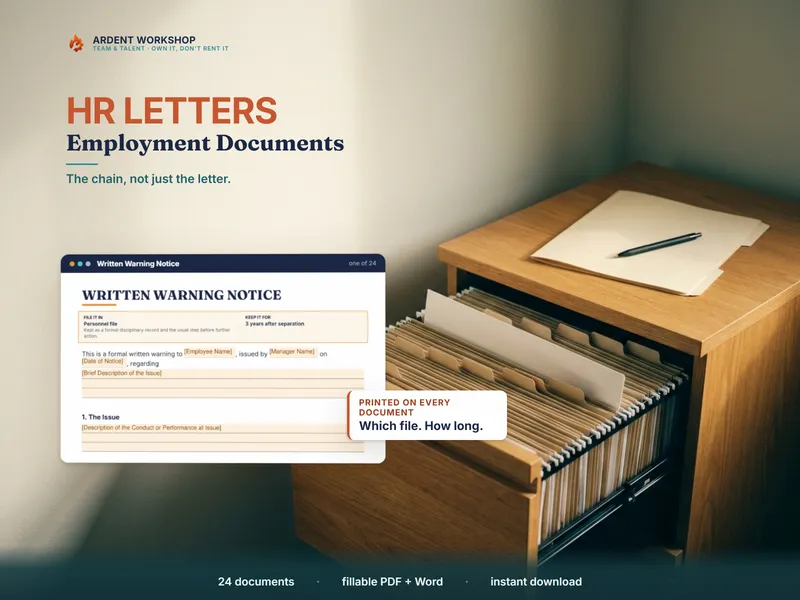
HR Letters & Employment-Document Template Pack — 24 Fillable Employment Documents, Each Stamped With Which Employee File It Goes In and How Long to Keep It
The letter is the easy part. This is the chain — which document a situation needs, what must already be on file, and where it gets filed. PDF + Word.
Team & TalentView details - $24.95 Mix

Manager's Difficult-Conversations Script Bank — 15 Word-for-Word Scripts, Each Branched for the Four Replies You Actually Get, With the Note to Write Afterward
15 word-for-word manager scripts for difficult conversations — each branched for the four replies you actually get, with the exact next line for every one.
Team & TalentView details