
What a print release gives the client, and what it does not
In the US, the photographer generally owns the copyright in the images unless a written agreement transfers it. That means a client who has paid for a session does not automatically hold written permission to copy the photos at a print lab or post them online. The print release supplies that permission, for personal use.
What it gives: a personal, non-exclusive, non-transferable license to the finished, edited images in the delivered gallery. The client may print for their home, family and friends at the lab of their choice, post the images on personal social media and personal websites with credit where the platform allows, share copies with family and friends, use them in personal photo books, gifts and cards that are not sold, and keep the files for their own use.
What it does not give: ownership. The release is a license, not a sale of the copyright, so you keep the copyright and can keep showing the work in your portfolio as your session agreement allows. It does not cover unedited files, outtakes or images you did not deliver. And it does not reach business use of any kind. Anyone who wants to put the images in advertising, on a product listing or on a company website needs a usage license instead.
For ready-made wording, the Photography Client & Contract Kit includes a fillable print release with the may-do and may-not lists already written. The free Model Release + Session Prep Starter covers the other direction: an adult model release and a client prep guide.
Print release vs usage license vs model release
Three documents that sound alike do three different jobs, and the quickest way to keep them straight is to ask whose permission is being recorded and for what.
- Print release. You give the client permission to use the images for personal purposes: prints, family sharing, personal social media. Used at delivery of personal-use galleries such as weddings, newborn, family, portraits, graduations and events.
- Usage license. You give a client or brand permission to use the images for business: advertising, a website, product listings, packaging, press. It states the use granted, for how long and where, and the fee is worked out from that use. Used for commercial, video, and architecture and real estate shoots where the client wants rights beyond the listing.
- Model release. The person in the photo gives you permission to use images of them, in the ways listed on the page. It runs the other direction from the other two. See what a model release is for the full picture.
A simple test: if the client is the one asking to use the pictures, you want a print release for personal use or a usage license for business use. If you are the one asking to use a person's likeness, you want a model release.
What goes on a print release
A print release is short by design. The parts that make it work:
- Who and what. Your studio and name, the client, the session date, and the gallery name and number of images released, so the release matches what was actually delivered.
- What it covers. The finished, edited images in that gallery, listed by file name or range. For a partial release, list each group.
- What the client may do. The personal-use list above, written so a client can read it in a minute.
- What the client may not do. No selling the images or prints, no contests, no business or advertising use, no removing your credit or watermark or claiming the work as their own, no filters or retouching that change the finished look when shared with your name attached (ordinary cropping for a profile photo or print size is fine), and no passing the images to anyone who will use them that way.
- Copyright and credit. A line saying you keep the copyright, plus the credit line you would like used when the client shares.
- A print lab line. Permission for the client to show the release to a lab or printer as proof they may print, with an email for the lab's questions.
- Signatures from you and the client, with a signed copy filed with the session paperwork.
The clause not to delete
The "may not" list is the half of a print release that actually protects you. The allowed list is easy to be generous about. The not-allowed list is what keeps your edited work from being resold, entered in contests or used in someone's business. Before you send the release, read that section yourself and cross out anything you are willing to allow. If you are happy for a cropped version to be a social profile photo, say so in writing.
Common mistakes
- Handing over files with nothing in writing. A client turned away at a kiosk because the lab wants a release is a client who is annoyed with you.
- Allowing everything because it feels generous. Personal use means the client's own home, family and social sharing, not resale, contests or a business. Say so kindly and clearly.
- Forgetting edits. A client who runs your work through a filter and posts it with your name on it has changed the work. The release can ask them not to.
- Attaching it only to the original agreement. Many clients do not remember what they signed months ago. Send the release with the delivered gallery, and mention it in the delivery message.
Where your state comes in
Copyright ownership and licensing of photographs are mostly federal in the US, but contract terms, how enforceable limits on use are, and any tax on a fee or on prints can vary by state. Ask a local attorney whether your state taxes digital files or prints, and whether you can restrict later alterations of the work the way the "may not" list does.
Where to start
A print release is one of the twenty documents in the Photography Client & Contract Kit, alongside the usage license with a calculating fee, adult and minor model releases, a property release and genre-matched contracts, each as fillable PDF, print PDF and Word, plus a Session Paperwork & Release Log workbook for Excel and Google Sheets. You buy it once and keep it. To try the approach first, the free Model Release + Session Prep Starter has an adult model release and a client session-prep guide, no signup. If a client wants business use, the kit's usage license and the workbook's License Quote tab work out the fee from your own rate card and the use granted. To see when to send each document, read what to send a client before a photo session; for pricing your packages, see how to price a photography package, and the photography hub has more.
Templates that implement this
Get a print release you can fill in
2 templates
A fillable print release, with the may-do and may-not lists and the print lab line already written, sits beside the usage license and model releases in a contract kit you own.
- $15.95 Mix
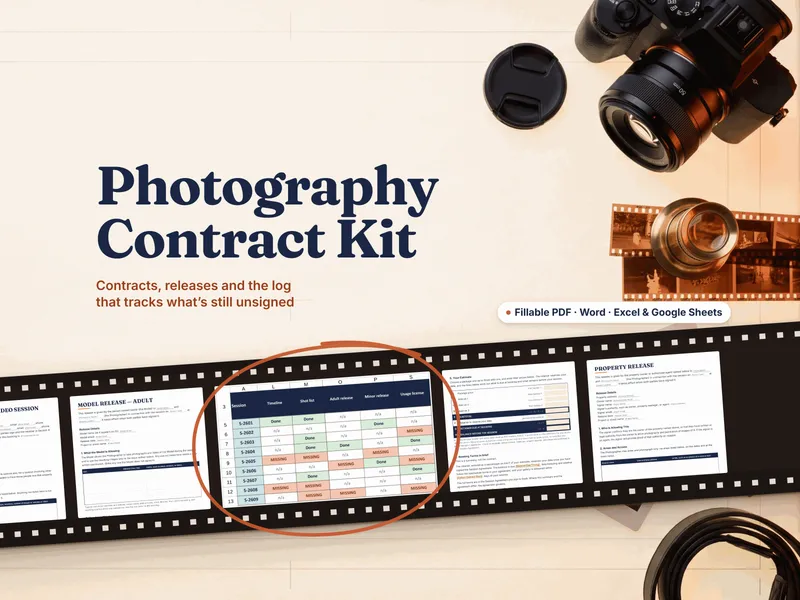
Photography Client & Contract Kit — Photography Contract Template, Model & Property Releases, Pricing Guide Template and a Session Paperwork Log (Fillable PDF, Word, Excel + Google Sheets)
A photography contract template kit: 20 client documents in fillable PDF, print and Word, plus a log that tracks which releases each booking still needs.
Operator OSView details - $29.95 Spreadsheet
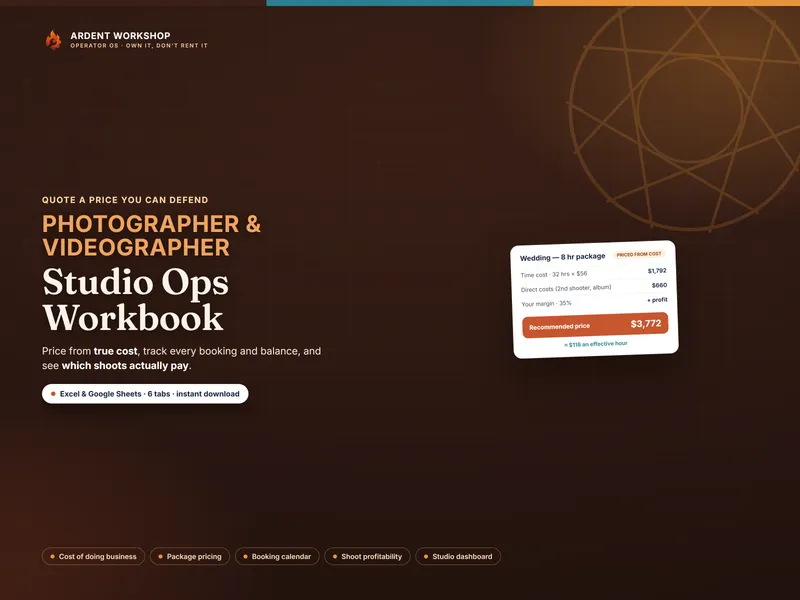
Photographer / Videographer Studio Ops Workbook — Package Pricing, Booking & Profit Calculator (Excel + Google Sheets)
Photography business workbook for Excel & Google Sheets — price packages from true cost, track bookings and balances, and see which shoots actually pay.
Operator OSView details
Frequently asked questions
- What is a print release in photography?
- A print release is a short document a photographer hands over with the finished gallery that gives the client written permission to print and share their images for personal use. It lists what the client may do, such as printing for the home, family and friends and posting on personal social media, and what they may not do, such as selling the images, entering contests or using them for a business. The photographer keeps the copyright.
- Does a print release transfer copyright to the client?
- No. A print release is a license, not a sale of the copyright. In the US the photographer generally owns the copyright in the images unless a written agreement transfers it, and a print release says in so many words that the photographer keeps it. Rules about copyright transfers and what you can restrict can vary, so ask a local attorney if you are unsure.
- What is the difference between a print release and a usage license?
- A print release covers personal use: the client's own home, family and social sharing. A usage license covers business use, such as advertising, a website, product listings or press, and it states what use is granted, for how long and where, with a fee worked out for that use. A client who wants business use should be pointed to the usage license rather than given a print release.
- Is a print release the same as a model release?
- No. A print release gives the client permission to use the delivered images for personal use. A model release works the other way: it records a person's permission for the photographer to use images of them, in the ways listed on the page. One protects the photographer's work from misuse after delivery; the other protects the photographer's use of a person's likeness.
- Can a client use a print release at a print lab?
- That is what it is for. A well-built print release includes a print lab authorization line that lets the client show the page to a lab or printer as proof they are allowed to print the listed images. Whether any particular lab accepts it is the lab's own policy.
- Do I need a print release for a real estate or commercial shoot?
- Usually not. A print release is for personal-use galleries such as weddings, newborn, family and portraits, graduations and events. Real estate, architecture and commercial work are business uses, where a usage license is the document that applies.