
What a model release grants
A good release is not a blanket waiver. It is a list of permissions, and every part of it exists to make the permission specific:
- The allowed uses. A table the model goes through line by line — portfolio and website, social media, print and ads, stock libraries, the client's marketing. They can say yes to some and no to others, and a struck row means no. Anything not listed needs a new written permission.
- How long it lasts. A written term, so the permission does not read as forever.
- What the model receives. Even if it is only the images or a meal, an honest line beats a blank one.
- How to stop future use. The model can ask in writing for you to stop using the images in new materials. You remove them from the sites you control, but you cannot recall what is already printed or published, or copies other people saved.
- What the model confirms. That they are an adult where they live, that they can sign, and that nothing else they have agreed to conflicts. The photographer keeps the copyright and may edit and retouch in the ordinary way.
The release does not transfer copyright and is not permission to use the person in a way meant to embarrass them or in a context they did not agree to. A specific release is also easier to explain to the person signing it, and easier to rely on later.
You can see one filled in before you write your own: the free Model Release + Session Prep Starter has an adult model release and a worked example, and the Photography Client & Contract Kit has the full set of releases beside the contracts.
Adult vs minor
The adult release is signed by the person in the photo. The minor release is signed by a parent or legal guardian, and it differs in three ways: the signer is not the person pictured, the page records their relationship to the child, and the uses are written narrowly. The minor version typically also keeps the child's full name, school, address and exact location out of published captions unless a row says otherwise.
The common mistake is accepting a signature from someone who is not the parent or legal guardian — a grandparent, a nanny, an event organizer. Ask who the legal guardian is and write it down. Also check the age of majority where you work, because it varies by state, and someone just under or over the line changes which release you use. A child grows up: pick a term, and tell the parent how to ask you to stop later. For commercial work with children, the client or production may have its own minor-talent requirements, such as work permits, which are separate from the release and vary by location.
Model release vs property release vs print release
These three get lumped together as "releases" and each answers a different question:
| Release | What it covers | Who signs | When it comes up |
|---|---|---|---|
| Model release | A person's image, in the uses listed | The adult, or a parent or guardian for a minor | At the session, when use goes beyond the client's own gallery |
| Property release | Entering, photographing and using images of a home, venue, studio or business | The owner or a documented authorized agent | Before the session, especially when the person who hired you does not own the space |
| Print release | What your client may print and post from their delivered gallery, and what they may not | You grant it; the client agrees | At gallery delivery, for personal-use work |
The first two are permissions you collect from other people. The print release is one you give to your client. And if a client wants business use of the images, that is a usage license, not a print release. A release for a property does not clear the artwork, logos or other people in the frame, so each person who is recognizable may need their own.
When commercial use needs one
Get a release whenever a recognizable person appears in work you plan to use beyond that person's own personal-use gallery: styled shoots, brand and commercial work, stock, advertising, and portfolio images of someone who is not your client. For a regular client, the portfolio and marketing clause in your session agreement usually covers portfolio use; reach for a separate release when the use goes further, or when the person in the photo is not the person who signed the agreement. Friends, relatives and passersby in a commercial image may each need their own.
Right-of-publicity and privacy rules differ by state, and some states treat commercial use of a likeness more strictly than editorial or portfolio use. What counts as valid consideration and whether a release can be revoked also vary. Ask a local attorney how your state treats advertising and stock use.
What to keep on file
- The signed release itself, filed with the session paperwork so you can find it in a year, and a signed copy handed to the model the same day.
- The model's name as it appears on their ID, matched to the printed name on the page — a release signed with a nickname is harder to rely on.
- For a minor, the parent or guardian's name and relationship written on the page.
- The term and the allowed-uses table, so you can see at a glance what a given image may be used for and when permission ends.
- Any written request to stop future use, kept with the release it relates to.
A verbal okay is the habit to retire. Memories differ, and the person who said yes at the session may not remember it when they see themselves in an ad.
Where to start
The adult model release, a one-page client session-prep guide and a filled-in example are in the free Model Release + Session Prep Starter — fillable and print PDF, no signup. When you want the full set, the Photography Client & Contract Kit adds the minor release, a property release, a print release and a usage license with a calculating fee, beside genre-matched contracts, in fillable PDF, print PDF and Word, and a Session Paperwork & Release Log workbook for Excel and Google Sheets that works out which documents each booking still needs signed. You own the files, so you edit them to fit your studio. To time each release, see what to send a client before a photo session; to decide whether you need an app to send them, see contract templates vs a studio-management app. For the money side of the studio, see the Photographer / Videographer Studio Ops Workbook, and the photography hub collects the rest.
Templates that implement this
Releases you fill in and own
2 templates
Adult and minor model releases, a property release, a print release and a usage license — beside genre-matched contracts and a workbook that tracks which paperwork each booking still needs signed.
- $15.95 Mix
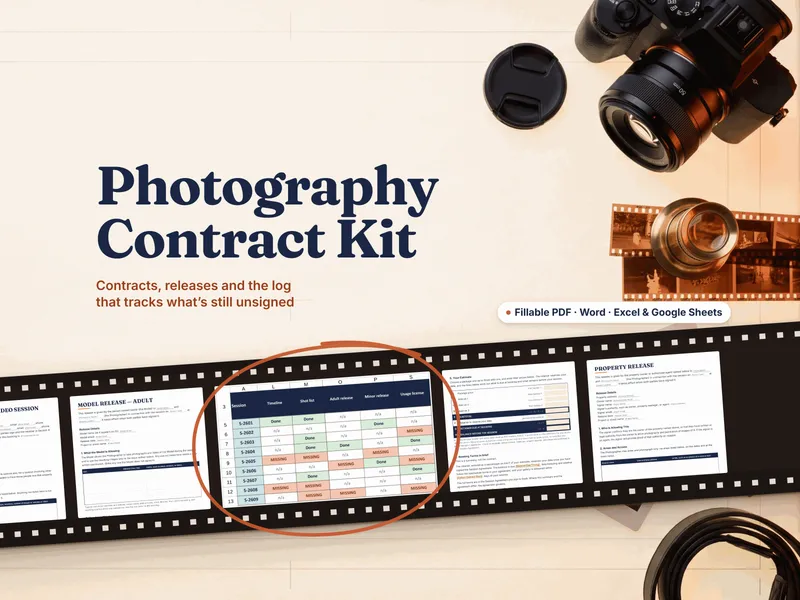
Photography Client & Contract Kit — Photography Contract Template, Model & Property Releases, Pricing Guide Template and a Session Paperwork Log (Fillable PDF, Word, Excel + Google Sheets)
A photography contract template kit: 20 client documents in fillable PDF, print and Word, plus a log that tracks which releases each booking still needs.
Operator OSView details - $29.95 Spreadsheet
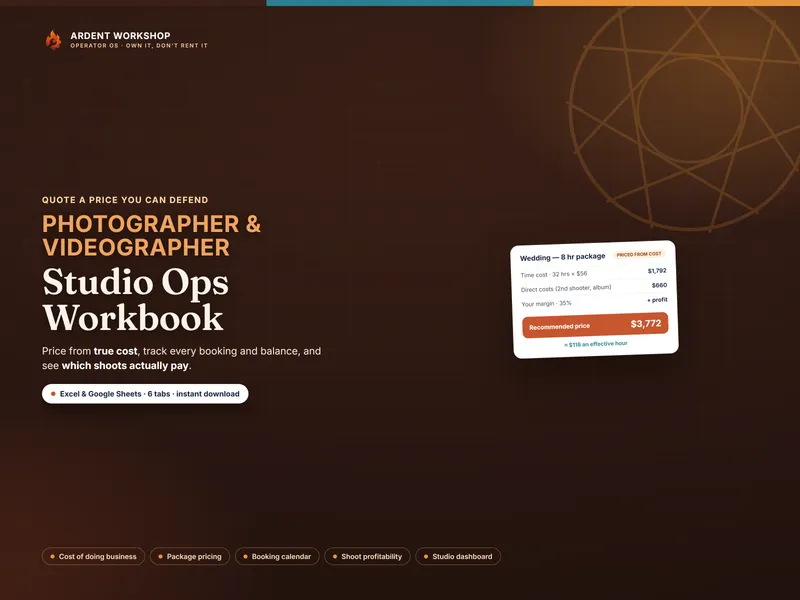
Photographer / Videographer Studio Ops Workbook — Package Pricing, Booking & Profit Calculator (Excel + Google Sheets)
Photography business workbook for Excel & Google Sheets — price packages from true cost, track bookings and balances, and see which shoots actually pay.
Operator OSView details
Frequently asked questions
- What is a model release?
- A model release is a signed page in which a person gives a photographer permission to use their image in the ways listed, for a stated length of time, and records how they can ask you to stop future use. It is not a blanket waiver: anything not listed needs a new written permission.
- Do I need a model release for a regular client session?
- Usually not for the client's own gallery. For a regular client, the portfolio and marketing clause in the session agreement typically covers portfolio use. Use a separate release when the use goes further than that, or when the person in the photo is not the person who signed the agreement.
- What is the difference between an adult and a minor model release?
- The adult release is signed by the person in the photo. The minor release is signed by a parent or legal guardian, records their relationship to the child, and keeps the uses narrower, including limits on publishing the child's full name, school or location. The age of majority varies by state.
- What is the difference between a model release, a property release and a print release?
- A model release covers a person's image. A property release is the owner's permission to photograph and use images of a home, venue or business. A print release goes the other direction: it is what you hand your client at delivery so they know what they may print and post.
- How long should I keep a signed model release?
- Give the model a signed copy the same day, and store your own signed copy with the session paperwork so you can find it in a year, when a question about an image comes up. How long you must keep it is a question for a local attorney.