Two passes, not one glance
A forklift pre-shift inspection isn’t a glance at the tires on the way to the seat. OSHA’s powered industrial truck standard — 29 CFR 1910.178(q)(7) (opens in new tab) — requires that a forklift be examined before it’s placed in service, and that it not be placed in service if the examination turns up anything that adversely affects safety; trucks used on one shift get examined at least daily, and trucks used around the clock get examined after every shift, not once for the whole day. The Vehicle & Equipment Pre-Use Inspection Log builds that cadence in: log each shift’s check against the truck, and it tells you which ones were missed. The method underneath it is two passes — a visual walk-around with the engine off, then an operational check with it running — and a clear line for what takes a truck out of service.
Step 1 — Start with the walk-around
Before the engine turns over, walk the truck. Check the tires and wheels for damage or low pressure, the forks and carriage for cracks or bends, the mast and lift chains, hydraulic hoses and cylinders for leaks, the overhead guard and load backrest for damage, and the horn, lights, and data plate. This pass catches what’s wrong with the truck sitting still — damage that operating it won’t fix and might make worse.
Step 2 — Then run the operational checks
Start the truck and check what only shows up moving: service brakes and parking brake, steering, horn, lights, and backup alarm, and the hydraulic controls — lift, tilt, and any attachment — through their full range of motion. Confirm the seat belt and any operator-presence interlock actually engage before the truck goes to work.
Step 3 — Know what takes a truck out of service
Findings aren’t all equal, and treating them as if they are is how a real defect gets waved through with the minor ones. A worn tire tread or a dim work light gets logged and watched. A cracked or bent fork, a hydraulic leak, failed brakes, a damaged overhead guard, or anything else that adversely affects safety is a take-out-of-service condition: under 29 CFR 1910.178(p)(1), a truck found to be in need of repair, defective, or otherwise unsafe stays out of service until it’s restored to safe operating condition. Decide the line before the shift, not in the moment — a mental “it’s probably fine” is exactly what this step exists to remove.
Step 4 — Tag it and report it
An out-of-service truck needs to actually stop being used, which means a visible tag on the truck and a report to whoever handles repairs — not a verbal heads-up that evaporates by the next shift change. The tag keeps the next operator from climbing on a truck someone already flagged; the report is what gets it fixed instead of just noticed.
Step 5 — Every shift, not once a day
A truck that only runs one shift needs one inspection a day. A truck that runs around the clock needs to be examined after each shift — the standard specifically calls this out, because a defect that develops six hours into a shift doesn’t wait for the next calendar day to matter. Whoever hands the truck off does the check before they walk away from it.
Step 6 — Record it, even though OSHA doesn’t require paperwork
Here’s the part that surprises people: OSHA does not require the pre-shift examination to be written down. An OSHA letter of interpretation dated February 7, 2000 confirms it — the standard requires the examination, not a form. But “not required” isn’t the same as “not worth doing.” A written, dated, signed record is what proves the inspection happened if a truck fails later and someone asks whether it was checked that shift, and it’s the only way to see a pattern — the same fork cracking twice, the same truck missing checks on the night shift — instead of relying on whoever happened to remember.
Step 7 — Roll it up across your fleet
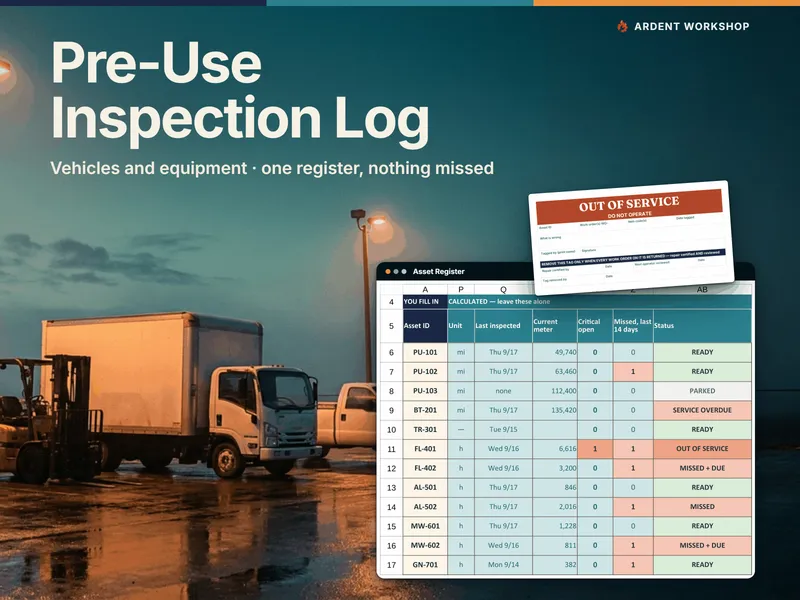
One truck’s checklist tells you about one truck. A register across every forklift, pickup, and piece of equipment you run tells you which inspections were actually completed, which trucks are currently tagged out of service, and which units keep generating the same defect — the signal that a “quick repair” needs to become a real one.
Worth knowing if that fleet includes highway vehicles: where a vehicle is a commercial motor vehicle operated under FMCSA rules — and plenty of work trucks and vans are not, so it’s worth checking your own status — the end-of-day paperwork is a different rule entirely. A written report is required on the days a defect turns up, not on every clean day, and a carrier’s certified repair and a next-driver signature attach to it. See what a DVIR is for where the two regimes part company, and the daily vehicle inspection checklist for how that one runs.
Keep the shift record without a clipboard
A forklift running three shifts generates three examinations a day, and a paper pad wedged behind the seat is where they go to be forgotten. The Vehicle & Equipment Pre-Use Inspection Log logs each check against the truck and the shift, so the after-every-shift cadence the standard asks for reads as a grid instead of a guess — a missed check is visible, a failed critical item becomes a work order, and the truck stays flagged out of service until the repair is certified and reviewed. Your pickups, lifts and mowers sit on that same register, so the forklift record isn’t a second system to maintain. Item codes on the printable tear-off pads match the workbook’s, plus an out-of-service tag. It works in Excel, Google Sheets and LibreOffice Calc, and ships with printable PDFs.
Running pickups and vans alongside the forklifts? The free daily vehicle inspection checklist covers that side of the yard — one printable page for a single vehicle, pre-filled with a worked example, with no log, defect tracker or out-of-service flags behind it. There’s no free forklift equivalent, but it’s a fair way to see whether the habit sticks before you pay for the paperwork around it.