Why the first week is different
Most move-in checklists are alphabetical, or organized by category, which is the same thing as being organized by nothing. A better ordering principle is what closes first — which things get harder fastest, whatever category they belong to.
Four groups, in order:
- Things that stop you losing the house to water or fire. The main water shutoff, the gas shutoff and a wrench that fits it, the main breaker, and a working smoke and carbon-monoxide alarm on every level.
- Things with an outside deadline. Driver’s license and vehicle registration addresses, a homestead exemption or property-tax filing, a warranty registration window, a property-tax appeal deadline. Somebody else set the date and nobody will remind you.
- Things that are only findable now. Paint colors, the filter size, the appliance model numbers, the breaker map, where the spare flooring is, what the seller knows about the roof.
- Things that are merely important. The furniture, the paint, the yard, the renovation you have been picturing since the second showing. These will still be there.
Almost every list you will find online mixes all four together. The reason this one starts at a valve rather than at a change-of-address form is that the valve is in group one and the form is in group two.
Day one: the four safety finds
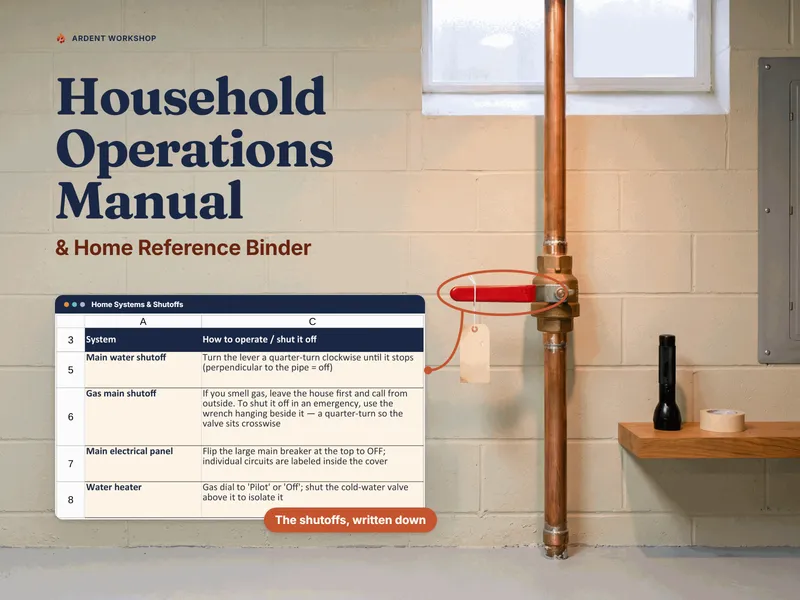
The main water shutoff
Almost every catastrophic, expensive, insurance-claim household event starts as water going somewhere it should not and continuing to go there for hours. The damage is a function of minutes, and every minute is decided by whether somebody knows where the valve is.
Follow the incoming pipe from the water meter. Then write down, in directions a stranger could follow, where it is and which kind of valve it is — a lever that turns a quarter turn, or a round handle that turns several times clockwise. Do the drill once with everyone who lives there: walk from the front door to the valve, turn it off, turn it on. The point is not the valve. The point is that somebody frightened and half-asleep can find it without thinking.
If it will not move, do not force it with a wrench — a snapped valve floods the house immediately. Write it down as a job for a plumber, and in the meantime find the street shutoff at the property line. That box usually needs a long hooked key you have to own; buy one.
The gas shutoff, and the wrench
The meter is typically on an exterior wall, with the shutoff on the pipe before it. The valve usually needs a specific wrench that is not a normal adjustable. Buy the inexpensive one and zip-tie it to the pipe.
If you ever smell gas: leave the house, do not touch switches, and call the utility from outside. Do not investigate.
The main breaker
Find the panel — usually a gray metal door in a garage, basement, utility room, or hallway — and identify the main breaker, typically the largest one at the top or center and marked with the service amperage. Open the outer door as much as you like; never remove the inner cover. The screws holding that cover are the boundary between things a homeowner does and things that kill people. Everything useful here is done with it in place.
Every detector
Press the test button on every smoke and carbon-monoxide alarm, then take each one down and read the manufacture date printed on the back. Smoke alarms are generally replaced at about ten years and CO alarms commonly at seven to ten depending on the model, so read the instructions on the unit rather than assuming. This is the check people skip because the units look fine — and looking fine is exactly the failure mode of an expired detector.
Day two to three: the locks, the filter, and the panel map
Rekey every exterior lock. You do not know how many keys exist, who has them, or when they were last accounted for. Rekeying four cylinders to a single key is a modest one-time cost, and it is the only version of this problem that ends.
Clear the garage-door opener’s memory and re-pair only your own remotes, then change the keypad code. Openers hold old pairings indefinitely.
Change the HVAC filter, and write the size on the return grille in marker. Then write it down again somewhere permanent. This is the single highest-value four seconds of labeling in the house.
Map the panel. Two people, one lamp, one hour, and it is right forever. Below is roughly what a filled-in map looks like — the point being that “Kitchen” on the original label card usually turns out to mean three different circuits and one of them also runs the garage.
| Breaker | What the label said | What it actually feeds |
|---|---|---|
| 1 | Kitchen | Kitchen counter outlets, north wall only |
| 2 | Kitchen | Refrigerator (dedicated) |
| 7 | (blank) | Garage outlets and the freezer |
| 12 | Bath | Both upstairs bathrooms — GFCI in the hall bath resets both |
| 18 | (blank) | Nothing found. Ask about the shed. |
An illustrative example, not a real panel. That last row is worth keeping honestly: a breaker that controls nothing you can find usually means an outbuilding, an abandoned circuit, or something in a wall, and it is a good question for the seller while they are still answering.
Day three to five: photograph everything, once
Twenty minutes with a phone, and it cannot be recreated afterwards:
- Every meter, the day you get the keys. It is your only proof of where the readings stood.
- The exterior — the roof from the ground on all four sides, each elevation, the grading, every downspout, the driveway, the fences.
- Every appliance data plate. You need the make, model, and serial for any warranty claim, part, or repair call, and reading them off the back of an installed dishwasher later is genuinely unpleasant.
- Every paint can label the seller left, noting which room each one is.
Then use the water meter as the leak detector you already own: read it last thing at night and again before anything is used in the morning. Any change at all is water you paid for and did not use — most often a toilet flapper, occasionally something much worse.
The transfers, and the lead time each one needed
The reason a move checklist stops working around week two is almost always that every item on it has the same due date. Half the list flips from fine to late on a single Tuesday, it sequences nothing, and you stop looking at it.
If you are reading this after closing, the first three are already behind you — the point of the table is the ones that are not, and what to check on the ones that are. Each gets the lead time it actually needs:
| Account | Typical lead time | Why that one |
|---|---|---|
| Homeowners insurance | About six weeks before closing | The lender will not fund without proof of coverage |
| Internet installation | About four weeks | The appointment is the bottleneck, not the paperwork |
| Electric and gas | Start on the closing date | You own an unheated, unlit building from the moment you close |
| Trash and recycling | About two weeks | Missing the first collection means a garage full of boxes |
| USPS mail forwarding | About two weeks before the move | A safety net, not a change of address — and it expires |
| Driver's license and vehicle registration | A legal deadline that starts after you move | Commonly ten to thirty days; check your state, it carries a penalty |
| Homestead exemption or property-tax relief | A one-time application, with a deadline to file it | Where it exists it is worth real money, and nobody reminds you |
These are illustrative starting points, not rules — providers and jurisdictions differ, and the deadline ones in particular vary by state and county and change. Confirm each with the agency itself; that takes one search and is the difference between a reminder and a penalty.
While you are on the phone setting each account up, write down what it costs and how often it is billed. It takes ten seconds and it is the only chance you will get without effort. Added up, that is what the house costs to run — and it is on no document anybody handed you at closing.
The last job of the week: ask the seller everything
This has the shortest fuse of anything on this page. For a few weeks the seller feels some obligation to answer; after that they simply stop. Send one message, in writing, asking for all of it at once:
- Manuals, remotes, spare keys, and how to change any codes
- Paint cans, colors and sheens, and where the spare flooring is
- Who serviced the furnace, who did the roof, and when
- Which contractors they would use again — and which they would not
- Anything about the house they wish somebody had told them
It is the cheapest information in the entire first year and it has a fuse on it.
Then: two dates, and the rest of the year
Write down your closing date and your move-in day, and hang everything else off them — noting against each task and each account which of the two it counts from.
That distinction is not pedantry. You own the house from closing, which is when the utilities should start and when the closing documents are dated. Your own clock starts at move-in, which is what the address changes, the license deadline, and the first maintenance cycles count from. If the two dates are a month apart — common enough — hanging everything off one of them puts half your schedule four weeks wrong in both directions.
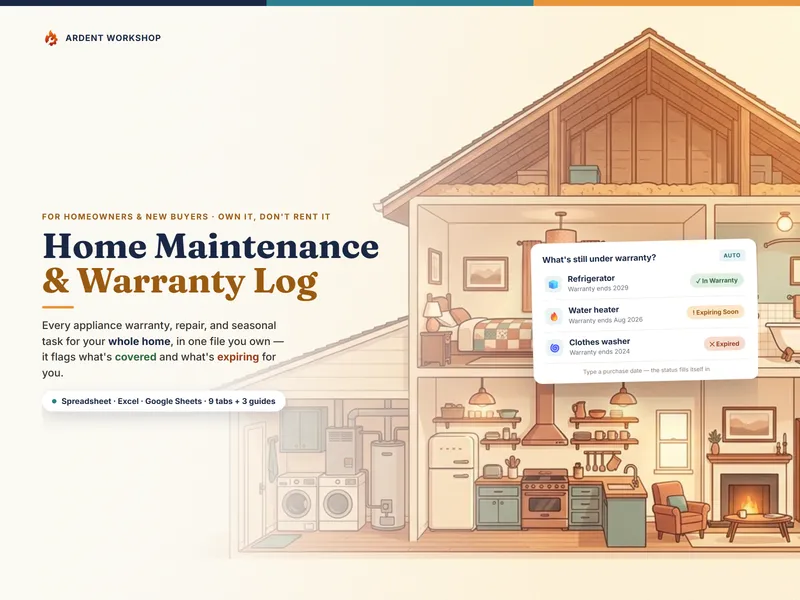
That is the whole idea behind the New-Homeowner Move-In & First-Year Setup Binder: you type those two dates once, and sixty setup tasks, forty account transfers, every warranty expiration and registration deadline, and a maintenance calendar that keeps rolling forward all schedule themselves from them.
For the rest of the year — the maintenance calendar, the running-cost picture, the household manual — see the templates for new homeowners hub. For the first week specifically, the free New-Home Move-In Checklist is the printable core of this page — the first-week jobs in order and the highest-priority accounts to open or tell, shown filled in. Take it into the house with a flashlight and a marker.
One rule for whatever you write down
Record where things are and how the house runs — never an account number, a policy number, a door or alarm code, or a login. A new-home page gets emailed to a partner, opened on a shared laptop, printed for a contractor, and left on a kitchen counter through a hard first month. That is what makes it useful, and it is exactly why the sensitive line is drawn where it is. “Where the code is written down” is the right level of detail for a page that gets shared.