Home warranty versus homeowner's insurance
The distinction is not a technicality. It decides who you call, who chooses the contractor, and whether you are covered at all.
| Homeowner's insurance | Home warranty | |
|---|---|---|
| What it is | A policy against sudden accidental loss — fire, storm, theft, water escaping where it shouldn't. | A service contract that repairs or replaces listed systems and appliances that fail from normal use. |
| What it pays for | Damage. It explicitly excludes wear, age, and lack of maintenance. | Wear and age — precisely the gap insurance leaves. |
| How a claim works | You file with the carrier and generally choose your own contractor. | You call the administrator, who dispatches theirs. Using your own can void the claim. |
| The limits that bite | Deductibles, category sub-limits, exclusions, and whether it settles at replacement cost or actual cash value. | Per-item caps, a service fee per visit, a waiting period, and exclusions for pre-existing conditions or improper prior maintenance. |
| Is it required | Effectively yes — your lender requires it while there is a mortgage. | No. Entirely optional. |
What a home warranty typically covers
Coverage is defined by a list, and the list is the whole contract. Read it before you assume anything is on it. Typical inclusions:
- Heating and cooling equipment — the furnace, the air conditioner or heat pump, and sometimes the ductwork
- The water heater
- Plumbing and electrical systems inside the house, often with limits on what counts as "the system"
- Major kitchen and laundry appliances — refrigerator, range, dishwasher, washer, dryer
- Sometimes, as paid add-ons: a well pump, a septic system, a pool, or a second refrigerator
And the exclusions that matter most, which are consistent across the industry rather than particular to one company:
- Pre-existing conditions. A problem that already existed when the contract started is generally not covered — which is exactly the situation a new owner of an older house is in.
- Improper prior maintenance. If the failure is attributable to neglect by whoever owned it before you, the claim can be denied. You inherited the neglect; you did not inherit the coverage for it.
- Per-item caps. A cap well below the real replacement cost of a modern system means a covered failure is still a substantial bill.
- Anything not on the list. Roofs, windows, foundations, and the structure itself are not warranty territory.
The honest test for whether one is worth it
It is not a question of opinion. It is arithmetic on the ages of the systems you actually own, and it comes out differently for different houses.
Every system in a house has a typical service life and a replacement cost, so owning it costs something every year whether or not you spend it — replacement cost divided by service life. A conventional tank water heater, at roughly $1,400 to $2,800 to replace over eight to twelve years, costs about $210 a year to own. Do that for every system you have, and you have a monthly reserve figure that is about your house rather than about a rule of thumb.
Then the decision is straightforward:
- If your systems are mostly newer and you have a funded reserve, you are buying a small chance of a capped payout, and self-insuring is usually better value. Put the annual fee into the reserve instead.
- If you inherited a house where several systems are at or past the end of their expected life and there is no reserve yet, a service contract can be a reasonable bridge for a year or two while you build one — as long as you have read the per-item caps and the pre-existing-condition exclusion first, because that is where the disappointment lives.
Either way, the useful move is the same one: walk the house, write down the age of every system, and let the numbers decide. That afternoon is worth more than the warranty either way, because it also tells you what is coming and in what order.
The seller-paid home warranty and its start date
This is the detail that catches people. A home warranty included in a sale is a genuine benefit, but it frequently runs from the date the seller bought it — often when the house was listed, potentially months before your closing. So "a year of coverage" can have four months left on it by the time you move in. The fix is trivial and almost nobody does it: read the start date off the contract, write it down, and put the real expiration date on your calendar rather than assuming twelve months from closing.
Does registration matter?
Separately from a home warranty, every appliance and major system carries a manufacturer's warranty, and new owners are often told that failing to send in the registration card voids it. For the basic warranty that comes with an appliance, that is generally not how it works in practice: what a manufacturer asks for at claim time is proof of purchase, not a returned card. The federal rule goes further only for warranties designated full — under the FTC's interpretation of the Magnuson-Moss Act (16 CFR 700.7), a full warranty may not make returning a registration card a condition of coverage. Most appliance warranties are designated limited, so the protection there rests on the manufacturer's own practice rather than on the statute. What registration reliably buys you is recall notices and a purchase date on file — worth doing for that alone.
Where registration genuinely matters is everywhere else: extended service plans, promotional term extensions (the "register within 90 days for the ten-year parts warranty" offers common on furnaces and water heaters), contractor workmanship warranties, and transferable structural warranties. Several of those are worth a great deal, all of them have short windows, and the windows land in exactly the weeks when you are moving. Check what the specific paperwork asks for rather than treating registration as either always-required or never-required.
Where to start
If you have only just closed, take the free New-Home Move-In Checklist into the house, then keep the warranties, closing documents, and their dates in the New-Homeowner Move-In & First-Year Setup Binder, which computes every expiration and registration deadline from the start date and term you enter. See also what a home maintenance log is, the templates for new homeowners hub, and the step-by-step guide to what to do the first week in a new house.
Two related terms worth knowing
- A builder's or new-construction warranty is a different thing again — coverage from the builder on a newly built home, commonly one year for workmanship with longer terms on some systems and on structure. It has a submission deadline, and the one-year mark is where most of it ends.
- Equipment breakdown coverage is an endorsement you can often add to your homeowner's policy for a modest premium. It covers mechanical or electrical failure of a system or appliance — closer to what people imagine a home warranty does, handled by your own insurer, and worth pricing against a warranty before you buy either.
General guidance, not insurance, legal, or tax advice. Coverage forms, exclusions, and statutes differ by state, by carrier, and by contract, and they change — your own declarations page and the warranty contract itself are the authorities on your situation. The cost and service-life figures above are typical bands offered for orientation, not quotes.
Templates that implement this
Work out whether you need one
4 templates
The honest test is arithmetic on the ages of your own systems — the playbook walks it, the setup binder tracks every policy and its expiration, and the calculator automates the reserve.
- $12.95 PDF

The First-Year Homeowner's Playbook — 119-Page Guide: What a House Costs to Own Per Month, the Month-by-Month First Year, and How to Read a Contractor's Quote
119 pages across 4 PDFs — a month-by-month first year, 32 systems with the annual reserve each implies, and a contractor's quote read line by line.
Life AdminView details - $24.95 Spreadsheet
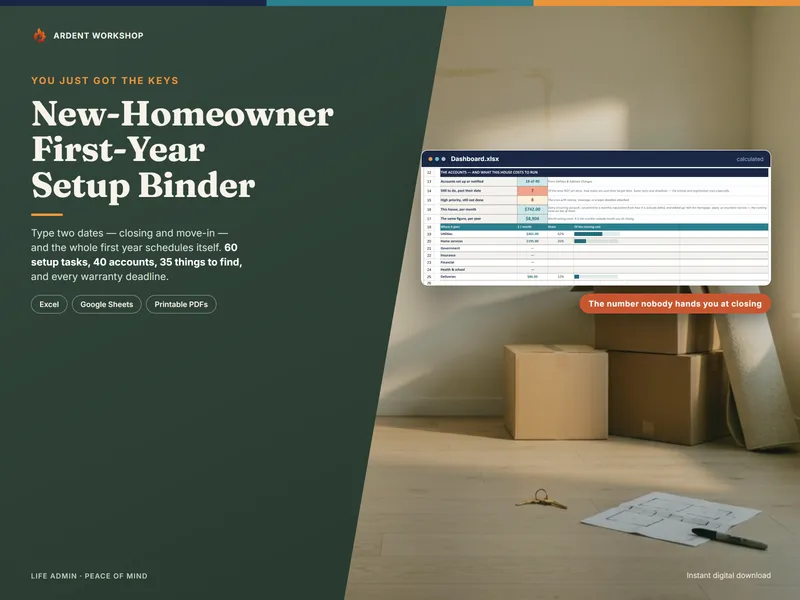
New-Homeowner Move-In & First-Year Setup Binder — 60 Setup Tasks, 40 Account Transfers, Warranty Registration Deadlines, and What the House Costs to Run (Excel + Google Sheets)
Type two dates and the first year in a new house schedules itself: 60 setup tasks, 40 account transfers, warranty deadlines, and the monthly running cost.
Life AdminView details - $14.95 Spreadsheet

True Cost of Homeownership Calculator — Every Carrying Cost, the Replacement Reserves & the Buy-vs-Rent Break-Even Year (Excel & Google Sheets)
Find what a specific home really costs per month — the mortgage payment plus the seven lines listing sites leave out — and the year owning beats renting.
Big DecisionsView details - $19.95 Spreadsheet
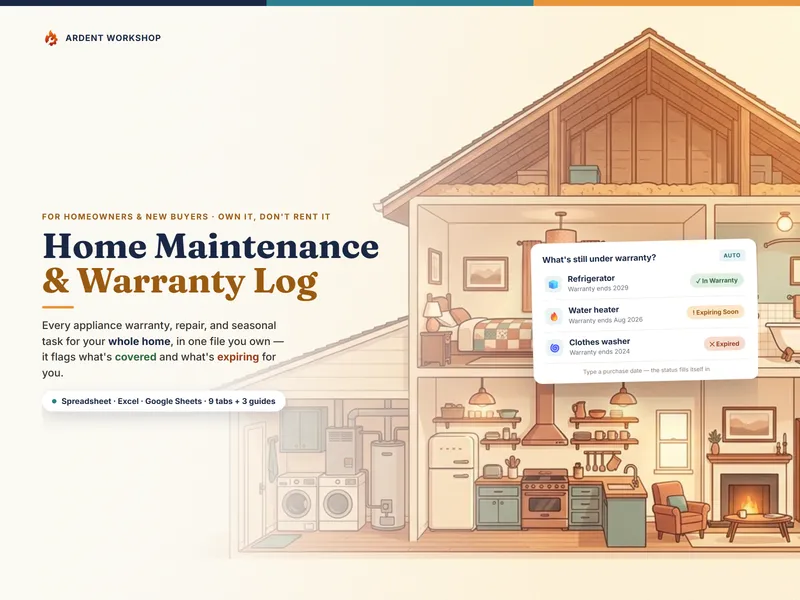
Home Maintenance & Warranty Log — Appliance Warranty Tracker, Repair Log & Seasonal Home Maintenance Checklist (Excel + Google Sheets)
Track every appliance warranty, repair, and seasonal task in one spreadsheet you own — type a purchase date and it flags what's still under warranty.
Life AdminView details