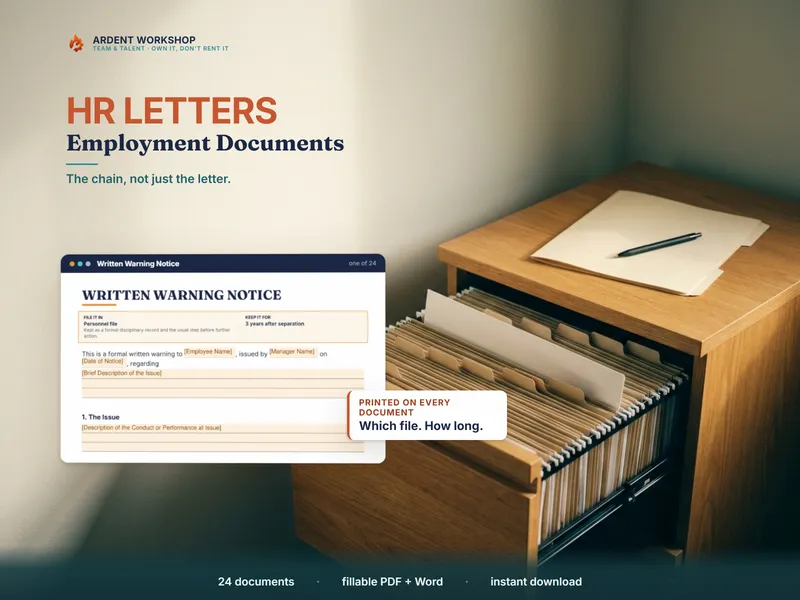
There is no form that appears the moment performance starts to slip. What actually happens is smaller than that: a missed deadline, then a second one, a conversation in a hallway that you half-remember having, and eventually a decision that something needs to be written down — with no clear sense of what, or how much.
This walks the sequence in the order it actually happens, not the order a policy binder lists it in.
This is general information, not legal advice. What counts as adequate documentation, what notice a warning requires, and what a performance improvement plan commonly contains are set by your own policies, by the laws of where you operate, and by the specifics of the situation — and they differ by country, by state, and sometimes by contract. Check with qualified counsel or an HR professional before you act on anything here, particularly before you issue anything formal.
Before anything is written: check what they were actually told
Skip this step and everything after it stands on sand. Before you write a word about the employee, find the job description and any written goals for the role, and check when either was last updated.
Two questions worth an honest answer:
- Was the standard actually stated, in writing, at some point — or only implied, or said once in a meeting eight months ago?
- Has the job changed since then in a way the description never caught up with — new software, a role that absorbed someone else’s work, a target nobody revised?
If either answer is no, that is the first gap in the file, and it is yours to close, not the employee’s to have guessed at. A written warning built on top of an unstated standard is a written warning about your own paperwork.
The coaching note — the step almost everyone skips
This is the informal conversation, and it is the one people are least likely to write down, which is exactly the problem. Skip it, and by the time a written warning arrives it looks sudden — to the employee, and to anyone who reads the file afterward and cannot find the step before it.
A coaching note is short, but it should capture:
- What was observed, with dates — not an impression, a specific instance.
- What was said in the conversation, in enough detail to be useful in six months.
- What was agreed, including anything the manager committed to on their own side.
- What support was offered — training, a changed workload, a point of contact.
- When it will be looked at again, as an actual date, not “soon.”
State plainly, on the note itself, that this is coaching and not discipline. That line matters twice: it tells the employee this is not yet a formal step, and it tells a later reader of the file exactly what it was.
The verbal warning that still gets written down
That sounds like a contradiction and it is not one. “Verbal” describes how it was delivered, not whether it gets recorded. A verbal warning that exists only as a memory is not a step at all — it is a conversation somebody can dispute ever took place, and six months later you are left with two competing recollections instead of a dated record.
Writing it down does not turn it into a written warning. The label stays different, the tone stays different, and what it triggers next stays different. What changes is that the file now has something in it besides your recollection.
The written warning — fact, history, and a real chance to respond
By this point the pattern is established rather than a single instance, and the record should carry:
- The issue as observable fact — what happened, not what it says about the person. “Missed the Tuesday deadline three times in five weeks” rather than “unreliable.”
- The standard that was in place, referencing the job description or the goals confirmed in step one.
- The history, with dates — the coaching note, the verbal warning, and anything in between.
- What has to change, and by when — specific enough that both sides could check it later.
- The support being offered, named rather than implied.
- The employee’s chance to respond, before the warning is finalized rather than after.
A common piece of the written warning that gets left out is that last line — the chance to respond. Its absence is one of the easiest things for a written warning to be criticized for later, and one of the cheapest to fix.
The performance improvement plan — the parallel route for capability
A PIP is not automatically the next rung after a written warning. It fits a different kind of problem: whether someone can do the job as it is currently defined, rather than whether they broke a rule. In many cases it runs alongside or instead of the warning sequence rather than strictly after it.
What makes a plan credible instead of a formality:
- Specific, measurable objectives — a number, a deadline, a deliverable, something that is either true or not true on the review date.
- Real review dates, plural, spaced through the plan rather than one date sitting at the end of it.
- A support section that is actually filled in — training, resources, check-in frequency, who is available and when. Employers routinely leave this section blank or vague, and a blank support section is the single detail that turns a plan into paperwork written to justify a decision that had already been made.
For the plan itself, part by part, with a filled-in eight-week example, see how to write a performance improvement plan.
The moment it stops being a performance conversation
Watch for this at every step above, not just at the start. If, at any point, a medical reason, a disability, a caregiving obligation, a leave request, or a complaint surfaces, the performance track pauses.
It becomes a different conversation — one that commonly involves a different process and different people — and the record of it moves to a separate confidential file rather than sitting in the file a supervisor can be handed. This is not a technicality. It is the point where documenting underperformance and documenting something else stop being the same task, and treating them as the same task is where files go wrong.
How to write it
Two rewrites, same underlying incident:
- “Has a poor attitude.” → “Raised their voice at a colleague in the Tuesday team meeting on August 4, and again in a one-on-one on August 11.”
- “Not pulling their weight.” → “Closed 6 of 14 assigned tickets in the two-week sprint ending August 8, against a team average of 12.”
- “Unreliable.” → “Arrived more than 15 minutes late on four of the last ten scheduled shifts, on dates logged in the attendance system.”
The pattern in all three: a date, a count, or a named instance, instead of a character judgment. A file full of conclusions is harder to defend than a file full of what actually happened, because a conclusion is exactly what gets argued with.
One more habit worth adopting early: a signature on any of these documents commonly acknowledges that the employee received and read it, not that they agree with it. Saying that plainly, on the document, avoids a dispute later about what the signature meant.
An honest word
This is general information about a documentation sequence, not legal advice, and it does not tell you what your own policies or your own jurisdiction require. Progressive discipline — moving through coaching, verbal, written, and formal steps in order — is a common practice, not a universal legal requirement, and skipping straight to a final step is sometimes appropriate. The honest point is narrower than “follow the steps”: a file that jumps straight to the end, with nothing behind it, has a hole in it, and that hole is what gets noticed. See what a performance improvement plan is and what progressive discipline is for how the pieces relate.
If you only need the first two steps right now, the Coaching Note & Verbal-Warning Record is free — no signup. For the full sequence — every document from offer letter through separation, a 40-situation router naming what has to already be on file before each one, and a filing-and-retention stamp on every document — see the HR Letters & Employment-Document Template Pack. Own the paperwork once; you will need it again.