Divide a total wedding budget by the number of guests and you get a cost per guest. It feels like a price tag on each person, so the natural move is to cut ten guests and expect ten times that number back. The trouble is that the average is not a price. It is the whole budget, including everything that does not care how many people attend, spread evenly across the guest list. In the invented example below, the average is $300 a guest, but the per-guest lines come to only $150 a guest.
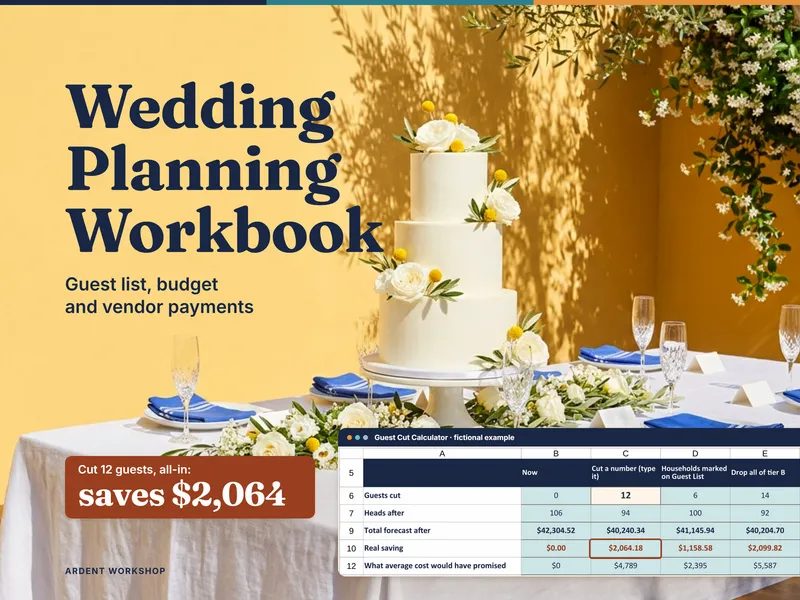
This page splits a budget into the parts that move and the parts that do not, then runs one example start to finish. If you would rather skip to your own numbers, the free Wedding Guest-Count Budget Calculator takes a guest count, multiplies your per-guest lines by it, adds your fixed costs and checks the total against a ceiling. The Wedding Planning Workbook goes further and, in its Guest Cut Calculator, states what cutting a number of guests saves beside what the average would have promised. Every figure below is an invented illustration, not a typical or recommended cost, and the arithmetic is shown so you can swap in your own quotes.
Three kinds of cost
- Per-guest: a unit price times head count. Food and drinks are the usual examples.
- Per-table: a unit price times the number of tables. Linens and centerpieces are sometimes quoted this way. Tables come in whole numbers, so this line steps rather than slides.
- Fixed: it does not change with guests. A photographer’s package is the classic case.
Which bucket an item belongs in depends on how that vendor quotes it, not on the item. One caterer may charge a flat fee for a cake and another by the slice. Read the quote, then tag the line.
The example: 100 guests, $30,000
Everything here is made up. The couple plans 100 guests at tables of 10, and each figure is all-in.
| Line | Basis | Math | Cost |
|---|---|---|---|
| Catering | Per guest | $90 x 100 | $9,000 |
| Bar | Per guest | $45 x 100 | $4,500 |
| Favors and stationery | Per guest | $15 x 100 | $1,500 |
| Linens and centerpieces | Per table | $120 x 10 tables | $1,200 |
| Venue | Fixed | $6,200 | |
| Photographer | Fixed | $3,200 | |
| DJ | Fixed | $1,800 | |
| Ceremony flowers | Fixed | $1,200 | |
| Attire and rings | Fixed | $1,400 | |
| Total | $30,000 |
Check the arithmetic: the per-guest lines are $9,000 + $4,500 + $1,500 = $15,000. The per-table line is $1,200. The fixed lines are $6,200 + $3,200 + $1,800 + $1,200 + $1,400 = $13,800. And $15,000 + $1,200 + $13,800 = $30,000.
Why the average misleads
The average is $30,000 / 100 = $300 per guest. But the per-guest lines add up to $90 + $45 + $15 = $150 per guest. The other $150 of the average is the per-table and fixed lines spread over 100 people ($1,200 + $13,800 = $15,000, and $15,000 / 100 = $150). The fixed $13,800 stays whatever the count, and the $1,200 per-table line falls only when a whole table empties.
Add tax and service on one line
Do this once, per line, before you total anything. If a quote leaves out tax or service, put both on that line so it reads all-in. In the example above every figure is already all-in. As a separate illustration, suppose a rental quote of $100 per guest base is charged 8% tax and 20% service, both on the base. The line is $100 x (1 + 0.08 + 0.20) = $128 per guest. Some vendors apply service to the subtotal after tax instead, which gives a different number, so confirm how your contract does it. Quote totals that mix all-in and pre-tax lines are one of the easier ways to misjudge a cut. This is general budgeting guidance, not tax advice.
What cutting guests really saves
Now cut guests from the example and compare the average-based promise with the real figure.
Cut 10 (100 down to 90). The average promises 10 x $300 = $3,000. Really: per-guest lines save 10 x $150 = $1,500. At 90 guests you need 9 tables instead of 10, so the per-table line falls by $120. Fixed lines save $0. Real savings: $1,500 + $120 = $1,620. That is $1,380 less than the average promised ($3,000 - $1,620), so the real savings are 54% of the promise. The $1,500 is the per-guest part alone, and it would be the whole answer if everything else in this budget were fixed. The extra $120 is here only because this example has a per-table line and the cut empties a whole table.
Cut 5 (100 down to 95). The average promises 5 x $300 = $1,500. Really: per-guest lines save 5 x $150 = $750. At 95 guests you still need 10 tables, so the per-table line saves $0. Real savings: $750, half of the promise.
Cut 20 (100 down to 80), with a catering minimum. The average promises 20 x $300 = $6,000. Suppose the caterer bills for a minimum of 85 guests. That minimum sits on the catering line only, so catering is still billed at 85 x $90 = $7,650, a saving of $9,000 - $7,650 = $1,350. The bar and the favors and stationery follow the real count, saving 20 x ($45 + $15) = $1,200. Eighty guests need 8 tables, saving 2 x $120 = $240. Real savings: $1,350 + $1,200 + $240 = $2,790, against a promise of $6,000.
| Cut | Average promised | Real savings | Why the gap |
|---|---|---|---|
| 5 guests | $1,500 | $750 | Fixed costs stay; 95 guests still need 10 tables |
| 10 guests | $3,000 | $1,620 | Fixed costs stay; one table drops |
| 20 guests | $6,000 | $2,790 | Fixed costs stay; two tables drop; catering minimum applies |
Two lessons come out of this. The more your budget is fixed, the more the average overstates a cut. And a minimum or a table boundary can make the first guests you cut worth less, or more, than the ones after.
Check your own budget
- Tag each line per-guest, per-table or fixed from the quote, not from the item’s name.
- Put tax and service on each line so every figure is all-in.
- Total the per-guest unit prices. That is your real per-guest rate. Compare it to total / guests.
- Look for guest minimums and table sizes before you price a cut.
- Compute the savings from the real rate and whole tables, with fixed lines at zero.
One more thing to watch once the cut is made: payments. In the Wedding Planning Workbook, a final balance is worked out from that line’s forecast all-in less your other payments, so on per-guest and per-table lines it moves with the guest count until you pay it. A cut therefore tends to show up as a smaller final balance, not as money back on a deposit you have already paid. Whether a deposit can come back is up to your contract. For more on how these rows fit together, see what a vendor payment schedule is.
The workbook is a spreadsheet you keep. A Google Sheets copy needs a Google account, but there is no Ardent Workshop account and no subscription. Phone apps are good at guest websites, RSVP collection and sharing a plan from your phone, and they can feed you the head count (spreadsheet vs app covers which job suits which). The per-guest, per-table and fixed split is what turns that head count into a budget you can trust. If the guest list is not your only open question, the Wedding Venue Decision Helper handles the venue choice that sets many of those fixed and minimum terms.
None of this is financial advice. Your vendors’ contracts decide what is refundable, what has a minimum and how tax and service are applied, so read them before you cut.