“Pay off the highest interest rate first” and “pay off the smallest balance first” are the two answers you’ll get if you ask five people how to attack multiple debts at once, and both come with reasons that sound right. Avalanche (highest rate first) is the order aimed at paying the least total interest. Snowball (smallest balance first) usually clears a first debt sooner, which is meant to keep you motivated for the rest. How big each advantage is depends on your debts, so it’s worth seeing as numbers instead of taking on faith. On the four debts below, avalanche saved $285.87 in interest, snowball cleared its first debt 17 months sooner, and both finished in the same month.
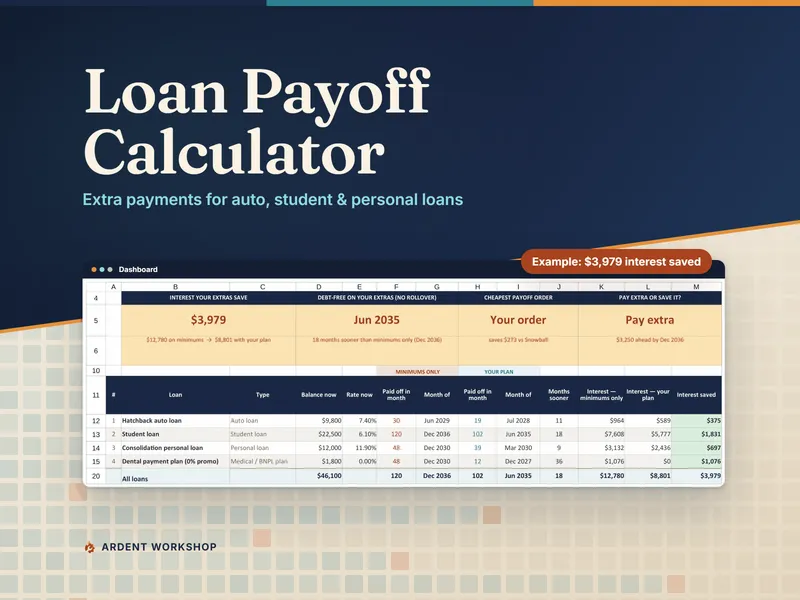
So here are both orders, run on the same four debts, the same extra $300 a month, month by month, on a monthly amortization model with the freed-up payments rolled forward — the same kind of month-by-month math the Loan Payoff Calculator — Extra Payments for Auto, Student & Personal Loans runs. The numbers below are what that model produced on this specific example; your own debts, rates and extra amount will produce different ones, which is the whole reason to run your own before picking an order.
The four debts
| Debt | Balance | APR | Minimum |
|---|---|---|---|
| Personal loan | $12,000 | 16.9% | $300 |
| Car loan | $14,000 | 6.9% | $330 |
| Private student loan | $18,000 | 5.8% | $200 |
| Medical payment plan | $2,400 | 8.9% | $75 |
Combined minimums come to $905 a month. Add $300 extra and the total going out every month is $1,205 — the number that stays fixed across both payoff orders below. What changes is only which debt that extra $300 attacks first.
The baseline: minimums only, no extra
Pay exactly the minimum on all four and nothing more, and the last one — the private student loan, at the lowest rate but the largest balance — doesn’t clear until month 119, just short of ten years. Total interest paid across all four debts over that stretch: $13,901.36.
That’s the number every extra-payment strategy is measured against. Anything that gets the group to zero faster, or cheaper, or both, is worth the comparison — the question is only which order to run the extra $300 in.
Avalanche: highest rate first
Avalanche ranks the four debts by APR, highest to lowest: personal loan (16.9%), medical payment plan (8.9%), car loan (6.9%), private student loan (5.8%). The full $300 extra goes to the personal loan while the other three get minimums; once the personal loan is gone, its old $300 minimum plus the extra roll onto the medical plan, and so on down the list.
| Order | Debt | APR | Paid off in month |
|---|---|---|---|
| 1 | Personal loan | 16.9% | 24 |
| 2 | Medical payment plan | 8.9% | 26 |
| 3 | Car loan | 6.9% | 33 |
| 4 | Private student loan | 5.8% | 45 |
All four debts are gone by month 45, and total interest across the whole group is $7,224.36 — a little over half of the minimums-only baseline. The first debt clears in month 24.
Snowball: smallest balance first
Snowball ranks the same four debts by balance instead of rate, smallest to largest: medical payment plan ($2,400), personal loan ($12,000), car loan ($14,000), private student loan ($18,000). Same $300 extra, same rollover rule, different target first.
| Order | Debt | Balance | Paid off in month |
|---|---|---|---|
| 1 | Medical payment plan | $2,400 | 7 |
| 2 | Personal loan | $12,000 | 26 |
| 3 | Car loan | $14,000 | 33 |
| 4 | Private student loan | $18,000 | 45 |
Snowball also clears the whole group by month 45 — the same finish line as avalanche — for total interest of $7,510.23. The first debt is gone in month 7.
The trade-off: $285.87 vs. 17 months
Put the two runs side by side and the difference is small and specific. Avalanche costs $285.87 less in total interest over the full payoff ($7,224.36 vs. $7,510.23). Snowball delivers a paid-off debt 17 months sooner — the medical plan is gone by month 7, against month 24 for avalanche’s first clearance, the personal loan. Both strategies finish the entire group in the same month, 45.
In this example, avalanche was the cheaper order — not because highest-rate-first is always cheaper, but because that’s what these four specific balances and rates produced when the extra was run through them. Change the balances, the rates, or the extra amount, and the size of that gap changes with them — it can shrink to almost nothing or grow well past this one; that’s why the comparison is worth running on your own numbers rather than assumed from the rule of thumb.
The bigger lever: the extra and the rollover
Line up all three runs and the gap between “minimums only” and either strategy dwarfs the gap between the two strategies. Avalanche saves $6,677.00 in interest and finishes 74 months sooner than minimums-only. Snowball saves $6,391.13 and finishes the same 74 months sooner. Whichever order you pick, the decision to add $300 a month and keep rolling the freed-up payments forward is doing far more work than the choice of which debt goes first.
That’s worth sitting with before the avalanche-vs-snowball debate, not after it: the order changes the outcome by a few hundred dollars and 17 months on one debt’s timeline. The extra and the rollover together change it by thousands of dollars and years off the whole group.
How to actually run this
Two things matter once you’ve picked an order and started sending the extra payment.
First, tell the lender what the extra money is for. Ask that any payment above the minimum be applied to principal immediately, not held and credited toward next month’s due date — a lender that applies it the second way can cancel much or all of the reason to pay extra, because the balance the interest is calculated on doesn’t drop right away.
Second, if one of the debts you’re attacking is an auto loan, know that many auto lenders compute interest daily on the outstanding balance (simple interest) rather than on a fixed monthly schedule. A monthly amortization schedule — like the model behind the figures above, and the one behind the calculator — gets close, but a lender accruing interest daily will land on a slightly different number depending on exactly which day payments post.
Which one to pick
If the $285.87 difference in interest matters more to you than seeing a debt hit zero 17 months sooner, run avalanche. If getting the medical plan off your plate by month 7 — one bill gone, one less thing to track — is worth $285.87 to you, run snowball. Both orders finish the whole group in the same month here, so neither choice costs you time overall; it only changes which debt goes first.
There’s a third option worth naming: a custom order, for a debt you want gone first for a reason the math doesn’t capture — a loan a co-signer is also on, say, or one you want gone before you apply for new credit. The rollover math works the same way regardless of which order you choose; it’s the ranking rule that changes.
Where this fits
This walkthrough runs one $300-extra scenario on one set of four debts by hand. The Loan Payoff Calculator — Extra Payments for Auto, Student & Personal Loans runs the same rollover math on up to eight loans of your own, in avalanche order, snowball order, or a custom order you set — with the interest saved shown against what that same extra money would earn if you saved it instead, so “pay extra or save it” is also a number and not a guess.
The free Loan Extra-Payment Calculator runs the single-loan, recurring-extra version of this same math, pre-filled, if you want to see the shape of it on one loan before deciding whether the multi-debt, multi-order version is worth it.