
What a vendor payment schedule is
Wedding vendors are often paid in pieces, depending on the contract. A venue, caterer, photographer or florist may ask for a deposit to hold your date, one or more milestone payments as the date gets closer, and then a final balance due before the event. A vendor payment schedule puts every one of those payments, for every vendor, in one list sorted by due date.
Each row needs only a few fields: the vendor, the payment type (deposit, milestone or final balance), the amount, the due date, and whether it is paid. From those you can flag what is overdue and what is coming up. The contract is the source of truth for the terms; the schedule is how you stop having to remember them.
Why final balances move with the guest count
A deposit or milestone is often a set amount written into the contract. A final balance often is not. It is better thought of as a calculation: the vendor's expected total, less everything you have already paid. If the total depends on how many people attend, the balance depends on it too.
That depends on how the vendor quotes the line. A per-guest line (a plated meal, drinks) is a unit price times a head count. A per-table line moves in steps as tables are added or removed. A fixed line, like a photographer's package, does not change with guests. Which one a given item is comes from the vendor's quote, so read the contract.
Suppose a caterer quotes $95 per guest and you have paid a $2,000 deposit and a $3,000 milestone payment.
| Guests | Forecast total ($95 each) | Already paid | Final balance |
|---|---|---|---|
| 120 | $11,400 | $5,000 | $6,400 |
| 110 | $10,450 | $5,000 | $5,450 |
Ten fewer guests lowers the final balance by $950, which is ten times the per-guest price. The deposit and milestone did not change. This is also why a schedule that stores the final balance as a typed-in number goes stale the moment the head count changes. Check, too, whether the contract sets a minimum guest count or a guarantee date, since those can limit how much a lower count saves.
The same logic is why an average cost per guest can mislead. Fixed costs are folded into the average but do not shrink when a guest does. In another invented case, $30,000 across 100 guests is a $300 average, yet if only $150 per guest moves with the count and everything else is fixed, cutting 10 guests saves $1,500, not the $3,000 the average suggests. The worked cost-per-guest tutorial gives that same $30,000 budget a per-table line, so the cut also drops one $120 table and saves $1,620.
Why payments bunch close to the date
Deposits can be spread across the months you book vendors. Final balances may not spread out the same way, because they are tied to the event date, not the booking date. Venue, catering, florist and others can each set their own deadline in the final weeks, and each one is reasonable on its own. Together they can land in one month, along with the guest-count-driven balances that you only know once RSVPs settle.
The fix is visibility, not a different vendor. Total what is due by month and the heavy months stand out. Seeing it early lets you do the practical things: line up when contributions arrive, ask a vendor whether a due date can move, or pay a balance a little earlier from a month with room. If several people are chipping in, split the monthly totals by contributor to see whose pledge runs short first.
What to put in your own schedule
- One row per payment, not per vendor. A vendor with a deposit, a milestone and a final balance gets three rows.
- A due date on every row. It is what lets overdue and upcoming flags work.
- Final balance as a formula. Forecast total for the line less your other payments, so it follows the guest count.
- A month-by-month total. This is where bunching shows up.
- Contract terms beside it. Minimums, guarantee dates and late fees live in the contract, not the spreadsheet.
Getting a schedule for your own wedding
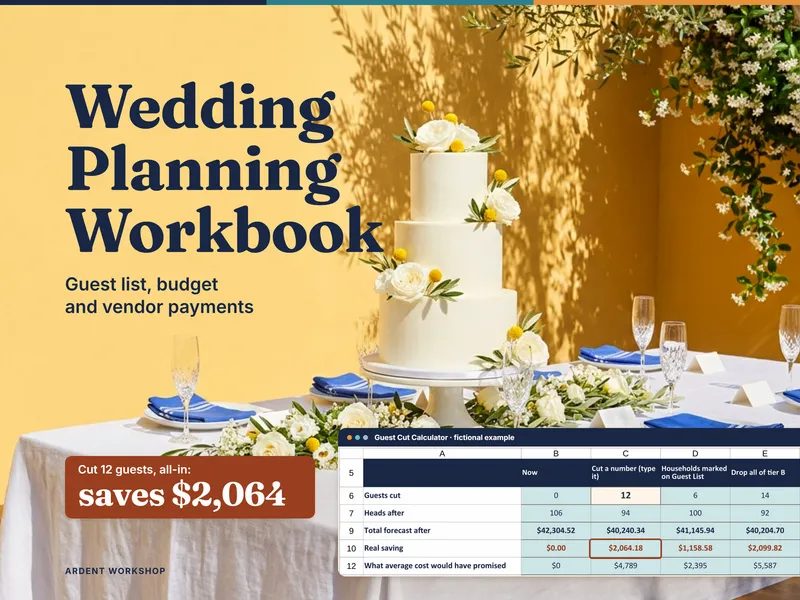
Many wedding apps do a good job with guest websites, RSVP collection and sharing a plan on a phone. A spreadsheet you own is a different tool: it keeps your numbers in a file you control, as the wedding planning spreadsheet vs app comparison lays out. The Wedding Planning Workbook covers this schedule in two tabs:
- Vendor Payments: deposit, milestone and final-balance rows, with due dates and overdue or upcoming flags. A final balance is worked out from that line's forecast all-in less your other payments, so on per-guest and per-table lines it moves with the guest count until you pay it.
- Cash by Month: 24 months of what is due, in total and per contributor, with flags on the peak month and any month where payments bunch.
The workbook comes as an Excel file and a Google Sheets copy, with no Ardent Workshop account and no subscription (a Google Sheets copy does need a Google account).
To see how a guest count moves a budget before you build a full schedule, try the free Wedding Guest-Count Budget Calculator: type a guest count and it multiplies your per-guest lines, adds fixed costs and compares the total with your ceiling. If you are still choosing where to hold the wedding, the Wedding Venue Decision Helper compares venues side by side.
This page explains a planning method. It is not financial, legal or tax advice, and your vendor contracts govern what you actually owe.
Templates that implement this
Track it in a workbook you own
1 template
Deposit, milestone and final-balance rows with due dates and overdue or upcoming flags, plus a 24-month view of what is due and where payments bunch. Excel and Google Sheets, with no Ardent Workshop account and no subscription.
Frequently asked questions
- What is a vendor payment schedule?
- A vendor payment schedule is the dated list of what you owe each vendor and when: often a deposit that books the date, one or more milestone payments, and a final balance due before the event. Each row has a vendor, a type, an amount and a due date, so you can see what is paid, what is upcoming and what is overdue.
- Why does a final balance change when the guest count changes?
- Because the final balance is whatever remains of the vendor's total after the payments already made. If that total is a per-guest price times a head count, the total moves with the head count, and so does the balance. In an invented example, a $95-per-guest meal for 120 guests is $11,400; with $5,000 already paid, the balance is $6,400. At 110 guests it is $5,450.
- Do all final balances move with the guest count?
- No. A fixed-price package, such as a photographer's flat fee, does not change with guests, so its final balance stays put. Whether a line is per-guest, per-table or fixed depends on how that vendor quotes it, so check the contract rather than assuming.
- Why do wedding payments bunch up close to the date?
- Deposits can be spread out as you book vendors, while final balances are tied to the event date, and several vendors can set similar deadlines. Terms vary by contract, but those separate due dates can land in the same month. A schedule that totals what is due by month shows the pile-up while you still have time to move money or negotiate a date.