The honest framing is not “save money by not hiring anyone.” It is that the two are aimed at different questions. Caregiving usually starts as a conversation problem — you know what needs to change, you just cannot face raising it — and only some of it becomes a coordination problem. Using a script on a coordination problem does nothing. So is paying an hourly rate to have somebody else tell your father the thing you were always going to have to tell him yourself.
The positioning: a conversation you keep not having, then scripts, then paid help
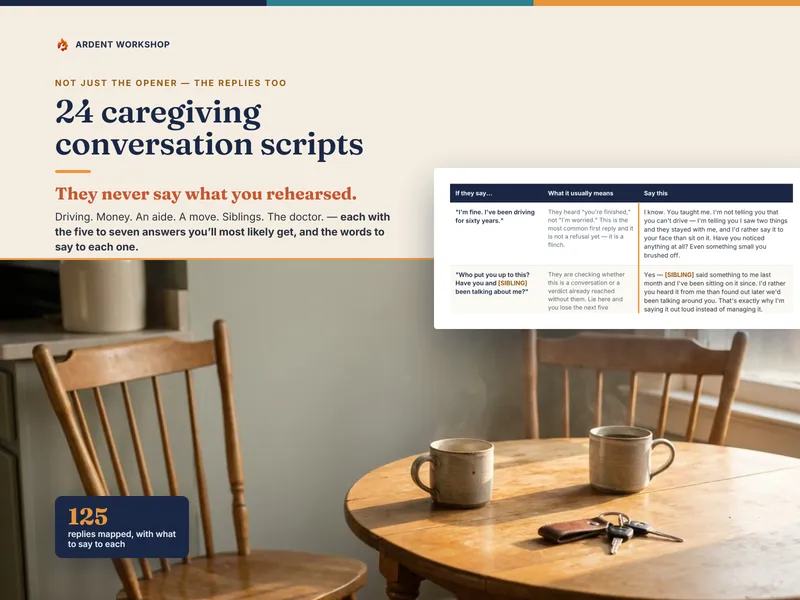
The usual starting point is the conversation you keep not having — you rehearse it in the car, you get as far as the kitchen, and you talk about something else. A script bank is the structured version of doing it yourself: the opener already written, the replies already mapped, and the words to say to each of them. A care manager is the rented version: somebody else's time, expertise, and local knowledge, engaged by the month. The script bank sits between them, and for most families it is where the first year of this actually happens.
| What matters | Conversation scripts | Geriatric care manager |
|---|---|---|
| The problem it solves | You cannot get the conversation started, or it dies at the first reply | The situation has outgrown what the family can coordinate itself |
| What it actually gives you | The opener, the replies you're most likely to get, what not to say, and a written version | An assessment, a care plan, arranged services, and someone on the ground |
| Cost shape | Paid once, reused for every conversation after it | An assessment fee, then hourly or retained; generally private pay |
| Speed | Tonight — the words already exist | Days to weeks to a first assessment, depending on availability |
| Knows your local system | No — and a good one says so and names who does | Yes; local knowledge is most of what you are paying for |
| Can be the neutral third voice | No — it is you talking, better prepared | Often yes, and that is sometimes the whole reason to hire one |
| Handles the sibling conversation | Yes — that is one of the eight situations | Sometimes; some will mediate, and it is worth asking up front |
| Decides anything for your parent | No, deliberately — persuasion, not override | No. Advises and arranges; the decision stays with the family |
| Still there next year | Yes — files on your own drive | The engagement ends when you stop paying for it |
Where a care manager genuinely wins
Anywhere the answer depends on the local system rather than on what you say. What actually exists near your parent and what it costs. Which facilities have beds and which have waiting lists. How a hospital discharge works in that county when the family has 48 hours to decide. What in-home support is available and who provides it well. A family three states away that has never navigated any of it is buying months of learning for an hourly rate, and that is usually a good trade.
They also win where a parent has stopped hearing their own children. A professional stranger with a clipboard sometimes gets a yes that a daughter has been refused four times, and pride explains most of the difference. Before you pay for that, though, it is worth knowing that your local Area Agency on Aging can tell you what exists near your parent for free — including in-home support, respite, and caregiver programs. In the United States you can find yours through the Eldercare Locator, a free public service of the U.S. Administration for Community Living, or by calling 1-800-677-1116.
Where the scripts win
Everything upstream of that — the part that comes first and comes back. Raising driving. Suggesting help in the home for the first time. Asking a parent about money without it sounding like an audit. Dividing the work with a sibling who has not noticed there is anything to divide. Being heard in a ten-minute appointment. Telling your own household what this is costing. None of those is a coordination problem, and none of them goes away because you hired somebody.
The specific thing a script bank does that paid help mostly does not is prepare you for the reply. An opener is easy to find; what nobody gives you is what to say twenty seconds later, when the answer to “can we talk about who does what?” is “you chose to do it, I never asked you to” — and everything you rehearsed has stopped applying. After a few conversations where you knew what came next, most of that value has transferred to you and stays.
Using both, in the right order
Have the conversation yourself, once, prepared. Write down what was agreed the same day. If nothing changes, come back with a smaller ask rather than a louder one. If you reach the point where the family cannot get to a decision, or the situation is moving faster than a monthly phone call can — then price a care manager, and arrive with the dated record of what has actually been happening. That record shortens their assessment, which is the part you pay a fee for.
And know where the scripts stop on purpose. Every one of them is written for persuasion, not override: an adult who has capacity has the right to make choices their family thinks are unwise, and whether a particular person can make a particular decision at a particular time is a clinical and legal judgment rather than a family one. When that is the live question, the answer is not a better script — it is a clinician and an attorney licensed in your parent's state.
Where to start
Take the driving conversation script — free, no signup, with the full reply map and the written follow-up — and read how to talk to a parent about giving up driving. If you are weighing whether you need paid help at all, read what a geriatric care manager is. If one relative's caregiving has become a job, what a family caregiver agreement is covers what gets written down. And tools for caregivers collects the rest.
This is a comparison of two ways to get caregiving unstuck — not medical, legal, or financial advice, and not a recommendation for or against engaging anyone. Confirm any professional's credentials, fees, and coverage with them and with your parent's own plans.
Frequently asked questions
- Can a care manager have the driving conversation for me?
- Sometimes, and it is one of the more common reasons families hire one — a parent who will not hear it from their daughter will occasionally hear it from a nurse. But two things are worth knowing. It is rarely a single conversation, so what you are buying is a professional relationship over months rather than one visit. And it does not remove your side of it: you are still the person who is there on Sunday, still the one who has to answer when they ask you what you think, and still the one having the follow-up when the answer is no. Scripts are for your half. A care manager can be very good at theirs.
- What does an aging life care professional cost?
- It varies enormously by region and by the individual professional, so treat any single figure with suspicion — ask for the fee schedule in writing before the first visit. The shape is usually the same: a one-time assessment fee, then an hourly rate for coordination, visits, and attending appointments, sometimes with a monthly retainer option. Families generally pay privately for this — ask the professional directly what, if anything, is covered, and check your parent's own plans rather than assuming either way.
- Do I need one if the family already agrees?
- Usually not yet. Care managers earn their fee where a family has run out of its own capacity — nobody local, a hospital discharge that has to be decided in 48 hours, siblings who cannot get to a decision, or a parent who refuses everything the family suggests. A family that broadly agrees and has somebody within driving distance is generally better served by getting the conversations and the record right first, and holding a care manager in reserve for the moment those stop being enough.
- Is a script going to make me sound rehearsed?
- The opposite happens, in practice. People sound rehearsed when they are improvising badly under pressure — repeating themselves, over-explaining, arriving at the point ninety seconds after it was needed. What a prepared opener buys you is the ability to listen, because you are not composing your next sentence while the other person is talking. The one thing that matters is changing every phrase that isn't yours before you use it, which is why the scripts ship as editable text files rather than as a locked PDF.
- What should I do first?
- Write down two things you have actually seen, with dates, and ask one person — not two — for one small, specific thing. That is the shape of most caregiving conversations that go well, and it costs nothing. If you get through that and the answer is still no, or the situation is moving faster than a family conversation can, that is the point at which paid help is worth pricing. Arriving at a care manager with a dated record of what has happened makes their assessment shorter and cheaper.