A family standing in a hospital corridor deserves a plain answer about each one, not a sales pitch for either side. A patient portal is the hospital's own system: it is authoritative, it needs no printing, and once results and notes are posted, it's reachable from anywhere. It just isn't built to hold the family's side of the stay — what somebody said out loud at 4pm, what the home medicine cabinet actually looks like, or who's taking the next shift at the bedside. That's the gap a printable kit is built to fill.
What the patient portal is genuinely good at
A portal's strength is that it's the hospital's own record, not a copy of one. It is authoritative — when it says a test result or a diagnosis, that's the hospital's own account, not a family's paraphrase written down after the fact. Once a discharge summary is posted, it carries the record you'll need later — for a follow-up doctor, for insurance, for your own files. It holds the official medicine list the hospital itself is sending you home on. It needs no printing, no folder, no cards to cut out. And it's reachable from anywhere you can log in — a sibling three states away can read the same discharge summary you can.
Where the portal doesn't help the person at the bedside
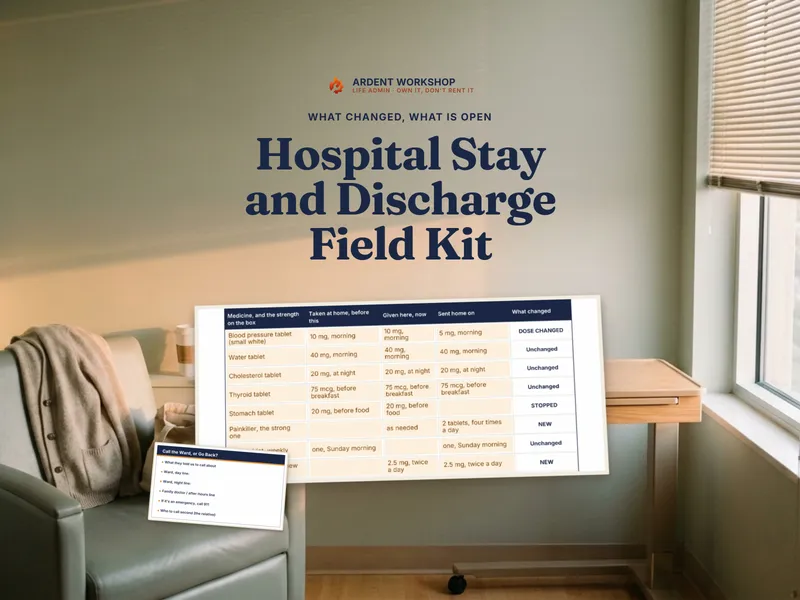
The same design that makes a portal authoritative also makes it one-sided: it shows the hospital's view of the stay, not the family's. Many portals let you message the care team or correct your details, but there is still nowhere in one to write down what a clinician said in the corridor at 4pm, what you asked in return, or what you were told would happen next — none of that is anyone's job to type into the hospital's system. And the medicine list it holds is the hospital's version of the list, not the one from your own medicine cabinet, so there's usually no before-and-after to read: portals generally show the discharge list rather than a comparison against what was being taken at home, so which medicines are new, which have stopped, and which changed dose is left for you to work out. Worth checking what yours actually shows.
Timing works against it too: discharge summaries and visit notes frequently post after discharge — sometimes hours or days later — which is after the decisions about medicines, follow-ups, and equipment were already made and you've already left the building. And a portal needs a login, a charged phone, and a signal, none of which are guaranteed at 2am in a ward with bad reception. Sharing it across a family takes setting up in advance: many portals offer proxy access, which gives a relative their own login where the hospital enables it and the patient grants it — worth asking for, but not something you arrange in the corridor, and not the thing you hand to the next person at the bedside the way you hand over a clipboard.
Printable hospital kit vs patient portal, side by side
| Consideration | Printable hospital kit (family's record) | Patient portal (hospital's record) |
|---|---|---|
| Whose record it is | The family's — what you were told, asked, and wrote down | The hospital's — its own official account of the stay |
| Test results & discharge summary | Not a source for these — the kit records what you were told about them | The authoritative source, once posted |
| Compares home meds vs. discharge meds | Yes — that comparison is the point | No — it holds the hospital's list, not the home one |
| Captures what a clinician said out loud | Yes — write it down as it's said | No — it isn't anyone's job to type that in |
| When it's available | The moment you write on it | Often only after discharge, once notes post |
| What it needs | A pen, or a PDF app | A login, a charged device, and a signal |
| Passed between relatives on a shift | Yes — that's what the hand-over card is for | Only via proxy access, set up in advance, where offered |
| If access changes or is discontinued | You still have the file | Access depends on the hospital's system staying as it is |
The honest verdict: both, doing different jobs
A printable kit doesn't replace a patient portal, and it shouldn't try to. The portal is the record of what the hospital did. The kit is the family's record of what they were told, what they asked, and what changed — including the medicine-list comparison and the discharge readiness count the portal was never built to make. That's the case for having both rather than choosing: the portal for the official record, and a kit for the parts of the stay only the family was in the room for.
Own it, don't rent it
A patient portal is access granted by an institution — useful for as long as you can log in, and the hospital's system, its notice policy, and whether it stays available are all decisions made somewhere else. A printed kit, or a filled-in PDF saved to your own drive, is a file your family keeps. It doesn't expire when a login does, and it travels with you to the next stay, the follow-up visit, or the rehab facility just as well as it did to this one.
More on a hospital stay
Three companion pages go deeper than this comparison: what to ask before a hospital discharge works through the six domains a discharge turns on; medication reconciliation explains the three-list comparison the portal can't make; and the discharge summary covers the document the portal is waiting to post.
Where to start
If you're heading in today, start with the free One-Page Patient Summary — no email, no signup — the sheet you hand a new clinician on arrival. That is the one thing worth doing before you leave for the hospital.
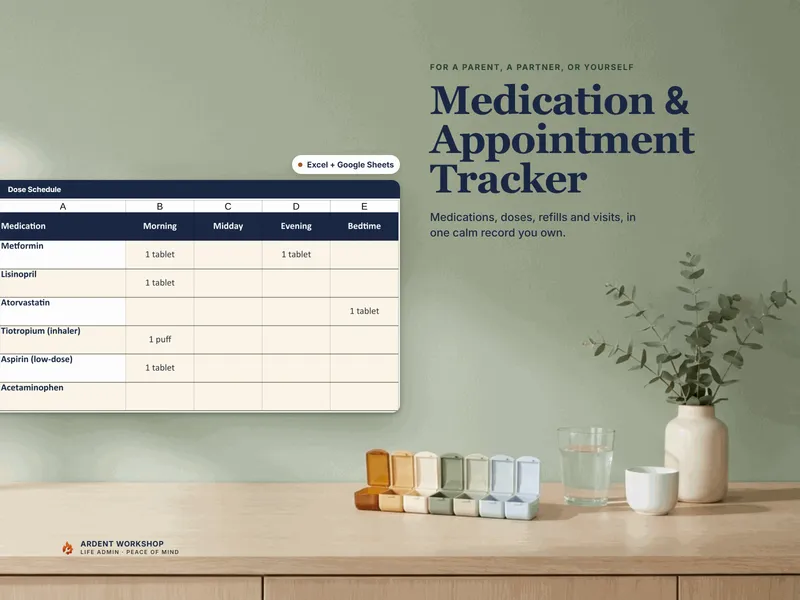
For the rest of the stay, the Hospital Stay & Discharge Field Kit carries the medicine-list comparison, the discharge readiness count, and the cut-out cards for a team that changes every shift. Once you're home, the caregiver templates hub has the ongoing tools — a medication & appointment tracker for the running list, a caregiver binder for the wider record, and a medical-bill review & appeals organizer for the bills and EOBs when they arrive.
This is a paperwork-organizing approach — not medical advice, not a substitute for the hospital's own record, and not affiliated with or endorsed by any hospital or patient-portal vendor.
Frequently asked questions
- If the hospital already has a patient portal, why would a family also need a printable kit?
- Because they hold different records. The portal is the hospital's own account of what it did — test results, visit notes, and (once posted) the discharge summary. Its medicine list is the hospital's version of the list, not the one your family kept at home, so it generally shows no before-and-after column and leaves which medicines are new, stopped, or changed for you to work out. And while many portals let you message the care team, there is nowhere in one to write what a clinician said out loud on rounds. A printable kit is the family's own record of what you were told, what you asked, and what changed — the two aren't competing for the same job.
- Can I just wait for the portal instead of writing anything down myself?
- You can, but the timing often works against you. Discharge summaries and visit notes frequently post to a portal after you've already left the building — sometimes hours or days later — which is after the decisions about medicines, follow-ups, and equipment were already made at the bedside. A page you fill in during the stay captures what was said while someone is still standing there to ask, rather than after the fact.
- What if a family member doesn't have portal access, a charged phone, or a signal?
- That's one of the portal's real limits: it needs a login, a device, and a connection, and none of those are guaranteed at a bedside, in an elevator, or overnight in a ward with poor signal. A printed page needs none of that. Many portals do offer proxy access, so a relative can hold their own login where the hospital enables it and the patient grants it — worth asking for, though it takes setting up in advance and doesn't help the person standing at the bedside with a flat phone.
- Does a printable hospital kit replace the patient portal?
- No, and it shouldn't try to. The portal is the authoritative source for test results, the official medicine list, and the discharge summary once it posts — nothing a family writes by hand replaces that record. The kit's job is the record the hospital was never keeping: what your family was told, what you asked, and how the home medicine list compares to the one you're leaving with. They do different jobs, and there's no reason to pick between them.