The word “discharge” makes it sound like one decision. It isn’t. It’s a stack of small ones — about medicines, equipment, appointments, warning signs, the ride home, and the house itself — made by different people, on different schedules, often while you’re standing in a hallway trying to hold all of it in your head.
You don’t need to memorize a script. You need a way to know, item by item, whether each one is actually answered — and by “answered” this means something specific: you have the answer, you know who gave it to you, and you know when. A nurse mentioning something while checking a monitor is not the same as that answer being written down. If it isn’t written down, it’s still open, no matter how confident it sounded in the moment.
The rule that makes any of this work
Before the six domains, one habit carries all of them: write down the answer, who gave it, and when.
Not “the doctor said she could go back to normal food” — write which doctor, or which team member, and the date. Not “someone’s ordering the walker” — write who is ordering it, who’s delivering it, and by when. A hallway conversation that never gets written down doesn’t survive the drive home; a shift change, and the next person on may have no idea it happened at all.
This is also why “unanswered” is the honest default. If nothing is written next to an item, it doesn’t matter whether it feels settled — treat it as open until someone specific has told you something specific and you’ve recorded it.
For U.S. Medicare-participating hospitals, 42 CFR 482.43 (opens in new tab) sets discharge-planning requirements, including patient and caregiver participation. The six domains below are our organizing format, not a statutory six-part test or a guarantee that discharge is safe.
Domain 1 — Medicines
This is where a recurring breakdown happens: nobody tells the family what actually changed in the medicine list. Not because anyone hides it — because a hospital stay often changes several medicines at once, and by the time discharge paperwork is read aloud, everyone in the room is tired and the list has already been through two or three revisions.
A side-by-side list helps prepare questions. AHRQ explains medication reconciliation (opens in new tab): the care team must identify and resolve discrepancies; a family worksheet supports that clinical process.
Get both lists next to each other: what your relative actually took at home (using the current record and containers, noting any difference between the label and actual use) and what they’re being sent home on. Then go down every medicine and ask, for each one:
- Is this new since the hospital stay?
- Is this one they were taking at home that has stopped?
- Has the dose or the timing changed from what it was at home?
- Or is it unchanged?
What a clear answer contains: a name for every medicine, on both lists, and a specific word against each one — new, stopped, changed, or unchanged. “Everything’s pretty much the same” is not a clear answer; it’s a guess dressed as a summary.
Who to ask: the discharging nurse or the discharge pharmacist, if the hospital has one — checking medicine lists against each other is a large part of what a pharmacist’s role does, so it’s a natural place to take the question. If no pharmacist is involved, ask the discharging physician directly to walk the two lists side by side with you before you leave.
Once you have the comparison, ask for it in a form you can hand to someone else — the pharmacy filling the new prescriptions, or the primary care doctor at the follow-up. A written “what changed” hand-over means nobody has to reconstruct the comparison from scratch a second time.
Domain 2 — Follow-ups
A discharge plan can name several follow-ups — a primary care visit, a specialist, a lab draw, a wound check — without ever saying who is supposed to book them. That gap is where a follow-up quietly doesn’t happen.
For every follow-up mentioned, ask:
- Who is booking this — the hospital, or the family?
- By when does it need to happen?
- If it’s on the family: who exactly do we call, and do we have the number and the referral in hand before we leave?
What a clear answer contains: a name (the hospital’s scheduling desk, or a specific family member) attached to each follow-up, a deadline, and the contact information needed to actually make the call. “You’ll get a call to schedule that” is not a clear answer until you know who is supposed to be calling and by when you should expect it — so you know when to follow up yourself if it hasn’t happened.
Who to ask: the discharge planner or case manager typically coordinates follow-ups; for anything they say is on the hospital’s side, ask them directly who owns it and by when it should be scheduled.
Domain 3 — Equipment
Equipment — a walker, a wheelchair, oxygen, a hospital bed, wound-care supplies, a shower chair — often gets ordered on the day of discharge, which means it may not be in the house when your relative walks in the door.
Ask, for each piece of equipment:
- What exactly is being ordered?
- Who is delivering it — a medical supply company, the hospital itself, someone else?
- When is it expected to arrive?
- Who do we call if it hasn’t shown up by then?
What a clear answer contains: a specific delivery window and a specific number to call if that window passes. “It’ll be there” is not a clear answer; “the supply company delivers Tuesday and Thursday, so expect it by Thursday, and call this number if it’s not there by Friday” is.
Who to ask: the discharge planner or case manager usually places equipment orders; the equipment itself is often supplied by a separate durable-medical-equipment company, so ask for that company’s name and phone number directly, not just “someone will bring it.”
Domain 4 — Warning signs
This domain is where the temptation to write down clinical thresholds is strongest, and where it’s most important not to. What you’re asking for here is not what a symptom means — it’s which door it means walking through.
Ask, before you leave:
- Which situations mean call the ward, a nurse line, or the doctor’s office?
- Which situations mean go straight to the emergency room?
- What are the actual phone numbers — the ward’s day line, the ward’s night line, the doctor’s after-hours line — and in what order should they be called?
- Who answers at 2am, specifically, if something comes up overnight?
What a clear answer contains: phone numbers, written down, in the order to call them, and a name for who’s on the other end at each one — not a general sense that “someone” is reachable. A wallet card with those numbers, filled out before you leave the building, is worth more at 2am than a memory of a conversation from the day before.
Who to ask: the discharging nurse or physician for what to watch for and where the line falls between “call” and “come back”; the unit’s front desk or discharge paperwork for the actual after-hours numbers, since that’s information staff can hand over even outside a clinical conversation.
Domain 5 — Transport
The ride home is easy to assume is settled and surprisingly often isn’t, especially when discharge happens faster than expected.
Ask:
- Who is picking your relative up, and at what time?
- Does the vehicle fit how they’re actually leaving — sitting up in a regular car seat, needing a wheelchair-accessible vehicle, needing to keep a leg elevated or a limb immobile for the ride?
- Is the person driving aware of any restrictions for the trip itself — no stairs at the pickup point, needing help getting in and out, a specific route because of distance or road conditions?
What a clear answer contains: a name, a time, and confirmation that the vehicle and the trip match how your relative is actually being discharged — not just “someone’s coming to get them.”
Who to ask: this one is mostly on the family to settle, but if there’s any doubt about how your relative needs to travel — a specific position, a piece of equipment that has to come along, a need for a wheelchair-accessible vehicle — ask the discharging nurse or physical therapist directly, since they’re the ones who’ve seen how your relative moves.
Domain 6 — Home setup
The last domain is the house itself. A hospital team can tell you what your relative needs; only someone who has actually seen the home recently can tell you whether it’s ready.
Ask, and check, before the day of discharge:
- Is there a clear path from the door to wherever your relative will spend most of their time — no rugs to trip on, enough room for a walker or wheelchair?
- Where will they sleep, and does that floor and that room work for how they’re moving right now?
- Who will be home for the first hours, and the first few days?
- Has anyone actually confirmed the equipment ordered in Domain 3 will fit through the doors and around the furniture it needs to sit near?
What a clear answer contains: a specific person confirming a specific thing has been checked — “I walked the path from the front door to the bedroom yesterday and moved the rug” is a clear answer; “it should be fine” is not.
Who to ask: this one is almost entirely the family’s job, though a hospital’s occupational or physical therapist can sometimes flag things worth checking — a step, a narrow doorway, a bathroom that won’t work with a walker — if you ask them directly whether they noticed anything during your relative’s stay.
Putting the six domains together
Laid out side by side, the six domains and their questions look like this:
| Domain | Ask | Who to ask |
|---|---|---|
| Medicines | What's new, stopped, or changed in dose or timing, comparing the home list to the going-home list | Discharge pharmacist, or the discharging physician |
| Follow-ups | Who is booking each one, and by when | Discharge planner or case manager |
| Equipment | What's ordered, who's delivering it, when, and who to call if it's late | Discharge planner or case manager, plus the supply company directly |
| Warning signs | What means call, what means go back, and the actual numbers in order | Discharging nurse or physician; front desk for the after-hours numbers |
| Transport | Who's driving, when, and whether the ride fits how they're leaving | Family; nurse or physical therapist if there's a movement restriction |
| Home setup | Is the path clear, is the room ready, who's home for the first days | Family; occupational or physical therapist if they observed anything during the stay |
An item is settled when its row has an answer, a name, and a date next to it. Everything else is still open — track it that way, and you’ll know exactly what’s left before anyone signs discharge paperwork, rather than finding out at home.
Two situations that run on different rules
Medicare’s fast-appeal guidance (opens in new tab) distinguishes hospital discharge appeals from other services ending. Use the notice for this stay and its deadline; a worksheet does not extend it.
If your relative is moving on to a rehab or skilled-nursing facility rather than straight home, or if the stay involved surgery, a few things work differently, and this is a place to ask rather than assume:
- A hospital discharge and the end of rehab or skilled-nursing coverage are two different events, with two different notices and two different deadlines. If there’s any possibility of an appeal or a question about coverage ending, ask specifically which notice applies to which stage — don’t assume the same paperwork or the same deadline covers both.
- Which notices you get can depend on how the stay is covered. Rather than assuming a rule you’ve read about applies to this specific stay, ask the discharge planner directly: which notices apply here, who hands them over, and what the deadline on each one is.
- A move to rehab or a nursing facility often adds its own set of questions — about the facility’s own follow-up schedule, its own equipment policy, and its own visiting and communication routines — on top of the six domains above, not instead of them.
If you’re not certain a specific rule applies to your relative’s situation, the safer move is always to ask the discharge planner or case manager to state it for this stay, in writing if possible, rather than relying on something read elsewhere.
What to do with the answers once you have them
Six domains, several items each, each needing an answer, a name, and a date — that’s a lot to hold in a notebook scrawled in a hallway, and easy to lose between the ward and the car.
Start with the free One-Page Patient Summary — no email, no signup. Take it in with you on day one: it’s the sheet you hand a new clinician on arrival, with conditions, current medications, allergies, and who decides if your relative can’t. It doesn’t do the medicine comparison or the readiness count; it’s the summary you walk in with, not the paperwork for walking out.
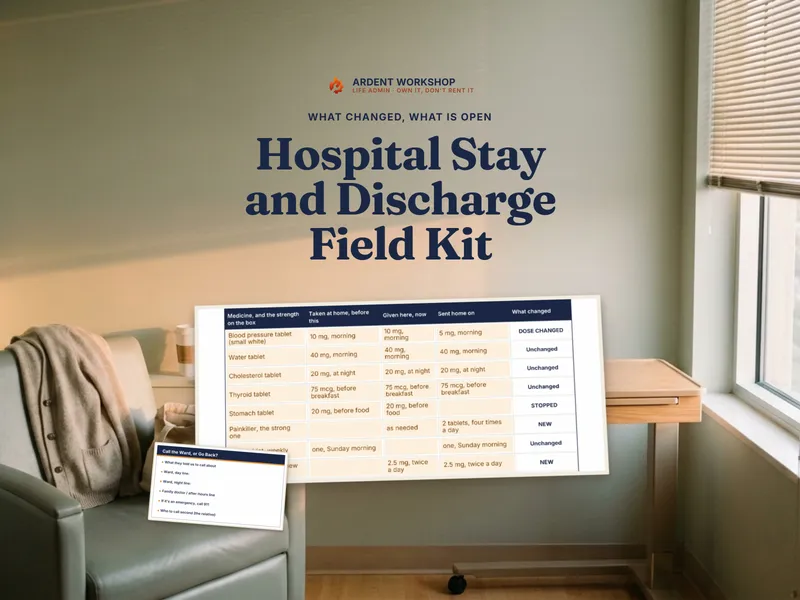
For the walking-out half, the Hospital Stay & Discharge Field Kit is built around exactly the structure above. Its discharge readiness ledger lays out 18 items across these same six domains and counts what’s still open — and names which domains the open items are in — while there’s still somebody standing there to ask.
Its medication reconciliation sheet does the same job for Domain 1: three columns you fill in (home, in-hospital, going-home) and it works out what’s new, stopped, or changed for every medicine, then writes a hand-over page from that comparison so you don’t have to explain the list twice. It also carries the surgery and rehab pages for the two situations above, and a reference sheet of cited statements — some about records and discharge rights, some pointing to official guides — each attributed to a named source so you can check it yourself.
If you want the background on any of this: what medication reconciliation is explains the three-list comparison behind Domain 1, what a discharge summary is covers the document the hospital writes about the stay and how to ask for your copy, and a printable kit versus the patient portal sets out which record holds what. For a shorter read on the same day — seven questions, plus your discharge paperwork and appeal rights — see the hospital discharge checklist; this page is the longer, domain-by-domain method behind it.
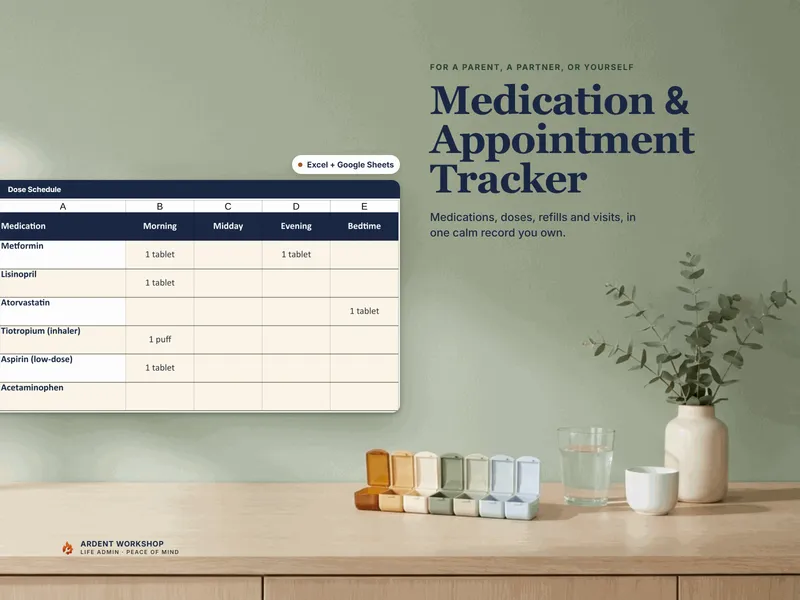
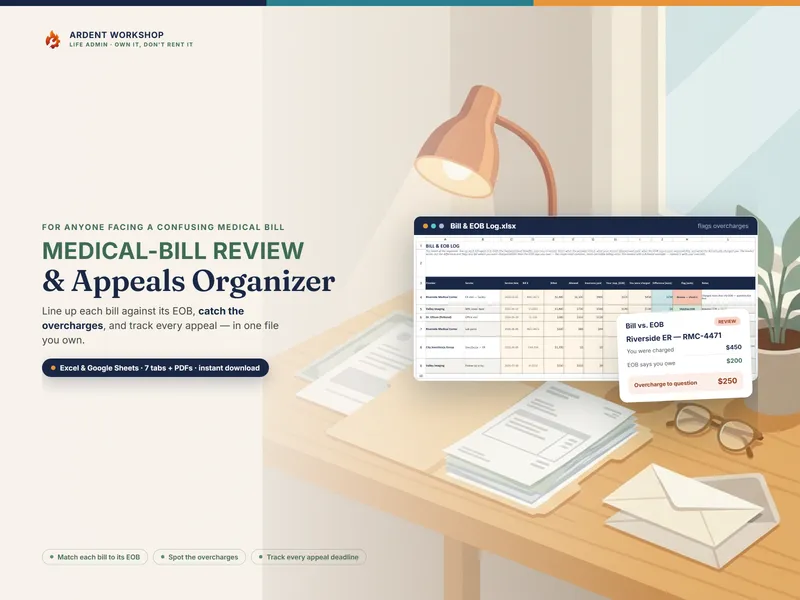
For the ongoing medicine list once you’re home, the Medication & Appointment Tracker keeps the day-to-day record current between visits. If a bill from the stay arrives that doesn’t look right, the Medical Bill Review & Appeals Organizer walks through comparing it to the insurance explanation of benefits and disputing an error. And for the wider job of coordinating care once your relative is home, the Caregiver Binder holds the daily schedule, the insurance details, and where the documents live. All four sit alongside the rest of the templates for caregivers.